Your Little Real Estate Game Ends Here
“Your little real estate game ends here.”
The words were not shouted; they were hissed, a concentrated stream of venom delivered directly into my ear. They burned themselves into my mind, refusing to fade even as the heavy oak doors of the courtroom swung shut behind us. The voice belonged to my brother-in-law, Chris Irving, who now sat in the plaintiff’s seat, radiating a smug, pre-emptive victory. He had leaned in to whisper that poison just minutes ago, passing me in the aisle with his entourage in tow, a shark smelling blood in the water.
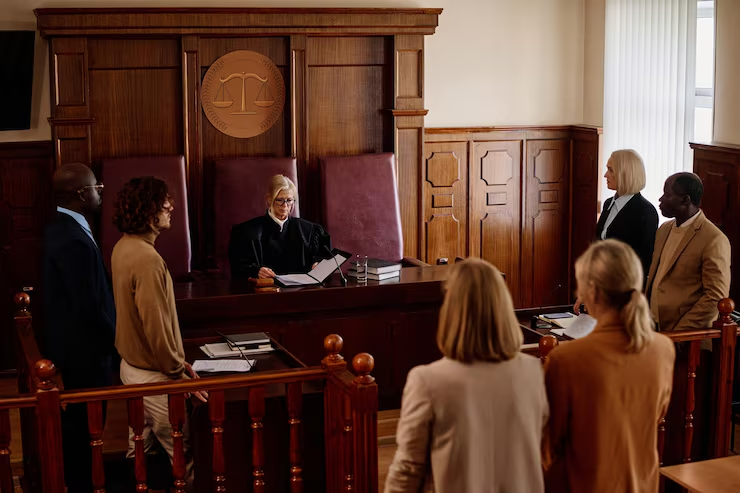
Before I could even formulate a response, the bailiff’s voice boomed, announcing the opening of the court. Judge Brown entered, her robes billowing like storm clouds, and took the bench. Chris’s insult had been delivered with perfectly calculated timing—a psychological grenade tossed right before the battle began.
Beside Chris, my biological sister, Nicole, wore a satisfied smile that didn’t quite reach her eyes. It was a smile of anticipation, the look a child gives when they are about to blow out the candles on a cake that isn’t theirs. In the gallery behind them, our parents, Richard and Susan Manning, nodded stiffly. They sat with the rigid posture of people who believed they were dispensing tough love, asserting what they delusionally believed to be their daughter’s rightful claim over my life.
The trial was unfolding exactly as they intended. Their lawyer, a man with a voice like oiled leather, stood up to present a carefully fabricated tapestry of lies.
“Your Honor,” he began, gesturing toward me with feigned pity. “Miss Tracy Manning has long exhibited extreme emotional fluctuations. She alternates between brief periods of rational clarity and long stretches of impulsive instability.”
I sat stone-still, my hands folded in my lap, digging my fingernails into my palms to keep my expression neutral.
“This contract,” the lawyer continued, holding up a document that I had never touched in my life, “was signed during one of her rare rational phases. At the time, she clearly stated, ‘This is a vacation home for the whole family,’ and signed of her own free will. However, recently she has entered another… unstable phase. She is now attempting to renege on this legitimate promise in order to selfishly monopolize a valuable asset.”
It was a flawless suit of logical armor they had constructed. Because I was “unstable,” I needed a guardian—them. But because the contract was supposedly signed when I was “rational,” it was valid. It was a catch-22 designed to strip me of my agency no matter which way I turned. They were dismissing the blood, sweat, and tears of my eight years of relentless labor as nothing more than the manic shopping spree of a fickle woman. Worse, they were trying to redefine my very sanity to suit their greed.
Chris looked back at me, the corner of his lip twisting into a smirk. His eyes broadcast a message loud and clear: We are the ones who write the story of your life, Tracy. You are just a character in our play.
“Tracy’s little real estate game.” That’s what they called the empire I had built from the ashes of their neglect.
I simply sat there in silence, watching their farce unfold. I felt a coldness settling in my chest, a glacial calm that I hadn’t felt in years.
The Judge’s Question
Judge Brown lowered her reading glasses, her gaze fixed on the contract that had been submitted into evidence. Her eyes stopped on the section listing the property details. A heavy, uncomfortable silence fell over the bench. The scratching of the court reporter’s machine seemed deafening.
Then, the judge slowly raised her head. Her eyes, sharp and unblinking, bored straight into mine.
“Miss Manning,” she said, her voice neutral but curious. “This address… this is listed as one of the twelve properties in your current real estate portfolio. Correct?”
“Correct, Your Honor,” I replied, my voice steady.
“How very interesting,” Judge Brown murmured, shuffling the papers. “I would very much like to review the rest of your holdings as well.”
The air in the courtroom froze instantly. It was as if someone had sucked all the oxygen out of the room.
Chris’s smirk stiffened into a rictus of confusion. I quietly watched as the color drained from Nicole’s face, leaving her looking pale and waxen. Behind them, my parents shifted uncomfortably, their stiff nods ceasing abruptly.
A heavy silence descended over the courtroom, thick with unsaid things. Moments ago, their lawyer had been overflowing with confidence, painting a picture of a helpless, chaotic woman. Now, that narrative felt like a lie from another dimension.
Chris’s ugly grin remained plastered to his face, frozen in place like a mask that had slipped. Nicole stared back and forth between the judge and me, disbelief written in the widening of her eyes. And our parents? They could only gape, mouths hanging slightly open, unable to comprehend the reality before them.
They had truly believed in the image they themselves had created. The illusion of a pitiful, incompetent Tracy. They believed I was recklessly burning through money, standing on the brink of ruin, exactly as their narrative dictated. That was why it never even crossed their minds that the phrase “twelve-property real estate portfolio” would ever be associated with my name.
Eight Years Ago
A memory from eight years ago stabbed into my mind like a serrated knife.
I was twenty-two. I stood in my parents’ living room, a space filled with expensive mahogany furniture and the scent of potpourri that always made me sneeze. My father’s voice rang out, devoid of warmth.
“We’ve decided to stop paying your college tuition after this term,” Richard Manning had said, not even looking up from his newspaper. “Nicole’s wedding is going to be expensive. And honestly, Tracy, investing in you any further would be a waste.”
My mother, Susan, followed without hesitation, sipping her tea. “That’s right, dear. You have no real talent. You’re plain. You should find someone suitable as soon as possible and settle down. It’s the best you can hope for.”
At that moment, the floor had dropped out from under me. I understood then, with crystal clarity: In this household, I was the first to be discarded. My dreams, my grades, my efforts held zero value compared to the floral arrangements at my sister’s wedding or my parents’ social image.
At the bottom of that cold despair, I made a quiet vow. I would rely on no one. I would let no one decide my worth. Absolute financial power would be my armor and my sword.
That was when my “little real estate game” began.
But it was never a game. It was a lonely, brutal fight for survival. I taught myself economics and property law in public libraries until closing time. I lived on instant noodles and adrenaline, juggling three part-time jobs, forcing my way forward like I was carving a path through dense jungle with a dull machete. While they mocked me at family gatherings I wasn’t invited to, I bought my first small, dilapidated apartment.
My battle continued quietly, unnoticed by anyone, but steadily, without fail.
I pulled my consciousness back from those bitter memories to the present courtroom. Beside me, my lawyer, Mr. Johnson, gave me a small, composed nod. He adjusted his tie, his eyes glinting with the thrill of the hunt.
It was time to strike back.
The Portfolio
Mr. Johnson rose slowly to his feet. Unlike my flustered family and their slick lawyer, his movements were calm, filled with an unshakable, predatory confidence. He lifted a massive leather briefcase onto the table and clicked the latches open. The sound echoed like a gunshot in the quiet room.
From within, he produced a thick stack of meticulously organized files, bound in heavy legal covers. That stack alone made the single, flimsy forged contract the plaintiffs had submitted look utterly insignificant.
“Judge Brown,” Johnson began, his baritone voice filling the room. “To provide context for the dispute over the vacation home, I would like to explain the full asset portfolio of my client, Miss Tracy Manning.”
His voice rang out clearly, reaching every corner of the courtroom.
“First, the initial property that was purchased eight years ago: a studio apartment in the Oldtown district. The down payment was saved entirely by Ms. Manning through working multiple jobs simultaneously as a janitor and a waitress.”
I glanced toward my father in the gallery. Confusion and panic were warring for dominance on his face. His words from eight years ago echoed sharply in my ears, the day I first told him my plan to buy that apartment.
“Real estate? Tracy, don’t make me laugh. That’s not work for a woman like you. It’s a dirty man’s world. You’ll be taken advantage of and chewed up in no time. Drop it.”
My father had dismissed my resolve as nothing more than a foolish, rebellious phase. He was hearing the truth now, and it was choking him.
“The second property,” Johnson continued, his tone steady and matter-of-fact, “was acquired fourteen months later. A small office building in the downtown commercial district. It was purchased using rental income from the first property combined with further savings accumulated by Ms. Manning herself.”
“The third property…”
With each property Johnson listed, I watched the physical reaction of my family. The color drained from Chris and Nicole’s faces in stages, turning them from pale to a sickly gray. Inside their heads, the gears were grinding, calculating in desperation just how much wealth Tracy—the woman they had sneered at as a pathetic spinster—had quietly built right under their noses.
And as their entire plan began to collapse at its foundation, the judge leaned forward, listening intently. This was no longer a simple family dispute. The existence of a vast, secret asset empire was being revealed publicly for the first time.
“And the fourth property?” the judge asked, her pen hovering over her notes.
Johnson paused briefly and turned the page with a deliberate rustle. I could almost feel that split second of silence tightening around Nicole’s throat.
He continued on to the fifth, then the sixth property.
When the address of the sixth apartment building was read aloud, I instinctively closed my eyes.
That property.
It was a four-story walk-up in a transitional neighborhood. Shortly after I purchased it, a severe structural defect came to light—rotten support beams that the inspection report had conveniently missed. The repair costs were astronomical, far exceeding my budget. It drained my available cash within weeks. The bank coldly refused additional financing. For the first time in my life, the word bankruptcy became frighteningly real.
Those two months were hell. I lived on one slice of bread and black coffee per day. I slept, at best, three hours a night, waking up in cold sweats. I had nightmares of losing everything and ending up back in my parents’ living room, hearing them say, “We told you so.”
Unable to ask anyone for help, I fought alone. I became a ghost in my own life, groping forward through a dark tunnel. But that despair made me stronger. I ran to the library, devouring textbooks on building codes and structural mechanics until my eyes blurred. I gathered estimates from twenty different contractors, learned to negotiate like a pit bull, rebuilt the repair plan myself, and ultimately succeeded in cutting costs by thirty percent.
That experience transformed me. It burned away the last of the scared little girl and forged a businesswoman capable of overcoming any adversity. Today, that very property is one of the highest-yielding assets in my portfolio. The symbol of my despair had become, ironically, a powerful weapon.
I slowly opened my eyes and looked at my sister. Nicole’s lips trembled as if she had seen a ghost. Her hand clutched her husband’s arm so hard her knuckles were white. But Chris no longer had the composure to support her. He was simply glaring at his own lawyer with eyes that clearly screamed, You useless idiot.
As Johnson moved on to the seventh and eighth properties, a murmur rippled through the gallery. The bailiffs and other lawyers waiting for their cases, who had likely dismissed this as nothing more than a domestic squabble, were visibly stirred.
No surprise there. What was being revealed was not merely a personal asset list. It was the portfolio of a single, invisible power player who had quietly yet decisively shaped the city’s real estate market.
The Truth Revealed
I forced myself to look at my parents. My mother, Susan, no longer had the composure to play the tragic heroine. She was twisting her expensive handkerchief into a tight knot, her eyes darting around as if looking for an exit. My father, Richard, had moved from confusion to anger, and now to something else entirely: humiliation.
For him, the realization that his daughter—the “plain, untalented” one—had achieved success far beyond him, entirely without his “guidance,” must have shattered his fragile ego.
When I still lived at home, whenever relatives gathered, my father always introduced me the same way: “This is my eldest daughter, Tracy. Plain girl, no particular talent, but she’s kind.”
It wasn’t affection. It was a curse. It was a way to define my value as harmless but incompetent, a way to keep me under his control. Whenever Nicole brought home her wealthy husband, Chris, my father would say, “Learn from Nicole. A woman’s happiness comes from finding a good man.”
My success destroyed every curse they ever placed on me. My very existence was a complete rejection of their values. That is why, in their world, I had to be poor and unhappy. If I wasn’t, their entire worldview collapsed.
The sound of Johnson turning a page echoed through the quiet courtroom.
“Ninth property.”
His voice sounded like the opening gong of my final revenge.
“And the tenth property,” Johnson announced, his voice dropping an octave for emphasis. “Located in the Downtown District, 15 Riverside Avenue. A commercial building, commonly known as the Phoenix Lofts.”
The moment Johnson spoke that name, the atmosphere in the courtroom shifted violently.
This was not the same restless murmuring as before. It was a silent shock laced with awe. I saw several journalists in the gallery hurriedly flip open their notepads, pens scribbling furiously.
The Phoenix Lofts.
That name was known to anyone involved in business in this city. Once, it was a derelict brick factory, a jagged eyesore so dangerous it was called a breeding ground for crime. The city had given up on it. Then, four years ago, an anonymous investor purchased that ugly structure and brought it spectacularly back to life.
It was a miracle redevelopment project. Today, it stands as a landmark, housing Michelin-star restaurants, avant-garde art galleries, and the offices of high-tech startups.
That project was the greatest gamble of my life. I poured nearly eighty percent of my entire net worth into it. I endured countless sleepless nights, negotiating with zoning boards and historical societies. But I will never forget the emotion of the night the first lights flickered on in the completed building. It was the moment my solitary battle was recognized publicly, even if my name wasn’t attached to it. Newspapers praised the “brilliance of the genius investor T. Manning.”
That success gave me wings.
I looked at Chris. His face had gone beyond pale; it was ashen, the color of wet concrete. I knew why. The impossible-to-book French restaurant he bragged about using for his anniversary dates sat on the top floor of the Phoenix Lofts.
Nicole must have realized it, too. Her favorite boutique, where she spent thousands of dollars of Chris’s money, was on the building’s ground floor.
The dazzling world they worshipped, the luxury they enjoyed merely as consumers… I owned it. Tracy, the woman they looked down on, was their landlord. That cruel truth was blasting straight through their minds like a gale-force wind.
Judge Brown narrowed her eyes behind her glasses, a flicker of recognition lighting her face. “The Phoenix Lofts. I see.”
That single murmur made it clear. Every scattered dot had just connected for her.
The Twelfth Property
Judge Brown raised a hand to stop Johnson. She had clearly decided there was no need to read any further down the list. She turned a severe gaze toward Chris, Nicole, and their sweating lawyer.
“Counsel,” she said, her voice deceptively calm. “Moments ago, you claimed that Miss Tracy Manning, your client’s sister-in-law, lacks judgment and engages in reckless spending. However, the facts revealed here tell a very different story.”
She leaned over the bench, staring them down.
“Miss Manning owns and operates the Phoenix Lofts, one of the most successful redevelopment projects in this city, and holds at least nine additional income-producing properties. How do you intend to explain the fatal discrepancy between your claim of ‘financial incompetence’ and these facts?”
The judge’s voice cut like steel. Chris’s lawyer broke into a cold sweat, stammering uselessly. “Your Honor, we… we were unaware…”
Then Johnson delivered the decisive blow.
“Your Honor, there is one more important property.”
He produced the final file.
“The twelfth property: The Grand Majestic Theater. A structure officially designated as a City Historical Landmark.”
The courtroom’s shock reached its peak. That beautiful theater, beloved by everyone in the city, had been closed and on the brink of demolition three years ago. It was saved and reborn as a cultural sanctuary by an anonymous patron.
“Surely not,” someone whispered in the gallery.
“Miss Manning personally funded the restoration of this theater,” Johnson continued. “And in recognition of her contribution, she has received an official commendation from the City Historical Preservation Society.”
He submitted a copy of the award certificate, framed in gold, as evidence.
“Your Honor, I ask you this: Is it conceivable that someone prone to emotional instability and impulsive waste could carry out a project requiring such long-term vision, meticulous planning, and above all, deep love for the community’s cultural heritage?”
The answer was obvious to everyone. The fabricated image of a mentally unstable Tracy collapsed without a trace under the weight of undeniable evidence.
“Now then, Your Honor,” Johnson’s tone sharpened to a razor’s edge. “Why would the plaintiffs bring such blatantly false claims? Their goal was to strip Miss Manning of control over her assets. But if she owns twelve properties, why were they so obsessively fixated on just one? This mountain vacation home.”
Johnson held a single document high.
“This is an article from a luxury lifestyle magazine’s website. Six weeks ago, this very vacation home was featured as a ‘Hidden Luxury Retreat.’ The owner’s name was withheld. And the very next day after the article was published, Ms. Nicole Irving placed a phone call to Miss Manning.”
Nicole’s syrupy voice echoed in my memory. “Hey, Tracy. I heard you bought an amazing vacation house. But you’re single. What’s the point? That’s something a family like ours should be using.”
It wasn’t a suggestion. It was the first declaration of ownership.
“Armed with a forged contract and malicious lies, they tried to take it,” Johnson declared.
At last, Chris screamed, unable to bear the humiliation. “Lie! It’s all a lie! There’s a contract! She signed it!”
His disgraceful scream echoed through the courtroom, but no one believed him anymore.
The Forgery Exposed
Judge Brown silenced him with an icy glare. “Mr. Irving. Regarding the contract you submitted.” She picked up the document with two fingers, as if it were contaminated. “There are several very interesting points.”
Right on cue, Johnson spoke up. “Your Honor, we commissioned a professional forensic analysis. First, the signature is a crude forgery that does not match Miss Manning’s handwriting with a probability of 98.7 percent.”
Nicole let out a short, sharp gasp. Chris glared at her, his face twisted with rage. It was obvious who had held the pen.
“More importantly,” Johnson continued mercilessly, “the paper and ink. Analysis shows that the ink used in this contract is a specific polymer blend released by the manufacturer just three months ago. The date written on the contract, however, is one year ago.”
Johnson paused, looking directly at Chris.
“Now then, how should we interpret that? Do the plaintiffs happen to own a time machine?”
A ripple of suppressed laughter spread through the gallery. This was no longer a trial; it was a public execution of their character.
The lawyer representing Chris and Nicole covered his face in despair. He realized, too late, that his career was ending today.
Judge Brown slowly reviewed the forensic reports. She placed the documents on her desk and turned toward me. Her expression softened, layered with something human.
“Miss Manning,” she said softly. “First, I wish to apologize for forcing you to waste your valuable time on such a baseless claim.”
It was an extraordinary statement.
“If you are willing,” she continued, “I would like to hear directly from you. Why did your family know nothing of this remarkable success?”
This was the final stage. The judge was handing me the microphone.
I rose slowly to my feet. I took a deep breath, filling my lungs with the scent of victory. I looked at the faces of the family who had betrayed me.
It was time to bring this farce to an end.
My Testimony
I acknowledged Judge Brown politely. “Thank you for your consideration, Your Honor.”
Then I turned toward the witness stand, gripping the railing. I didn’t look at the floor. I looked directly at my family. My voice did not shake. Eight years of solitary struggle had given me a core of iron.
“The reason I never told my family anything is simple,” I began, my voice projecting to the back of the room. “Because they did not want me to succeed.”
I saw my father flinch as if physically struck.
“Eight years ago, I told my father I wanted to start investing in real estate. He told me I had no talent. He told me it was a ‘man’s world’ and I would be chewed up. My mother told me a woman’s happiness only comes from finding a good man.”
I let the silence hang for a moment.
“Instead of believing in my potential, they forced the role of the ‘incompetent daughter’ onto me because that was more convenient for them. It made them feel superior.”
I looked at Nicole. She was weeping now, her mascara running in dark streaks down her face.
“When I bought my first small apartment, my sister laughed. Her husband, Chris, called me a ‘pathetic single woman.’ They wanted me to fail. Somewhere deep down, they expected me to be poor, miserable, and eventually come crawling back to them.”
I took a step closer to the railing.
“My success would prove that everything they believed—the values they forced onto me—was wrong. They couldn’t accept that reality. So when they learned of my assets, their response wasn’t celebration. It wasn’t respect. It was to steal it and destroy it.”
The courtroom was utterly still.
“The forged contract they submitted was not merely a tool of fraud,” I said, my voice dropping to a whisper that carried more weight than a scream. “It was the embodiment of their desire. The ugly wish that I would be exactly as they said: foolish, reckless, and incapable.”
I turned back to the judge.
“Judge Brown, regarding their claims about my mental instability… Yes, I may have seemed distant. For eight years, I walked this path alone. There were countless nights when I felt my heart might break. But not a single one of my decisions was made on impulse. Each of the twelve properties was acquired through meticulous calculation. Redeveloping the Phoenix Lofts and restoring the Grand Majestic Theater were not acts of chance. They were investments in this city, and in myself.”
I looked straight at Nicole one last time.
“What they wanted was a single, one-and-a-half-million-dollar vacation home. What I was protecting was my life. My empire.”
I sat down.
The Judgment
After a long, heavy silence, Judge Brown finally spoke. Her voice carried the solemn resonance of a final judgment.
“Miss Tracy Manning, thank you for your courageous testimony.”
She then directed her gaze to the plaintiff’s bench. Her eyes held no sympathy, only the stern, cold light of justice.
“Miss Nicole Irving, Mr. Chris Irving. Your actions go far beyond a simple family dispute. You knowingly used forged documents and filed malicious, false claims to deceive this court. You attempted to unlawfully seize another person’s property and destroy her reputation. This is an egregious act of fraud.”
She pronounced each word deliberately, carving them into the record.
“Accordingly, this petition is dismissed in its entirety. Furthermore, I declare that the allegations of perjury and fraud in this case will be formally referred to the District Attorney’s office for immediate criminal prosecution.”
A sharp clatter rang out. Chris’s lawyer dropped his briefcase. Chris slumped forward, his head hitting the table. Nicole let out a broken, jagged sob.
Judge Brown wasn’t finished. Her piercing gaze swept to the gallery.
“Mr. Richard Manning, Miss Susan Manning. You did not take the stand. Yet throughout this charade, you nodded in approval, endorsing this fraud. Such behavior amounts to admitting complicity. Your responsibility will also be pursued by Miss Manning’s counsel in civil court.”
My parents froze, realizing their ruin was sealed. The excuse of being “just bystanders” had evaporated.
The gavel banged, a sound like a thunderclap ending a long storm.
The Aftermath
Chris was taken into custody immediately. The man who had laughed arrogantly in my face was dragged away by the bailiff, his legs dragging, unable to even resist. His career, his pride, his lifestyle—all ended in that room.
Nicole eventually received a suspended sentence, but her social death was immediate. Her circle exiled her. Invitations stopped coming. Her husband was in prison, her home was confiscated to pay legal fees, and the role she played of the “wealthy, happy wife” was stripped away.
As for my parents, Mr. Johnson pursued them relentlessly in civil court. They were forced to pay substantial damages. But the real punishment was the public shame. The local media branded them as “toxic parents” who cannibalized their own daughter. Their high-end furniture business collapsed as customers refused to associate with them. They retreated into a small, rented apartment, spending their days blaming each other—a prison of their own making.
I obtained permanent restraining orders against all of them. My twelve properties were placed under ironclad trust management.
As I walked out of the courthouse that day, the sun hit my face. It felt different. Warmer.
They have no place in my world anymore. My future begins now, viewed from the balconies of the twelve fortresses I fought to protect. And for the first time in eight years, I wasn’t fighting alone. I was fighting for myself, and I had won.
The “little real estate game” they mocked had become my empire. And I was finally, irrevocably, free.