The Uninvited
The invasion began with a vibration in my pocket, a digital summons delivered three months in advance.
“We planned a family reunion at your beach house. 47 people. Four days,” the text read. It was from my sister, Paige. “Stock the fridge by Friday.”
I was sitting at my kitchen island, the granite cool under my forearms, still wearing my surgical scrubs. The smell of antiseptic clung to me, a scent I usually washed off before dinner, but today, exhaustion had won. My son, Milo, was half-asleep on the couch, the blue light of his Nintendo Switch casting a soft, ghostly glow on his face.
I hadn’t been asked. Not once. No “Hey, Adam, are those dates open?” No “Would that work for you and Elena?” Just an announcement, issued as if I were the concierge at a resort they already owned.
I stared at the message, the white bubble taunting me. I typed No. I watched the typing bubbles pop up on her end, disappear, and pop up again.
Then her reply came through: We’re coming anyway. What are you going to do? Call the HOA?
I put my phone face down on the counter. The silence in the kitchen was heavy, broken only by the hum of the refrigerator. I tried to focus on the lasagna I’d picked up on the way home, but my appetite had vanished.
Milo padded over in his socks, his hair sticking up in a chaotic tuft. He gave me that soft, unguarded look he gets when he’s not fully awake, the one that still reminds me of the three-year-old I met eight years ago.
“Everything okay?” he asked, his voice rough with sleep.
“Yeah, bud,” I lied, forcing a smile that felt tight on my face. “Just family stuff.”
He nodded, accepting the lie because he’d heard it a thousand times. Because he knew exactly what “family stuff” meant in our house.
The Price of Success
I’m Adam, forty-two, a neurosurgeon in Jacksonville, Florida. I spend my days navigating the delicate, treacherous geography of the human brain. I fix things that are broken. But when it comes to the people who share my DNA, I have been unable to fix a single thing.
My family lives an hour inland in a town that believes “doctor” is a synonym for “ATM.” My parents raised three kids: me, my younger brother Mark, and Paige. I’m the oldest, and the only one who escaped the gravitational pull of their entitlement.
When my career took off, I did what oldest sons are conditioned to do. I helped. I paid off my parents’ lingering credit card debt—fourteen thousand dollars gone in a single wire transfer. I covered the last seven years of their property taxes because the county kept raising them, and my mother would call weeping, claiming they were drowning. I sent a thousand dollars every month to a joint account so they wouldn’t worry about groceries. I co-signed on Mark’s truck. I gave Paige twenty thousand dollars for a down payment on her house when her husband’s business imploded.
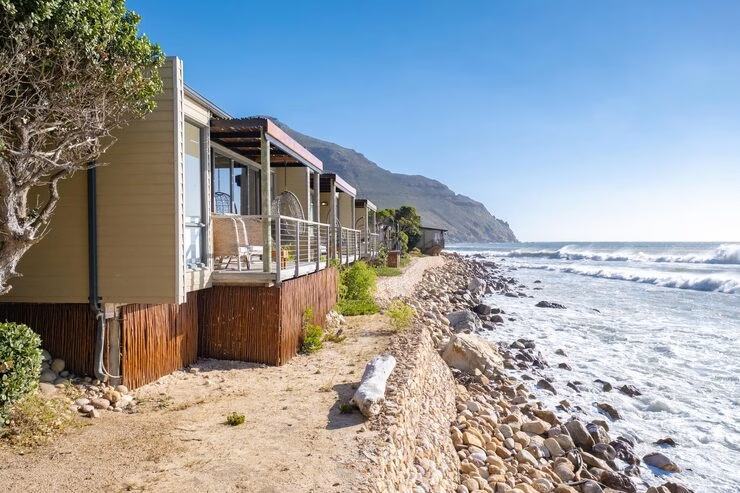
And five years ago, when my salary became the kind of money people only whisper about, I bought the beach house. Three bedrooms, two bunk rooms, a wraparound deck with an ocean view. To my colleagues, it was a nice getaway. To my family, it was a castle they believed they had inherited by proxy.
“This is all of ours,” my mom had said the first time she stood on the deck, a glass of my wine in her hand. Not yours. Ours.
That should have been my first warning. They started calling it “The Family House.” They would text my wife, Elena, like she was the booking manager. “Hey, we want to use the house the second week of June.” Not “Is it free?” Just “We’ll be there.”
They left sand in the showers, sticky beer rings on the teak tables, and once broke a flatscreen TV without even leaving a note. I swallowed it. I told myself this was the price of success. I could handle paying for deep cleans.
What I couldn’t handle was the way they treated my kid.
The Side Character
Milo is quiet. He reads thick fantasy books, draws intricate sci-fi cities in his notebooks, and gets overwhelmed when a room breaches a certain decibel level. My parents never said it outright, but they made the hierarchy clear. Mark’s and Paige’s kids were the real grandkids. Milo was just “Elena’s boy.”
At Christmas, the other kids had needlepoint stockings with their names embroidered in gold thread. Milo had a generic red one my mom grabbed from a dollar-store multipack. In family photos, they would conveniently forget to call him over.
I let a lot of little things go. I told myself it was generational. I told myself they would come around.
I believed that lie right up until last Fourth of July.
The morning of the boat trip, I was stuck on a call with a resident regarding a post-op complication. By the time I jogged down to the dock, the air thick with humidity and salt, everyone was already climbing onto the boat. The cousins were in neon life jackets, coolers were loaded, and a Bluetooth speaker was blasting country music.
Everyone except Milo.
He was sitting on the end of the pier, his legs folded tight against his chest, his sketchbook closed next to him. He looked small against the vastness of the water.
“Hey,” I said, dropping down beside him. “You’re not getting on?”
He shrugged without looking at me. “They said there isn’t room.”
I looked up at the boat. It was a twenty-footer. There was space. Too much space. Half the kids were still standing, arguing over seats.
My sister caught my eye and called over the water. “We’re at capacity, Adam! Coast Guard rules. Eighteen max.”
I counted. Fourteen heads. Even if I was missing one, they weren’t at capacity.
I walked to the edge of the dock. “There’s room for one more. Milo can sit up front with me.”
Paige’s husband chimed in, cracking a beer. “We already divided the weight by seat, man. It’s not safe to change it at the last minute.”
My dad lifted his drink and smirked, the sun glinting off his sunglasses. “You two can take the jet ski out later. Boys’ time. Let the cousins have their day.”
The cousins. As if Milo wasn’t one.
“It’s fine, Dad,” Milo said from behind me, his voice tiny. “I’ll stay. I get seasick anyway.”
He doesn’t. He loves the water.
One of Paige’s kids, a twelve-year-old clone of his father, muttered loud enough to be heard, “He’s not even a real cousin anyway.”
The laughter that followed wasn’t raucous, but it was there. A ripple of amusement. No one corrected him. No one scolded him.
My hands clenched so tight my knuckles turned white. I felt my heart banging against my ribs, the same adrenaline spike I feel in the OR when a clip slips and I have half a second to stop a bleed. I should have said something then. I should have thrown someone off that boat. I should have cancelled the trip and evicted them all.
Instead, I swallowed it. Again.
“Text me if you want me,” I told Milo, my voice tight. “We’ll go for ice cream later, okay?”
He nodded. The boat pulled away, the engine churning the dark water into white foam. The kids waved. My family laughed. Milo stared at the wake until they were just a blur on the horizon. Then he picked up his sketchbook and drew alone on the pier while I went inside and pretended to help Elena with lunch.
That night, while everyone watched fireworks on the beach, he handed me a drawing. It showed the boat, the fireworks, everyone on deck depicted as stick figures. Off to the side, on the pier, was a smaller figure drawn with darker, heavier lines. Alone.
“That’s me,” he said. “It’s fine. Sometimes side characters are more interesting.”
Side character.
It took everything in me not to weep right there in the sand.
The Facebook Event
My family had been punishing me ever since I started saying “no” about money. But this? This was punishment for making them look at a child they didn’t want to claim.
So, by the time the reunion text came—47 people for 4 days—I shouldn’t have been surprised.
They had created a Facebook event. Paige sent screenshots to the group chat. “FAMILY BEACH BASH” in a cheesy, comic sans font. The cover photo was my house, taken from an old Christmas picture Elena had posted.
Under Location, it said: Adam’s Beach House – Our Family Place.
I scrolled through the posts. Room assignments. Who was bringing fireworks. “Kids’ bunk room is going to be wild!”
Then I saw Paige’s comment in a thread about sleeping arrangements.
“Don’t worry about Milo. He’s sensitive. Probably better if he stays at Elena’s parents’. They hate the beach anyway.”
My mom replied with a heart reaction.
Someone asked, “Is he not coming at all?”
And Paige wrote: “We’ll invite him for a day trip, of course. But the overnight bunk thing is for the real cousins.”
The real cousins.
I stared at that message for a full minute, my pulse hammering in my ears like a war drum. I took a screenshot. I didn’t send it to Elena yet. I knew how she’d react. I knew how I wanted to react.
I tried to give them one last chance. I called my mom.
“Hey,” I said. “I just saw the reunion thing. You didn’t ask about dates.”
“Oh, honey,” she breezed, her voice dismissive. “We knew you’d say yes. You never use the place in August.”
“Elena, Milo, and I were planning a week there,” I lied. We weren’t, but I needed this to land. “And forty-seven people? That’s over capacity. The HOA will fine me.”
“Oh, don’t start with your rules,” she snapped. “You’re always so strict. It’s family.”
“Mom,” I said carefully, “I also saw the comments about Milo.”
Silence stretched on the line.
“Those were jokes,” she said finally. “You know how Paige is. Don’t take everything so personally. Milo is… different. He doesn’t like noise. We don’t want him to be uncomfortable.”
“You mean you don’t want to adjust anything for him?”
“We’re not doing this,” she hissed. “Either let us use the house or don’t, but don’t make us the bad guys. You’re the one hoarding your blessings.”
Hoarding. That was rich coming from the woman whose credit card debt I had erased.
I hung up before I screamed. I sat at the kitchen table, looking at the thumbnail of my house on my phone.
Something inside me clicked. A clean, sharp break.
I had spent years delicately navigating the gray matter of the brain, but I had let my family lobotomize my self-respect. I held people’s lives in my hands, yet I let these people treat my son like a prop in a life I worked myself to the bone to provide.
That was the last straw. The audit was over. The eviction was beginning.
The Fortress
On Friday morning, the day of their big “Family Beach Bash,” I woke up with the cold clarity of a surgeon entering the theater.
I changed the gate code. I hired security. Not in a dramatic movie way, but in a boring, administrative, phone-calls-and-confirmation-emails way.
First, I called the property management company.
“This is Dr. Adam Carter, Unit 12B,” I said. “I’d like to update my access list for the main gate and request on-site security for the weekend.”
The woman on the line perked up. “Of course, Dr. Carter. What are we adjusting?”
“Remove all existing recurring guest passes,” I said. “Especially anything under the surnames Carter, Lewis, or Hill. Those are my parents and siblings.”
“All removed,” she said after a few clicks. “Current guest list is empty.”
“Good. And I’d like a guard stationed at the gate from noon to 8:00 p.m. today. No one enters my property unless their name is on a specific list I’m about to email you. If there’s pushback, they can call the police. No exceptions.”
I emailed her the list. Adam Carter. Elena Carter. Milo Carter. Three names. That was it.
Next, I logged into the smart home app. I reset every code on the digital locks. The one my mom used, the one I gave my brother for emergencies, the generic 1234 I kept for the pool guy. Gone. I set a new master code that only Elena and I knew.
Then, I opened my banking app. I navigated to the “Family Emergency” card I had set up three years ago. The one they used for “gas only” but which frequently showed charges for Costco, liquor stores, and fireworks outlets.
Balance: $1,982.64.
I transferred the entire remaining balance back to my main savings account. Then I hit the button: FREEZE CARD.
Are you sure? the app asked.
I had never been more sure of anything in my life. Yes.
Finally, I called the private security firm that monitored the house alarm.
“Hi, this is Dr. Carter. I have a large group that is planning to enter my property without consent today. I’ve handled the gate, but I want a uniformed officer in a vehicle parked near my driveway as a visual deterrent.”
The man on the phone chuckled. “No problem, Doc. We see this more than actual break-ins. Family squabble?”
“Just a lot of entitlement,” I said.
By the time Milo came downstairs in his Spider-Man t-shirt, pouring himself a bowl of cereal, the fortress was secure.
“Are we still going to the beach?” he asked cautiously, sensing the tension in the air.
“We are,” I said. “Just us. Maybe Aunt Leah and the twins if they want to join.”
Leah was my cousin, the only member of the extended clan who ever texted just to ask how Milo was doing, not to ask for a loan.
“What about Grandma and everyone?” Milo asked.
“They made other plans,” I said. “And we made different ones.”
He studied my face for a second, his dark eyes searching for the lie. When he didn’t find one, he nodded. “Okay.”
We loaded the car. Elena kept glancing at me in the rearview mirror as we drove toward the coast.
“You good?” she asked quietly when Milo put his headphones on.
“I think I’m done,” I said. “Done being their wallet. Done begging them to see our son.”
Elena reached over the console and squeezed my hand hard. “Then let’s be done.”
The Standoff
We were already at the beach house, unpacked and barefoot, when the first SUV pulled up to the community gate.
I watched it unfold on the security app on my phone. The grainy footage showed my parents’ white SUV, followed by Paige’s minivan, and a convoy of trucks trailing behind. Coolers were stacked high, inflatable paddleboards roped to roofs, kids’ faces pressed against the glass.
My sister called me immediately. I let it go to voicemail.
A moment later, a different number popped up. GATE HOUSE.
“Dr. Carter,” the guard’s voice crackled. “We have a group here insisting they have permission to access Unit 12B. They are… quite upset.”
“I’m sure they are,” I said, leaning back in my deck chair. “Their names are not on the list. They do not have permission.”
“Understood, sir. One of them is demanding to speak to you.”
“Put her on speaker if you want,” I said. “But my answer isn’t changing.”
There was a shuffle of the phone being passed. Then Paige’s voice came through, tinny and furious.
“Are you kidding me right now?” she snapped. “The gate guy says we aren’t on the list. It’s our reunion, Adam.”
“No,” I said calmly. “It’s your reunion. At my house. That you planned without asking.”
“Stop being dramatic!” she yelled. “We drove all this way. The kids are excited. Open the gate and we’ll talk about whatever petty thing you’re mad about inside.”
“No,” I repeated. “The house is not available. You need to turn around.”
In the background, I heard my mom. “What is he saying? Is he opening it?”
Paige’s voice dropped lower, venomous. “You’re really going to pull this because of a Facebook comment? Milo isn’t even a beach kid. He hates sand. You’re doing this to punish us.”
I looked out at the deck where Milo was building a small fort with beach towels, humming to himself, completely unaware of the standoff happening a mile down the road.
“You told forty-seven people you were spending four days in a house you don’t own,” I said. “You booked time off work. You bought food. You did all of that without checking with me. And then you planned to exclude my son from his own home.”
“We said he could come for the day!” she shot back.
“You treat him like an afterthought,” I said, my voice rising just enough to be final. “I’m not hosting a family that doesn’t host my kid.”
My dad’s voice cut in, loud and slurred with rage. He must have leaned into the window. “We raised you!” he barked. “We wiped your backside and this is how you repay us? Leaving us on the street like dogs? You think you’re better than us with your big brain job and your fancy house?”
I could picture his face—red, pinched, veins popping in his neck. I had seen that look my whole childhood whenever the world didn’t bend to his will.
“I don’t think I’m better,” I said. “But I am done. I am not your backup bank. I am not your beach house manager. I am your son, and Milo is your grandson. If you can’t handle that, you don’t get access to anything that is mine.”
For a second, there was silence on the line. Just the faint sound of waves behind me and a kid crying in one of the cars on their end.
Then my mom started sobbing. “You’re tearing this family apart! Over money? Over that boy? Blood is blood, Adam. You don’t just cut off your parents.”
“You did that when you decided he wasn’t really yours,” I said.
I hung up.
The guard called me back two minutes later. “They’re insisting they have some kind of ownership claim,” he said, sounding weary. “I’ve told them multiple times they don’t. I can call the local PD if they refuse to leave.”
“If they aren’t gone in ten minutes, do it,” I said. “I’m sorry you’re stuck in the middle.”
He chuckled. “I’ve seen worse. But I have to say, sir, you’re handling this more calmly than most.”
He didn’t see my hands shaking.
Milo wandered over, flopping onto the outdoor couch next to me. “Can I put up my hammock?” he asked. “The one Grandma said was a fire hazard?”
I swallowed a laugh that felt like a sob. “Yeah, buddy. Put it wherever you want.”
On my phone screen, the tiny figures argued with the guard, milled around the asphalt, and then, finally, turned their cars one by one. The convoy disappeared down the road, defeated. The gate slid shut.
I dropped my shoulders for what felt like the first time in forty-two years.
The Storm
The next twenty-four hours were a storm of buzzing phones.
Texts from my mother: I can’t believe you did this. We are sitting in a Motel 6 because of you. Your father’s blood pressure is through the roof. Think of the kids.
Texts from my father: You owe us. Enjoy your precious house. You’ll die alone in it.
Paige went nuclear in the family group chat: Adam locked us out of our house over his trauma child. He’s been brainwashed by Elena. He even hired security on his own family.
Mark stayed quiet in the group chat but sent me one private message: Man, you could have at least warned us. Couldn’t you just have had a talk with them instead?
I stared at that for a long time. I had been “having talks” with them for eleven years.
I wrote back: The problem isn’t that they don’t understand, Mark. It’s that they don’t care.
He didn’t respond.
Around dinnertime, as I was flipping burgers on the small grill, my phone buzzed with a name that surprised me.
Leah: Hey. Just heard what happened from Mom. She’s stunned. I’m kinda proud of you. Also, are you really at the beach house alone? The twins and I can be there in an hour if Milo wants actual cousins who aren’t rude.
I laughed out loud.
“Who is it?” Milo asked.
“Your cool cousin Leah,” I said. “She wants to know if you want company.”
He hesitated, then nodded, a small smile tugging at the corner of his mouth. “Only if they like card games,” he said. “I brought my whole deck.”
“They do,” I said. “And they like you.”
Leah showed up just before sunset with her two kids, a bag of groceries, and a look on her face that said she’d been arguing with someone all afternoon.
“They’re saying I betrayed the family by coming here,” she said as we hugged. “My mom told me I was choosing sides.”
“Are you?” I asked.
She glanced over at Milo, who was showing her son how to properly string the hammock.
“Yeah,” she said simply. “I am.”
The New Normal
We roasted marshmallows on the grill because I hadn’t thought to buy skewers. The kids built a lopsided sandcastle by the steps. Milo’s laugh came easier and easier as the night went on.
At one point, Leah leaned on the railing beside me, watching the ocean. “I saw that Facebook thread,” she said quietly. “The ‘real cousins’ thing. I wanted to say something then, but Mom told me to stay out of it. I’m sorry I didn’t.”
“You’re here now,” I said. “That’s what matters.”
The fallout continued for weeks. Missed calls, voicemails, long emails about “ungrateful sons” and “disrespect.” But none of them mentioned Milo. Not once. They talked about money, convenience, and losing face.
I realized then it had never been about family for them. I was a line item in their budget, a resource, a door that stayed open as long as I swallowed their venom.
That door was welded shut now.
Two weeks later, we drove back to the beach house. No group chats, no event pages, no convoys. Just our family and two of Milo’s friends from school.
We stopped at a roadside produce stand on the way. Milo stood there in his new baseball cap, comparing two watermelons like it was a life-or-death decision. He caught me watching him and grinned—not the careful, half-smile he gave my parents, but a real one.
“Can we make watermelon juice?” he asked.
“We can make whatever you want,” I said.
At the house, I noticed something I’d never really seen before: how quiet it was when it was just us. No slamming doors, no arguments about rooms.
Milo disappeared for a while after lunch. When he came back, he handed me a new drawing.
It was the beach house again. The deck, the steps. Four stick figures on the sand this time, holding ice cream cones. A hammock strung between two imaginary posts. But this time, the figure in the hammock wasn’t off to the side. It was in the center. And there were no angry scribbles on the periphery.
“This one’s better,” he said shyly. “I like this version.”
“So do I,” I said. I taped it to the fridge, right in the center.
That evening, I watched Milo run along the edge of the water, his feet splashing, his voice carrying on the wind as he called out to his friends. For the first time in a long time, he didn’t look like a side character in someone else’s story. He looked like the main character.
And I realized that was my job now. Not to be everyone’s emergency fund or silent punching bag. Just to be his dad.
The rest of them can plan all the reunions they want. They just won’t be planning them at my house, or with my money, ever again.