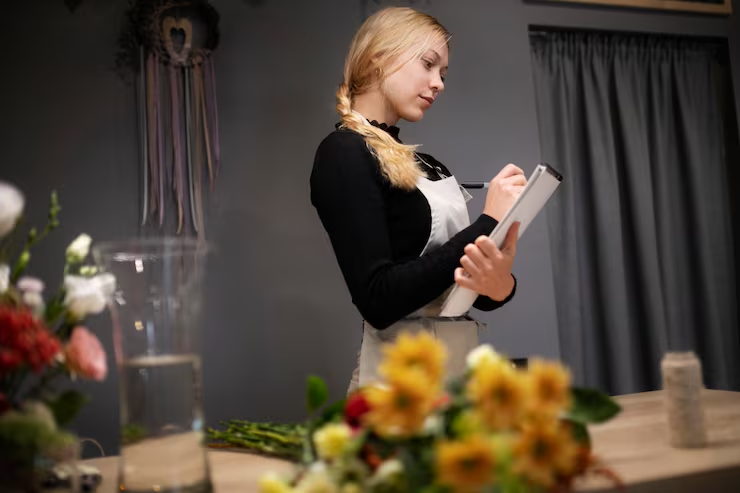
My Mother Banned Me From Her Gala For Being A Waitress
My name is Invera Toland, and I’m twenty-nine years old. Have you ever been banned from your own family’s event because of your job? Not for a scandal, not for a crime—just for how you earn a living. That’s how my stepmother, Victoria Ashford Toland, chose to introduce me to her world: as a problem to be removed by security.
The Lauron Hotel ballroom gleamed like a crown: crystal chandeliers, white-linen islands, five hundred guests draped in couture. The placards read Toland Foundation Charity Gala, but the air read something else—pedigree, policing, performance. I adjusted the cuffs on my Le Bernardin server’s jacket, the one I’d asked to wear on the floor tonight instead of hiding in the kitchen. If they were going to erase me, I wanted to watch them try.
Victoria saw me first—her flute paused, smile faltered, eyes calculating fast. Two black-suited guards materialized by the entrance. Her assistant pressed a phone to his ear, lips moving at tempo. The quartet’s Mozart kept twinkling as if nothing were happening, which somehow made the tension louder. Across the room, my father glanced up, caught my eye, and then pivoted to admire a painting he would never bid on. That small turn of his shoulder cut deeper than anything Victoria could say.
I moved through the tables with a tray of canapés, professional, invisible. Cassandra, my stepsister, whispered into a ring of influencers—diamonds flashing, cameras up. “Isn’t that Robert’s daughter?” Aunt Helen announced to no one and everyone. “Serving?” Uncle George snorted, “Mortifying.” The word hung in the air like perfume.
My phone buzzed against policy. I didn’t check it. I didn’t have to. He has impeccable timing.
Victoria closed the distance, heels ticking like a metronome. “Ladies and gentlemen,” she purred into a suddenly obtained microphone, “we have a small security matter to address.” Fifty conversations broke off mid-sentence. The quartet stopped mid-bar. Every face turned. “Just a minor issue with someone who shouldn’t be here.” Her gaze never left mine.
The guards approached. “Ma’am, please come with us.”
I stood still, breathing through my count. One. Two. Three. The main doors remained closed, but the marble beyond them carried footsteps—measured, deliberate, familiar.
“You’re not on the list,” Victoria said, voice honeyed and sharp.
“I’m working,” I replied, even, careful to let it carry.
“Then stay in the kitchen,” she smiled. “This is a private event. Family and supporters only.”
“Funny,” I said before I could stop myself, “how I’m neither, despite being both.”
A collective gasp. Even Cassandra blinked.
My phone vibrated again—three long pulses. Five minutes. Don’t leave.
“Security, please escort her out through the service exit,” Victoria said, and the guests obligingly formed a corridor, phones lifted like modern torches. The guard’s hand hovered at my elbow. Four. Five.
The main doors swung open.
Every head pivoted. The footsteps entered the light. Energy in the room tilted, as if the chandeliers had shifted on their chains.
Victoria lifted the mic. “This is a private—”
And then the voice from the doorway carried, calm and precise: “I see you have a situation.”
The room forgot to breathe.
The Man in the Doorway
Julian Kane walked into the ballroom like he owned it. Not with arrogance—he wasn’t that kind of man—but with the quiet certainty of someone who knew exactly what he was worth and didn’t need anyone else’s validation.
He wore a tuxedo. Not rented. Not borrowed. Custom-tailored, midnight blue, fitting his frame like it had been sewn onto him by someone who understood that clothes were architecture. His shoes were polished to a mirror shine. His cufflinks caught the chandelier light—platinum, simple, expensive.
But it was the way he moved that stopped the room. Shoulders back, stride unhurried, eyes scanning the crowd with the practiced assessment of someone used to reading rooms full of powerful people.
Victoria’s smile froze. She didn’t know who he was. But she knew power when she saw it.
“And you are?” she asked, recovering her composure with impressive speed.
“Julian Kane,” he said, stopping beside me. His hand found the small of my back—not possessive, just present. “Invera’s husband.”
The word husband detonated across the room like a shaped charge.
Cassandra’s phone nearly slipped from her fingers. Aunt Helen’s champagne flute paused halfway to her lips. Uncle George’s snort died in his throat.
My father, across the room, went completely still.
“Husband?” Victoria repeated, the word sharp as broken glass. “Invera doesn’t have a husband.”
“She does,” Julian said mildly. “Has for six months now. We had a small ceremony. Civil, quiet. Just the way Invera wanted it.”
“This is the first we’re hearing of it,” Victoria said, her voice climbing an octave despite her best efforts.
“That’s because you weren’t invited,” I said quietly. “None of you were.”
The silence that followed was exquisite.
Victoria’s assistant whispered something urgent in her ear. She waved him away, but I saw the flicker of panic in her eyes. She was losing control of her own event, and she knew it.
“Well,” she said, forcing brightness back into her voice, “congratulations are certainly in order. Though I must say, it’s quite unusual to learn about a family wedding through… an interruption at a charity gala.”
“Is it?” Julian asked. “I thought it was quite unusual to have one’s wife escorted out of her own family’s event by security. But perhaps I’m not familiar enough with high-society protocols.”
The barb landed. Victoria’s smile became a rictus.
“Invera is working tonight,” she said. “As staff. This is not appropriate—”
“Invera owns twenty percent of the Toland Foundation,” Julian said, his voice never rising but somehow filling the entire ballroom. “She inherited it from her mother, Catherine Toland. That makes her not just family, but a stakeholder. So when you say she’s ‘not on the list,’ what you mean is that you deliberately excluded a board member from a foundation event.”
Victoria’s face lost color. “That’s not—how do you—”
“I’m a corporate attorney,” Julian continued. “Mergers and acquisitions, primarily. But I have a passing familiarity with foundation law. And I believe the bylaws require all stakeholders with voting shares to be notified of major events. Wasn’t there a vote tonight? On the new scholarship program?”
He knew. Of course he knew. I’d told him about the vote—the one Victoria had scheduled for tonight, knowing I’d be working in the kitchen, unable to participate.
My father finally moved, crossing the room with the careful steps of a man walking through a minefield.
“Julian,” he said, extending his hand. “Robert Toland. I’m Invera’s father.”
“I know who you are,” Julian said, shaking his hand with precise professionalism. “Invera speaks of you often.”
The lie was delivered so smoothly that even I almost believed it. I rarely spoke of my father. What was there to say about a man who’d remarried six months after my mother’s funeral and spent the next decade pretending I was a ghost in his new wife’s perfect house?
“Perhaps we should discuss this privately,” my father suggested, his voice tight.
“I don’t think so,” Julian said. “I think we should discuss this right here, in front of all these witnesses. Because I have a feeling that once we leave this room, the truth will be revised. The narrative will shift. And Invera will somehow become the villain in a story where she’s actually the victim.”
He turned to address the room, his voice carrying with the practiced ease of someone who’d given presentations to boardrooms full of skeptical executives.
“For those who don’t know,” he said, “Invera Toland is the daughter of Robert Toland and the late Catherine Toland. Catherine was a founding member of this foundation. When she passed away twelve years ago, her shares were left to her daughter. Invera has been a silent stakeholder ever since, because she was told—repeatedly—that her input wasn’t needed. That the foundation was ‘being handled.'”
Victoria opened her mouth to protest, but Julian continued smoothly.
“Tonight, there was supposed to be a vote on a new scholarship program. A program that would fundamentally change the foundation’s mission. Invera, as a stakeholder, should have been notified. Should have been given the opportunity to vote. But instead, she was scheduled to work. In the kitchen. Where she couldn’t possibly participate in foundation business.”
“That’s a serious accusation,” Uncle George blustered.
“It’s a statement of fact,” Julian corrected. “And I have the documentation to prove it. Email chains, scheduling records, foundation bylaws. All of it very neatly organized and ready to be submitted to the Illinois Attorney General’s office if necessary.”
The room had gone from shocked to riveted. Phones were no longer recording for social media gossip—they were recording evidence.
Victoria’s assistant was typing frantically on his phone. Victoria herself looked like she was calculating odds, running scenarios, trying to find an exit strategy.
“This is absurd,” she said finally. “Invera has never expressed any interest in the foundation. She’s been content to let us manage—”
“Content?” I interrupted, finding my voice. “Or silenced?”
I stepped forward, away from Julian’s protective presence. This was my fight. He’d given me the opening. Now I had to walk through it.
“I’ve tried to participate,” I said, my voice steady despite the adrenaline coursing through my veins. “I’ve sent emails. I’ve requested meetings. I’ve asked to review budgets and program proposals. Every single request has been ignored, deflected, or met with ‘we’ll get back to you.'”
“You’re a waitress,” Cassandra said, her voice dripping with disdain. “What do you know about running a foundation?”
“I’m a waitress at Le Bernardin,” I corrected. “One of the most prestigious restaurants in Chicago. I’ve worked there for five years, working my way up from busser to senior server. I make six figures a year, before tips. I know how to manage complex service systems, handle high-pressure situations, and deliver exceptional experiences to demanding clients. Those are transferable skills.”
Cassandra blinked.
“But more importantly,” I continued, “I have a degree in nonprofit management from Northwestern. I graduated summa cum laude. I wrote my thesis on sustainable funding models for educational foundations. I know exactly what I’m doing. I’ve always known. You just never asked.”
My father’s face had gone gray. “Invera, I didn’t know—”
“You didn’t ask,” I said simply. “None of you did. You assumed that because I chose to work in service, I must be failing. That I must be struggling. That I must need your pity or your help.”
“We tried to help,” Victoria protested. “We offered you positions, opportunities—”
“You offered me secretary work,” I said. “Filing. Answering phones. Work you could supervise. Work that would keep me small and grateful. You never once offered me a seat at the table where decisions were made.”
The Vote
Julian’s phone buzzed. He glanced at it, then looked at me. “It’s time.”
I nodded. We’d timed this perfectly.
“Ladies and gentlemen,” Julian said, his voice cutting through the murmurs, “according to the foundation bylaws, any stakeholder can call for an emergency vote if they believe there’s been a governance violation. I’m calling that vote now, on Invera’s behalf.”
“You can’t do that,” Victoria said.
“I’m her legal proxy,” Julian replied, pulling out a document. “Filed with the foundation secretary this morning. Perfectly legal. Perfectly binding.”
He handed the document to my father, who read it with growing horror.
“The vote is simple,” Julian continued. “Should Victoria Ashford Toland be removed as chair of the foundation, effective immediately, for violation of fiduciary duty and deliberate exclusion of a voting stakeholder?”
“This is outrageous,” Victoria hissed.
“The bylaws require only a simple majority of voting shares,” Julian said. “Robert holds thirty percent. Invera holds twenty percent. Victoria holds thirty percent. The remaining twenty percent is held by Catherine’s sister, Helen Ashford.”
All eyes turned to Aunt Helen, who’d been watching the proceedings with increasing fascination.
“Helen,” Victoria said, her voice desperate, “you can’t possibly—”
“Actually,” Aunt Helen said, setting down her champagne, “I can. Catherine was my sister. My best friend. When she died, I watched Robert replace her within months. I watched you erase her from this foundation, from this family. I watched you treat her daughter like hired help.”
She walked toward me, her heels clicking on the marble floor.
“I’ve been waiting twelve years for someone to stand up to you,” she said to Victoria. “I just never thought it would be little Invera. But then again, Catherine always said her daughter had steel in her spine.”
She turned to Julian. “I vote yes. Remove her.”
Victoria’s face crumpled. “Helen, please—”
“Robert?” Julian prompted. “You hold the deciding vote.”
My father looked at me. Really looked at me. Maybe for the first time in twelve years.
“I’m sorry,” he said finally. “I should have protected you. I should have seen what was happening. I should have been your father.”
“That’s not an answer,” I said quietly.
He closed his eyes. When he opened them, they were wet.
“I vote yes,” he said. “Victoria is removed as chair.”
The room erupted.
The Aftermath
Security—real security, not Victoria’s hired muscle—escorted Victoria and Cassandra out of the ballroom. They left in a flurry of threats about lawyers and lawsuits, but Julian had already handed a thumb drive to the foundation’s legal counsel. Evidence. Documentation. Everything we needed.
The gala continued, but the atmosphere had completely changed. The guests who’d been whispering about me an hour ago were now trying to introduce themselves, to apologize, to network. I ignored most of them.
My father approached hesitantly. “Can we talk?”
“Not tonight,” I said. “Tonight I just want to leave.”
“But the foundation—you’re a stakeholder, you should be involved in—”
“I’ll be at the next board meeting,” I said. “With my lawyer. With my ideas. With my mother’s vision for what this foundation could be. But tonight? Tonight I’m done.”
I took Julian’s hand. We walked out of the ballroom together, past the whispering guests, past the shocked staff, past the life I’d been trying to fit into for twenty-nine years.
The Mustang
The engine of the ’68 Mustang growled—a throaty, visceral rumble that vibrated through the bucket seats and settled into my bones. It was the sound of raw power, unrefined and unapologetic, the exact opposite of the polite, stifled atmosphere we had just left.
We drove in silence for the first ten blocks. The city lights of Chicago blurred past—neon signs reflecting on wet pavement, the L train rattling overhead like a mechanical snake. I rolled down the window. The air was cold and smelled of exhaust, damp concrete, and the ozone scent of an approaching storm, but to me, it smelled like oxygen. I took a deep breath, filling my lungs, purging the scent of expensive lilies and Victoria’s cloying, powdery perfume.
Julian shifted gears, his hand warm and steady on the stick shift. He glanced at me, his eyes catching the reflection of a passing streetlight.
“You’re quiet,” he said. “Regrets?”
I looked at the side profile of the man I had married. The strong jaw, the grease stain he had missed near his ear—a tiny smudge of engine oil that no tuxedo could hide—and the way his hands gripped the wheel with a familiarity that spoke of hours spent under hoods.
“No regrets,” I said. “Just… processing. I feel like I just jumped out of a plane without checking the rig.”
“And the parachute opened,” he smiled, shifting into third as we hit the open stretch of Wacker Drive. “We landed, Invera. We landed.”
We pulled up to El Camino on 4th. It wasn’t a restaurant; it was a glorified shack with a corrugated tin roof, a line of people wrapped around the block, and the smell of al pastor pork roasting on a spit that could make a vegetarian weep.
Julian parked the Mustang next to a dumpster. In the valet lot at the Lauron, this car—despite being a classic worth six figures to the right collector—would have been sneered at because the paint wasn’t pristine. Here, a guy in a hoodie nodded appreciatively at the chrome bumper.
We got out. I was still in my black camisole and dress slacks, my server’s apron folded in the back seat like a retired flag. Julian loosened his bow tie, letting it hang undone around his neck. We looked like runaways from a high-society wedding, or perhaps the stars of an indie movie about class warfare.
“Two al pastor, two carne asada, and extra lime,” Julian ordered at the window. The woman behind the counter, Maria, who knew us by name and order history, looked at the tux.
“Job interview?” she asked.
“Something like that,” Julian said.
We sat on the hood of the Mustang, eating tacos wrapped in foil, sauce dripping onto our fancy clothes. The storm finally broke—fat drops of rain that smelled like metal and wet earth. We didn’t move. We just sat there, getting soaked, eating street tacos, laughing like idiots.
“So,” I said between bites, “about that thumb drive.”
“Completely empty,” Julian admitted. “I was bluffing.”
I choked on my taco. “You were bluffing? With Victoria’s entire legal team in the room?”
“They didn’t call my bluff,” he shrugged. “And by the time they realize it, we’ll have actual documentation compiled. Your aunt Helen already texted me. She’s got twelve years of emails, meeting minutes, budget reports. Everything we need.”
“You’re terrible,” I said.
“I’m effective,” he corrected. “There’s a difference.”
I leaned against his shoulder, rain plastering my hair to my face. “Thank you. For tonight. For everything.”
“You would have done it without me,” he said. “You were already in that ballroom, already serving, already refusing to hide. I just provided the dramatic entrance.”
“You provided the credibility,” I said. “They wouldn’t have listened to me. Not without you.”
“Then we’ll change that,” he said. “Starting with the next board meeting. You’re going to walk in there with a full proposal for restructuring the foundation. With data, with projections, with everything they can’t dismiss. And you’re going to do it as yourself. Not as my wife. Not as Robert’s daughter. As Invera Toland, foundation stakeholder and nonprofit expert.”
“And waitress,” I added.
“And waitress,” he agreed. “Never stop being proud of that. Some of the hardest-working, most resilient people I know are in service industries. Your family thinks it makes you less. I think it makes you more.”
We finished our tacos in the rain, two people who’d just burned down a world they’d never quite fit into, ready to build something better from the ashes.
Six Months Later
The foundation offices had changed. Gone were the stuffy portraits and heavy curtains. In their place: light, space, photos of scholarship recipients. Real people whose lives had been changed by my mother’s vision.
I sat at the head of the conference table—my mother’s old seat—reviewing proposals for the new scholarship program. Not the one Victoria had tried to push through. The one I’d designed. The one that focused on first-generation college students from service industry families.
My father sat two seats down. We were cordial now. Not close. Maybe we’d never be close. But we were honest. He’d voted with me on every major decision since that night at the gala. It was his way of apologizing, I supposed.
Aunt Helen sat across from me, reading glasses perched on her nose. “The Ramirez application is strong,” she said. “Single mother, working two jobs, daughter wants to study engineering.”
“Approve it,” I said. “Full ride.”
My phone buzzed. A text from Julian: How’s the meeting?
I typed back: Approving scholarships. Changing lives. The usual.
His response: Dinner at El Camino after?
Obviously.
I looked around the table at the new board I’d assembled. Community leaders. Educators. People who understood what it meant to work for a living. People who’d earned their seats through merit, not marriage.
This was my mother’s foundation now. This was her legacy, finally realized.
And I was exactly where I was supposed to be.
Not in spite of being a waitress. Because of it. Because I understood what it meant to work hard, to serve others, to find dignity in honest labor.
Victoria had tried to erase me. She’d tried to make me small, to keep me in the kitchen where I couldn’t threaten her control.
But she’d forgotten something important.
The kitchen is where the power is. The kitchen is where the real work happens. The kitchen is where you learn to take the heat, to stay focused under pressure, to create something beautiful from raw ingredients.
And I’d been in the kitchen a long time.
I was ready.






Loved this story, stepmother finally put in her place. The daughter of the woman that started the org. finally doing what her Mom wanted to do with the foundation.