The Restoration of Violet Morris
My husband served me divorce papers on Christmas Eve while forty of his relatives laughed. His father, red-faced with wine and malice, announced I would be on the street by New Year’s. He raised his glass like a king sentencing a peasant.
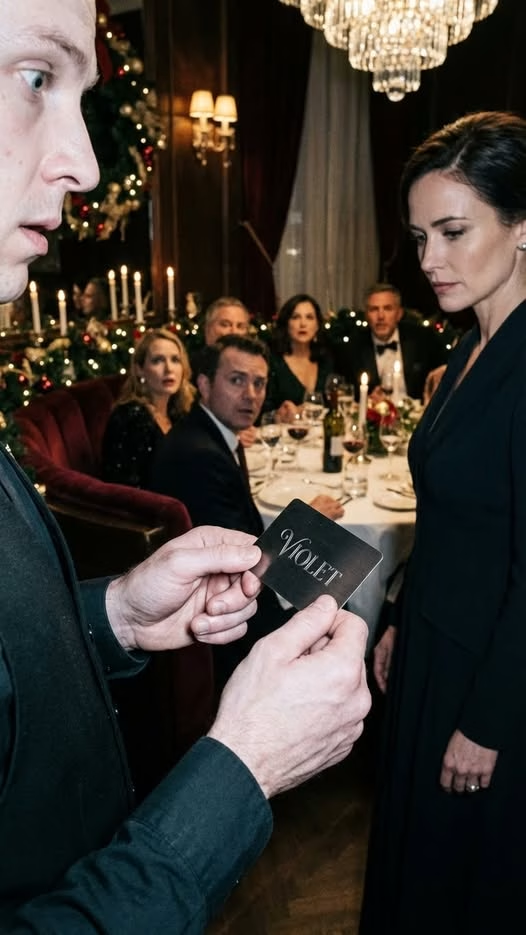
I did not cry. I did not scream. I simply handed a matte black metal card to the trembling waiter and said, “I am paying for everyone.”
When the waiter saw the name etched in silver on that card, his face went pale, and the room froze. They had spent years mistaking my silence for weakness. But tonight, the bill was finally due.
The Kill Zone
My name is Violet Morris, and I was sitting in the center of a kill zone disguised as a Christmas dinner at the Waverly House. To understand why the room fell silent, you have to understand the hands that held the card.
My hands are not soft. They are not manicured like Celeste Hargrove’s, nor are they smooth like the hands of the women Spencer usually speaks to at his country club mixers. My hands are rough. The pads of my fingers are permanently calloused, textured like fine grit sandpaper, and my cuticles are often stained with dark walnut hull or linseed oil.
I am a restoration artist. For fifteen years, I have taken furniture that other people have discarded—chairs with shattered legs, vanities with peeling veneer, dining tables scarred by water rings—and I have brought them back to life. I run a small but successful business restoring heritage woodwork. I make a good living, enough to support myself comfortably without anyone’s help. I drive a truck because I need to haul lumber, not because I cannot afford a luxury sedan. I wear work boots because safety matters more than fashion.
To the Hargroves, my work was manual labor, something to be looked down upon. To me, it was alchemy. I took the broken and the forgotten, and I gave them dignity again.
That was how I was raised. I grew up in a town so small you could drive through it in two minutes without hitting a red light. My mother raised me alone, and she taught me that dignity was the one thing you could not buy, which meant it was the one thing you could not afford to sell. She used to tell me that I should never borrow self-esteem from others to trade for their recognition. If I did, I would always be in debt.
I carried that lesson like a shield. I did not need the Hargroves to think I was special. I knew who I was.
When I first met Spencer four years ago at an estate sale, I thought he knew who I was, too. He was different back then. I was inspecting the dovetail joints on an 18th-century highboy, and he was watching me with a look of genuine fascination. He was not the corporate climber he is today. He was charming, slightly disheveled, and he seemed exhausted by the pretenses of his own world.
He told me he wanted to be the kind of man who could build things, not just manage them. He courted me with a persistence that felt like a fairytale. He would come to my dusty workshop, bringing coffee and sitting on a milk crate while I stripped layers of old varnish off a cabinet. He told me he loved my focus. He told me he loved that I did not care about his last name.
When he proposed, he promised me that he would always protect me from the toxicity of his family. He said we would build our own life, a fortress where their judgment could not reach us.
I believed him. I believed him so much that I ignored the way his mother looked at me at our wedding.
When Spencer joined Hargrove Motor Holdings, the shift began. The pressure to conform, to fit into the mold of the perfect executive wife, began to chip away at the man I fell in love with. The defense turned into silence. The silence turned into agreement.
“Don’t make a huge thing out of it, Violet,” he started saying when I pointed out his mother’s insults. “She is just old-fashioned. You are being too sensitive.”
I watched my husband slowly dissolve into the very people he used to despise. I stayed silent because I thought my love was a strong enough varnish to protect the wood of our marriage. I thought if I just endured enough, if I just proved I was good enough, eventually they would stop sanding me down.
I was wrong. You cannot fix rot by painting over it.
But there was one thing I had kept hidden, even from Spencer. Years ago, long before I met him, I was given a small, heavy box by the only relative who ever really understood me. Inside that box was the black metal card I had just handed to the waiter. I had never used it. I had never even checked the balance. To me, it was not money. It was a terrifying responsibility.
But tonight, as I listened to Gordon Hargrove announce my homelessness, as I watched my husband smirk while his family tore me apart for sport, I realized something. I had been saving my dignity like a miser, afraid to spend it.
Spencer thought he was discarding a broken wife. He did not realize he was unlocking a vault. He did not know that the woman he married was not just a carpenter. And staring at the terrified waiter holding the card that bore the name of a ghost, I knew that the time for silence was over.
The time for restoration was finished. It was time to strip the paint.
The Ghost and the Key
The name on the card belonged to a ghost. But she was the most alive person I had ever known.
To the rest of the world, Eleanor Kincaid might have been a mystery, a name on a deed, or a signature on a trust fund document. To me, she was just Aunt El. She was a recluse who lived in a weathered cedar cabin at the very edge of the Pisgah National Forest, miles away from the paved roads and country clubs that people like the Hargroves inhabited.
She did not own a television. She did not have a smartphone. She spent her days in a pair of men’s work boots and a flannel shirt that smelled of woodsmoke and dried sage. She was the one who put the first sandpaper block in my hand when I was ten years old.
“Most people only see what is broken, Violet,” she told me once, her voice rough like the bark of the oak trees surrounding us. “They are trained to throw things away. They want shiny. They want new. They are terrified of things that have lived a life. But you and I, we see the bones. We see what is underneath the paint.”
Eleanor was the only family I had who never looked at me with pity. She acted as if we were the richest people in the world because we knew how to build things with our own hands.
“Do not let anyone appraise you by the noise they make,” she used to say. “A hollow drum makes the most noise, Violet. Gold does not make a sound when it sits in the ground. It just is.”
I did not realize then that she was training me. I did not know she was teaching me how to survive a room full of people like the Hargroves.
On my eighteenth birthday, the day I was packing my bags to leave for trade school, Eleanor called me out to the porch. It was raining, a cold gray drizzle that soaked into the earth. She reached into the pocket of her oversized coat and pulled out a small velvet box.
Instead of jewelry, she handed me the heavy black metal card. I stared at it, confused. It had no bank logo, no expiration date, just her name and a magnetic strip. It looked industrial, almost military.
“What is this?” I asked.
“It is a key,” Eleanor said simply.
“A key to what?”
She leaned forward, her steel-gray eyes locking onto mine. “Listen to me carefully, Violet. This is not for buying clothes. It is not for vacations. It is not for making life easy. Do not use this when you are angry. Anger is cheap. If you use this in anger, you will waste it.”
“Then when do I use it?”
“You use it when you need to stand straight,” she said. “You use it when the world tries to bend you so far you think you are going to snap. When you have no other voice left, you put this on the table.”
She closed my fingers over the card. “When you hand this card to the right person, they will know who you are. And more importantly, you will know exactly who they are.”
Eleanor died four years later. I kept the card in my safe, tucked inside an old envelope. I never tried to activate it. To me, it was just a memento. I lived my life. I met Spencer. I fell in love. I endured the sneers of his family.
But the breaking point came three weeks before Christmas.
I had come home early from a site visit. The house was quiet. I walked into the kitchen and heard Spencer’s voice coming from the sunroom. He was on the phone, his voice relaxed and confident—a tone he hadn’t used with me in over a year.
“Don’t worry, Mom,” he said. “I know. I am handling it. I am not going to let it drag into the next fiscal year. She is just dead weight at this point. I will end this before the New Year to keep it clean. It will be my Christmas present to myself.”
He laughed. It was a cold, dismissive sound.
“Yeah, I have the papers ready. I’m just waiting for the right moment. Maybe the holiday dinner. Dad thinks it would be a power move to do it in front of everyone. Put her in her place.”
My breath hitched. I felt a physical blow to my chest. He wasn’t just planning to leave me. He was planning to destroy me. He was conspiring with his mother to turn our divorce into a public spectacle.
I backed away slowly. I did not scream. I went upstairs, closed the door, and looked at the photos of us. I turned the frame face down.
I was a restorer. I knew how to fix things. But I also knew when something was too rotten to be saved. When wood is infested with termites, you do not paint it; you burn it.
Spencer wanted a show. He wanted to ambush me at Christmas. Fine.
I went to my workshop and opened the safe. I took out the black metal card. I was not going to run. I was not going to beg. I was going to prepare.
The Ambush
The private dining room at the Waverly House was cavernous, designed to make everyone inside feel important and everyone outside feel small. There were over forty people already seated when we arrived. This was not an intimate family gathering. It was a shareholder meeting disguised as a holiday party.
I took my seat next to Spencer. Halfway down the table, I felt invisible. The eye of the storm turned toward me during the lull between the appetizer and the main course.
Gordon Hargrove, seated at the head of the table like a king on a throne, cleared his throat.
“So, Violet,” Gordon said, his voice booming. “Spencer tells me you are still playing around with that little furniture hobby of yours.”
The table went silent. Forty pairs of eyes shifted to me.
“It is not a hobby, Gordon,” I replied, my voice steady. “It is a restoration business. We had a very profitable year.”
“Profitable,” he chuckled, tasting the word like it was a bad oyster. “Cute. You sand down old chairs, don’t you? Tell me, how many chairs do you have to sand to afford a single bottle of the wine we are drinking tonight?”
A ripple of tittering laughter moved through the room.
“It is honest work,” I said.
“History doesn’t pay for memberships at the country club, my dear,” Gordon sneered. “It is quaint, I suppose, like a child selling lemonade. But let’s be real. You are not exactly contributing to the Hargrove Empire, are you?”
I looked at Spencer. This was the moment. This was when a husband was supposed to step in.
Spencer picked up his wine glass and swirled the red liquid. “She likes getting her hands dirty,” Spencer said with a tight, apologetic smile directed at the guests. “Not me. I keep telling her to hire people to do the grunt work, but she insists on wearing those overalls herself. It is eccentric.”
The betrayal hit me harder than Gordon’s insult. He wasn’t just failing to defend me. He was apologizing for my existence.
“We just worry about you, Violet,” Celeste added, her voice dripping with faux concern. “You cannot rely on manual labor forever. What happens when your hands give out? You are a liability.”
The waiter arrived to clear the plates, but the tension didn’t lift. It thickened.
“Is something wrong, Spencer?” I asked, breaking the silence just as his hand touched his jacket pocket. “You look like you have something you want to get off your chest.”
He looked at me, surprised by my directness. Then his eyes hardened.
“Actually, Violet,” he said, his voice loud enough to silence the room once more. “I do.”
The envelope hit the tablecloth with a soft, final thud. Spencer pushed it across the white linen with two fingers, treating the document as if it were contaminated.
“I am tired of pretending, Violet. We both know this does not work. You do not fit here.”
At the head of the table, Gordon Hargrove stood up, his face flushed with wine and triumph. He raised his glass high.
“To the New Year,” Gordon bellowed. “And to shedding dead weight. By the first of February, my son will be a free man. You will be on the street before the Super Bowl, darling. But do not worry. I am sure there is a shelter somewhere that appreciates rustic charm.”
The room erupted. It wasn’t just a polite chuckle. It was a roar of applause. They were clapping. They were celebrating the destruction of my life as if they had just witnessed a touchdown.
I looked at Spencer. Sitting across from me was not a husband. He was a terrified little boy in an expensive suit, desperate for his father’s approval. He wasn’t divorcing me because he hated me. He was divorcing me because he was too weak to love me against their wishes.
I did not feel heartbreak. I felt disgust.
“Go on, Violet,” Celeste huffed. “Sign it. Save us the legal fees.”
“Do you even have a pen?” someone shouted. “Or do you use a crayon?”
I reached out and picked up the envelope. I did not open it. I folded it in half, creasing the paper with a sharp, precise pressure of my thumb. Then I folded it again. I placed the folded square into the inner pocket of my blazer, right next to the metal card that was burning against my ribs.
I raised my hand.
Eli, the young waiter who had been hovering near the wall, stepped forward.
“Yes, ma’am?”
“I am ready for the check,” I said. My voice was not loud, but it carried. “I want to pay for the entire table. Everything. The food, the bar tab, the room rental.”
Spencer burst out laughing. “You are going to pay with what? The change in your truck’s ashtray?”
“Bring it, Eli,” I said gently.
When he returned with the payment terminal, the entire table was leaning in, waiting for the decline message. I ignored them. I reached into my pocket and pulled out the matte black card.
“Run it,” I said.
Eli took the card. I saw the moment the name registered. His eyes bulged. He looked from the silver engraving to my face, his mouth opening in a perfect ‘O’ of shock.
“Sir,” Gordon barked. “What is the holdup? Tell her it is declined.”
Eli looked up at Gordon, then back at me. He swallowed hard.
“I… I cannot run this here,” Eli stammered. “I have to get Mr. Renshaw immediately.”
“Why?” Spencer demanded. “Is it fake?”
“No, sir,” the waiter said, clutching the card to his chest as if it were a holy relic. “It is not fake. It is… It is the Owner’s Key.”
The Owner’s Protocol
Eli turned on his heel and practically ran toward the kitchen.
“Unbelievable,” Celeste huffed. “She hands him a fake card, and the boy panics.”
I sat perfectly still. Two minutes later, the kitchen door swung open. It wasn’t Eli who came out first. It was Mr. Renshaw, the General Manager of the Waverly House—a man who terrified his staff and bowed to Gordon.
But tonight, Mr. Renshaw was not smiling. He walked with a rigid, fast-paced stride, flanked by two men in dark suits. He walked right past Gordon without even a glance.
Renshaw stopped directly in front of me. He clasped his hands and bowed lower than I had ever seen him bow.
“Ms. Morris,” Renshaw said. He used the name on my driver’s license—the name I had started with.
The table went dead silent.
“Renshaw,” Spencer interrupted. “Her name is Mrs. Hargrove.”
Renshaw held up a hand, silencing my husband. “Ms. Morris,” he repeated. “We received the alert. I apologize for the delay. Nobody has used a Black Onyx card in this facility in seven years. We had to verify the serial number with the central trust database.”
“And?” I asked calmly.
“The verification is complete,” Renshaw said. “The card is authentic. It triggered the Owner Access Protocol immediately.”
“Owner Access?” Gordon sputtered. “What are you babbling about? I am a platinum member!”
“The Waverly House is a subsidiary of Kincaid Meridian Hospitality,” Renshaw said, his voice clipped. “And the holding group is a trust founded by the late Eleanor Kincaid. According to the documents, the sole beneficiary and current executive of the Kincaid estate—which includes this restaurant, the hotel above it, and forty-two other properties across North America—is Ms. Violet Morris.”
The silence that followed was absolute. It was the silence of a worldview shattering.
Spencer looked like he was trying to solve a complex math equation and failing.
“That’s impossible,” Spencer whispered. “Violet restores furniture.”
“She is the Chairwoman of the Board,” Renshaw corrected him. “This card is the master key. It overrides all billing, all reservations, and all security protocols.”
Gordon turned a dangerous shade of purple. “This is a scam! She is a nobody!” He lunged forward.
The two security guards blocked his path instantly.
“Mr. Hargrove,” Renshaw said, his voice dangerous. “You are shouting at the owner of this establishment. If you continue, I will have you escorted off the premises.”
Gordon froze. He slumped back into his chair, gasping for air. Celeste was staring at my rough hands, and suddenly she didn’t see poverty. She saw the kind of money that didn’t need to shout.
“Violet,” Spencer said, his voice small. “Is this true? Aunt Eleanor… the woman with the cabin?”
“She wasn’t just a woman with a cabin, Spencer,” I said softly. “She was a woman who knew the difference between value and price. Something you never learned.”
“Mr. Renshaw,” I said. “Thank you. No need to close the restaurant. Since I own the place, am I still paying for this dinner?”
“For you, Ms. Morris, it is always on the house. However, for non-owners…” Renshaw glanced at the wine bottles. “Standard rates apply.”
“Good,” I said. “Then bring me the bill. I said I would treat everyone. And unlike the Hargroves, I keep my promises.”
The transformation in the room was instantaneous and grotesque. The faces that had mocked me were now rearranging themselves into masks of ingratiating warmth.
“Violet, darling,” Aunt Beatrice cooed. “I always said you had a distinguished air.”
“Yes, absolutely,” Uncle Julian chimed in. “About that market talk… I hope you know I was just jesting.”
I watched them, feeling a cold knot of revulsion. They were sunflowers turning not toward the sun, but toward the scent of money.
Spencer reached out, grabbing my wrist. “Violet, we need to leave. Let’s go home and talk about this.”
“Home?” I asked. “You mean the house you just ordered me to vacate by February?”
“Don’t be like that,” he hissed. “I didn’t mean it. Come with me.”
I yanked my arm back. “Do not touch me. You lost the right to touch me when you slid those papers across the table.”
“We were just acting out of tough love!” Celeste pleaded.
“You clapped, Celeste,” I said, my voice ice. “When Gordon announced I would be homeless, you clapped. Do not insult my intelligence.”
I stood up. “I am leaving. I am going to a hotel—one of my hotels—where the locks work and the people don’t despise me.”
As I turned to leave, Renshaw stepped closer. “Ms. Morris. There is one more thing. The system triggered a secondary protocol. Eleanor Kincaid left a physical file in the main safe. It is marked sensitive and references the name ‘Hargrove’.”
A chill went down my spine. Eleanor hadn’t just left me money. She had left me a weapon.
The Noose
I sat in the penthouse suite, reading Eleanor’s letter.
My dear Violet… I know you married a Hargrove. Years ago, Gordon tried to bribe my procurement officer. A man who cheats to get through the door will steal the silver once he is inside. Be careful. Use the law.
Attached was a file. It contained evidence of Gordon’s past ethical violations, but more importantly, it pointed me toward where to look now.
The next morning, I went to the law offices of Kincaid Meridian. My lawyer, Sarah Jenkins, had already pulled the records.
“You were smart to insist on that transparency clause in your post-nuptial agreement,” Sarah said, projecting a document onto the screen. “Spencer signed a joint liability agreement for a failing subsidiary of Hargrove Motors. He personally guaranteed a loan of four million dollars. He did this during your marriage without your consent.”
“He wants to divorce me now so he can stick me with half the debt,” I realized. “He wants to bankrupt me.”
“It gets worse,” Sarah said. “He forged your signature on a refinancing application for your house to cover his gambling debts. If the auditors come on January 5th, he goes to prison. He needs you off the deed before then to retroactively validate the collateral.”
He wasn’t just trying to hurt me. He was trying to make me an accomplice to a felony.
“File the motion,” I said. “I am not just countersuing for divorce. I am filing for fraud.”
The Settlement
The mediation took place on January 2nd. The Hargroves were cornered animals. Spencer sat across from me, twitchy and frantic.
“We are arguing that Ms. Morris acted in bad faith,” Spencer’s lawyer began. “She concealed assets. We believe Mr. Hargrove is entitled to an equitable share of the Kincaid trust.”
Sarah smiled a shark’s smile. “The trust is irrevocable and generation-skipping. Inheritance kept separate is not marital property. Spencer gets zero.”
Gordon slammed his fist. “This is entrapment!”
“You never asked, Gordon,” I said. “You assumed I was poor because my hands were rough. That is not deception. That is prejudice.”
“We want the house,” Spencer blurted out. “I need my share of the equity.”
Sarah slid the audit report across the table. “Actually, Spencer, because you violated the transparency clause and failed to disclose the four-million-dollar liability, and because you forged Violet’s signature… the court is not going to divide this debt. It is entirely yours. Violet is absolved.”
The color drained from Spencer’s face.
“Furthermore,” Sarah continued, “we are filing a motion to remove your name from the deed immediately due to the attempted fraud. You leave with what you brought in: debt and a potential criminal indictment.”
The room went silent. The trap had snapped shut.
Gordon stood up, purple with rage. “I will bury you in litigation! I have friends!”
“Sit down, Gordon,” I said, my voice absolute. “You have no friends. You have accomplices. And the auditors are coming on Monday.”
Gordon slumped back, defeated.
“Violet,” Spencer whispered, tears streaming down his face. “Please. I was scared. Dad pressured me. We can start over. With your capital… we could be a power couple.”
I looked at him one last time. I saw the fear in his eyes. He wasn’t grieving his wife; he was grieving his safety net.
“You do not love me, Spencer,” I said. “You tried to throw me away like a broken chair. You only want me now because you realized I am made of gold. But it is too late.”
“Violet, please!”
“Goodbye, Spencer,” I said. “Try not to spend it all in one place.”
I walked out of the conference room and down the long hallway of the courthouse. I could hear him crying, but I didn’t slow down. I pushed open the heavy double doors and stepped out into the crisp January air.
I wasn’t Violet Hargrove anymore. I wasn’t the wood-fixer. I was Violet Morris. I was a restorer. I had stripped away the rot, sanded down the rough edges, and revealed the strong, unyielding grain underneath.
I walked to my truck, unlocked the door, and climbed in. My life—my real life—was just beginning.
And this time, I was building it on my own terms.