The Dress I Never Wore
My name is Madison Taylor, and three years ago, I believed my life was as close to perfect as anyone could hope for. I was twenty-eight, full of plans, dreams, and that soft kind of confidence that only comes when you think the world is finally on your side.
I lived in a small white cottage on the outskirts of Asheville, North Carolina. It was the kind of place where the mountains roll in gentle waves like sleeping giants, and the mornings smell like wet pine needles and dark roast coffee. My life was quiet, but it was sweet, like honey melting in tea. Every morning, I’d wake up to the sound of the French Broad River outside my window. Its voice was steady and patient, as if it had been whispering stories to the land long before I was born. I’d make coffee in my chipped blue mug—a relic from my college days—and sit on the porch, waiting for the fog to lift from the hills. It was the kind of peace I used to think would last forever.
At that time, I was engaged to Daniel Cooper.
Daniel was charming, handsome, and endlessly ambitious. A man with a smile that could light up a cavern and a voice that could make even the dullest conversation sound like poetry. We met at a charity fundraiser in Charleston, South Carolina, under the warm glow of string lights. I remember thinking he seemed a little too polished for someone his age, his suit tailored just so, his laugh practiced. But he looked at me like he saw something different—something worth chasing. And I was naive enough to believe that love like that couldn’t possibly hide anything dark.
Within six months, he proposed. It was a perfect evening—candlelight flickering against the walls of his apartment, soft jazz playing in the background, a diamond ring that sparkled like moonlight on calm water. I said yes without hesitation. My parents, Linda and Richard Taylor, were overjoyed. My sister, Emma, cried tears that, at the time, I thought were happy ones.
We began to plan a wedding that felt like a dream. Springtime in Savannah, Georgia, under a canopy of blooming magnolias. The kind of wedding you see in glossy magazines but never believe could happen to you.
But before the wedding, I decided to do something I’d always wanted. I took a six-month volunteering trip to Europe, specifically to Lisbon, Portugal, where I worked at an orphanage for displaced children. I had always believed in giving back, and Daniel, ever the supportive fiancé, encouraged me to go.
“You’ll come back with stories,” he told me, pressing a kiss to my forehead the night before I left. “And when you do, we’ll start our real life together.”
His words filled me with warmth and hope. I had no reason to doubt them.
Lisbon
Lisbon was everything I imagined and more. Sun-soaked streets, the smell of roasted chestnuts in the air, and the melancholic music of Fado spilling out from the little cafes that lined the cobbled alleys. The orphanage where I worked was small but full of life. The children, though poor, had spirits brighter than the Atlantic sun. I spent my mornings teaching English and my afternoons painting murals with them on the crumbling limestone walls.
I sent photos and letters home every week. My parents always replied with polite enthusiasm. Daniel’s letters, though, were what I lived for. Each one began with, “My dearest Maddie,” and ended with, “Forever yours, Daniel.” They were filled with stories about the house he was renovating for us, about the business he was expanding, about how he missed the way I made coffee. He told me he couldn’t wait to see me walk down the aisle.
I carried those letters with me everywhere, tied together with a silk ribbon in my suitcase. But as the weeks passed, something began to feel off. His replies grew shorter, less detailed, and more formal. He stopped calling as often, saying he was “busy closing deals” or “traveling for work.”
I told myself not to worry. After all, life went on even when you were in love. Still, sometimes at night, as I watched the lights of Lisbon flicker across the Tagus River, I’d feel a small unease curling in my stomach like smoke. It was the kind of feeling you can’t quite name. A whisper that something is shifting beneath the surface, waiting to break.
Then came the message that changed everything.
It was a quiet Sunday evening in late March. I had just come back from a long day at the orphanage and was sitting by the window, sipping tea and writing in my journal. The sun had dipped below the horizon, leaving a soft orange glow over the terra cotta rooftops.
My phone buzzed on the wooden table. A message from my mother.
It said: “Don’t rush home. Your sister Emma has married Daniel. We’ll explain later.”
I read it once. Then again. I was convinced it was some kind of mistake, a cruel joke, a typo. My heart began to race, thumping against my ribs like a trapped bird. Married? My sister? My fiancé?
I laughed out loud at first—a short, sharp bark of a laugh that sounded nothing like joy. Then, slowly, the meaning settled in like lead in my gut. The shorter letters. The silence. The missing warmth. It all made a terrible kind of sense.
My mother didn’t answer when I called. Neither did Daniel. Emma, the sister who used to braid my hair and borrow my sweaters without asking, didn’t reply either.
I sat there for hours, staring out the window, the city lights blurring through my tears until they looked like streaks of fire. I felt a chasm opening up beneath me, swallowing everything I thought I knew about loyalty, family, and love.
For the next few days, I walked through Lisbon like a ghost. The cobblestones felt hard and unforgiving under my feet. The children at the orphanage asked why I wasn’t smiling anymore, their wide eyes filled with innocent concern. I told them I was just tired. But inside, I was unraveling.
I couldn’t eat. Food tasted like ash. I couldn’t sleep. My thoughts kept circling back to home, to the people who had betrayed me. The betrayal itself was bad enough, but what cut deeper was my parents’ silence. They had always favored Emma, the younger, prettier one—the golden child. But I never imagined they would bless her marrying the man I loved.
Eventually, one of the other volunteers, a kind woman named Clara with silver hair and eyes that had seen too much of the world, noticed something was wrong. We were cleaning brushes in the sink when she placed a hand on my arm.
“You look like you’re carrying a mountain, Madison,” she said softly.
I told her everything. The words tumbled out of me, jagged and raw. When I finished, she didn’t offer empty platitudes. She just shook her head, a sad smile playing on her lips.
“You can’t fix people like that, Madison,” she said gently. “Some things you just have to let burn. Let the fire take it. Only then can you see what’s left in the ashes.”
Her words sank into me like a stone dropped into deep water. I realized that I couldn’t go back. Not yet. Not until I had gathered the strength to face them without crumbling.
I extended my stay for another month, trying to lose myself in work, trying to heal through kindness. Every morning, I woke before dawn and watched the city come alive, hoping that the sunlight would somehow erase the shadow of what had happened. It didn’t, but it taught me something vital: the world doesn’t stop turning for your heartbreak. The river still flows. The children still laugh. Life still goes on, even when yours feels shattered.
By the time I finally packed my bags to return to America, I wasn’t the same woman who had left six months earlier. The girl who believed in perfect love had died somewhere on those Lisbon streets, replaced by someone quieter, sharper, and far less trusting.
I didn’t know what awaited me at home, only that I had to see it for myself. I had to look them in the eye.
When the plane lifted off from Lisbon, I looked down at the city one last time. I thought about Daniel’s promises, my sister’s smile, my parents’ silence—all the things I’d once called love. Somewhere inside me, beneath the pain, a voice whispered: “This is not the end, Madison. This is where your real story begins.”
But as the plane banked west, turning toward the Atlantic, a cold dread settled over me. I wasn’t flying home. I was flying into a storm.
The Homecoming
The flight from Lisbon to New York City had been long and restless. I remember staring out the airplane window as the coastline appeared beneath the clouds, gray and formidable. Instead of excitement, all I felt was a heavy, suffocating dread. The country that had always been home now felt foreign, almost hostile.
Everything in me wanted to believe there had been some kind of misunderstanding. That maybe my mother’s message had been worded wrong. That maybe it wasn’t the betrayal I feared. But deep down, I already knew the truth. You can sense when something inside your world has shifted beyond repair, like the air pressure dropping before a hurricane.
I took a train from New York to Richmond, Virginia, because that’s where my family lived. The train ride was a blur of passing trees and industrial towns. When I finally arrived, I took a taxi to the house.
It was the same as I’d left it. Pale blue paint, white shutters, and pink roses growing along the porch railing. I had planted those roses with my mother years ago, one summer when she still smiled at me the way mothers should. The sight of them used to make me feel safe. But that day, I couldn’t even bring myself to touch them. It was strange how something as beautiful as a flower could suddenly feel like a warning sign.
I walked up the steps, my suitcase dragging behind me like a dead weight. I rang the bell. My hands were trembling—not from fear, but from something colder. Anticipation, maybe. Or anger trying to disguise itself as calm.
When the door opened, I froze.
It was Emma. My younger sister. My best friend, once upon a time.
She stood there wearing my wedding dress.
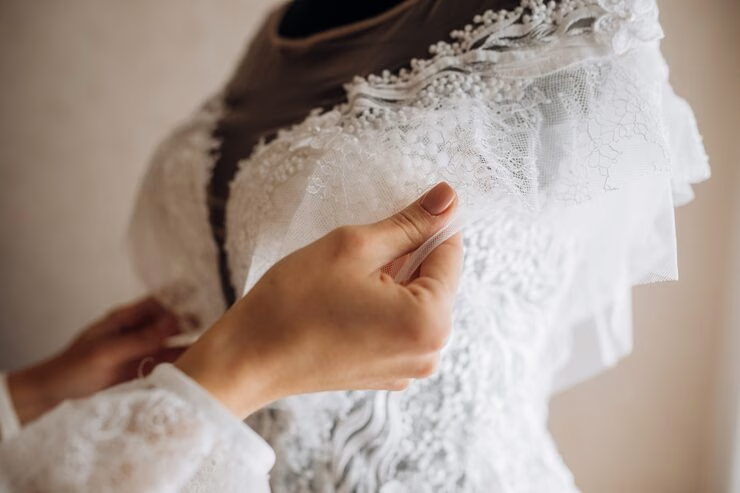
The same one I had chosen in Charleston after trying on half a dozen others. The ivory silk, the delicate lace sleeves, the way the neckline dipped just enough to be elegant but not bold. It was all mine. I remember how my mother had cried when I first showed it to her, saying I looked like an angel.
Now that same dress clung to Emma’s body. But she looked nothing like an angel. She looked triumphant.
“Madison!” she exclaimed brightly, spinning around as though modeling it for me. “You’re home! Do you like it? It fit me perfectly. Almost like it was meant to be.”
I couldn’t breathe. The air had left the porch.
Behind her, Daniel appeared. He was wearing a gray suit, holding a glass of champagne, smiling like the world had given him everything he’d ever wanted.
“Maddie,” he said, his voice light but laced with a subtle unease. “It’s been a long time.”
I stared at them both, silent for a moment. Then, a laugh escaped me. It wasn’t happy. It was a sharp, uncontrollable sound that echoed through the hall like breaking glass.
“I didn’t mean to,” I gasped, wiping a tear from my eye. “It just… escaped.”
My parents came out from the living room. My mother was clutching a pearl necklace at her throat, her face a mask of anxious propriety. My father wore that look of calm authority he always used when trying to make unreasonable things seem logical.
“Madison, sweetheart,” my mother began, stepping forward but not reaching for me. “Please don’t make this harder than it needs to be. Things have changed. Emma and Daniel… they fell in love while you were away. You were gone for so long, and you have such a good heart. You’ll understand one day.”
“Understand?” I said, my voice trembling now, the laughter dying in my throat. “You mean you all agreed to this? You thought it was fine that my sister married my fiancé in my dress?”
My father sighed, adjusting his glasses. “Daniel is a good man, Maddie. He takes care of your sister. He’s built a life here. You were off chasing causes in Europe. We thought… maybe you’d moved on.”
I remember standing there, feeling my knees weaken. They weren’t just defending it. They were proud of it. The people who raised me, who taught me about honesty and love, were now treating betrayal like a pragmatic business decision.
But what struck me most wasn’t even their words. It was Daniel’s eyes. He couldn’t meet mine for more than a few seconds. There was guilt there, yes, but also fear. The kind of fear that comes from knowing your lies are starting to crumble, the mortar turning to dust.
I didn’t say another word. I turned around, walked down the steps, and kept walking until I reached the corner of the street. My hands were shaking so badly that I dropped my phone twice trying to call a cab.
When I finally got into one, the driver asked where I was headed.
I looked back at the pale blue house, now just a smudge in the distance. “Anywhere but here,” I whispered.
The Unraveling
Over the next few days, I stayed in a cheap motel near downtown Richmond. The room smelled of old carpet and lemon cleaner, but it was quiet, and I needed that silence like I needed air. I barely slept. My mind replayed everything on a loop: Daniel’s smile, Emma’s voice, my parents’ calm explanations. It was like reliving a nightmare in slow motion.
I wrote Daniel an email asking for answers. He replied with a single sentence: “I didn’t mean for things to happen this way.”
No apology. No explanation. Just cowardice wrapped in brevity.
Then, about a month later, I found out the truth.
I had gone to a small cafe one morning to clear my head. While scrolling through the news on my phone, sipping a lukewarm latte, I saw his name.
Daniel Cooper.
It was in an article headline: “Virginia Businessman Under Investigation for Fraudulent Investment Schemes.”
The words didn’t make sense at first. I read them again. And again. My stomach dropped.
Daniel had been running fake investment accounts, scamming families across multiple states. He wasn’t wealthy. He was stealing everything—the cars, the house, the donations he made in his name. It was all other people’s money. It was a scheme built on charm and lies.
And then, a detail that made my blood run cold: He had used Emma’s name to open one of the offshore accounts.
My sister, the one who betrayed me, had unknowingly tied herself to his crimes. She was his accomplice, his shield.
I wanted to feel vindicated. I wanted to feel the righteous rush of “I told you so.” But I didn’t. I felt sick. I had once loved this man. I had dreamed of building a life with him. Now I realized he had never truly loved anyone but himself.
I went to see Emma that evening. The house looked different now—darker, less welcoming. She opened the door, looking thinner, paler. Her confidence had cracked like dry glaze.
“Madison,” she whispered, her voice trembling.
“You knew?” I asked.
She shook her head frantically. “He… he said it was just business. He said we were investing.”
“He’s a thief, Emma,” I said, my voice flat. “He’s been lying to you. To all of us.”
She sank to the floor in the hallway, burying her face in her hands, and began to cry. For a brief moment, seeing her so small and broken, I almost felt sorry for her. Almost. But then I remembered the look on her face when she’d spun in my wedding dress, proud and glowing.
I couldn’t comfort her. Not this time.
Within a week, Daniel vanished. The authorities said he had likely fled the state. My parents tried to call me again, leaving voicemails saying they were sorry, saying they hadn’t known, begging me to help them understand the legal mess Emma was in.
I didn’t answer. I couldn’t. Some betrayals are too deep to patch over with apologies. They are structural failures. The foundation was gone.
Denver
I spent that summer rebuilding myself. I sold my engagement ring to a pawnbroker for twelve hundred dollars. It felt like blood money, but I used it to move into a small apartment on the other side of town. It wasn’t much—one bedroom, one window overlooking an alley, one fragile hope—but it was mine.
I couldn’t bear the thought of staying in Virginia. The air felt too heavy. So, I packed what little I had: two suitcases, my camera, and a few hundred dollars in savings.
I wanted a city far enough away to breathe, but not so far that I felt like I was running from my own shadow. That’s how I chose Denver, Colorado. I’d never been there before, but when I saw photos of the Rocky Mountains surrounding the city like guardians, something in me whispered: “Start here.”
I found a small apartment above a bakery in the Capitol Hill neighborhood. It wasn’t much—creaky floors, drafty windows, and a tiny balcony that looked out over the rooftops—but I loved it instantly. Every morning, the smell of freshly baked sourdough drifted up through my window, a warm, yeasty reminder that good things could still rise from the heat.
I got a job at a community counseling center, helping people find jobs, apply for housing, and navigate through difficult times. It wasn’t glamorous, and the pay was modest, but the work gave me something my old life never did: Purpose.
The first few months were lonely. I didn’t know anyone in Denver. When people asked about my past, I simply said I needed a change. It was a relief to be around people who didn’t know my family, who didn’t whisper when I entered a room.
Then came Lara Bennett.
She was a client at first, a single mother trying to get back on her feet after leaving an abusive marriage. She had a son named Owen, who was six and loved drawing dinosaurs on everything, including my desk. Lara had a quick wit and a kind heart. Soon, we became friends. We’d sit together after work at a little cafe on Colfax Avenue, drinking coffee and trading stories.
One evening, she looked at me over the rim of her mug. “You’ve been through something, haven’t you?”
I hesitated. “What makes you say that?”
“You have that look,” she said softly. “Like you’ve lost something important, but you’re still standing. It’s in the eyes.”
Her words caught me off guard. I smiled and nodded, feeling both seen and safe. From that day on, Lara became the sister I wished Emma had been.
Through her, I met Ethan Cole.
He was a quiet journalist who occasionally volunteered at the center. He was in his mid-thirties, thoughtful, with that calm kind of confidence that doesn’t demand attention. We met one afternoon while organizing donation boxes. He struck up a conversation about books, and I noticed he had this habit of looking you in the eye when he listened—not to judge, but to truly understand.
We started talking more after work. Sometimes over coffee, sometimes over nothing but silence and shared company. He never asked about my past, and I never offered it. Somehow, he understood that I needed space more than sympathy. That was what drew me to him: his patience. It reminded me that not everyone wanted something from me. Some people just wanted to sit beside you until you remembered how to breathe again.
By autumn, Denver had started to feel like home. I got used to the rhythm of the city, the golden aspen leaves scattered across the sidewalks, the way the air turned crisp in the evenings. Every Friday night, I’d sit on my little balcony with a cup of tea and watch the city lights stretch toward the mountains. It became my ritual.
One night, as I was closing the counseling office, Ethan stopped by with two cups of coffee.
“You look tired,” he said gently. “You should see the mountains this weekend. They’re covered in snow already.”
I smiled, taking the cup. “Maybe I will.”
“Good,” he said. “Everyone deserves to start over somewhere, Madison.”
After he left, I stood by the window, watching the first flakes of winter snow begin to fall. For the first time in a long time, I felt something soft bloom inside me. Not love, not yet. But something close to hope.
Full Circle
Two years passed.
By the time I turned thirty-one, the city that had once felt like a hiding place had become my sanctuary. I had saved enough to leave my little apartment above the bakery and buy a small house just outside Aurora. It was pale yellow with green shutters and a garden that needed work.
The first night I slept there, I sat on the porch steps under a blanket, sipping tea and staring at the open sky. I realized I didn’t need anyone else to make my life whole.
Then, one chilly evening in late November, everything came full circle.
I stopped by a small grocery store after work. As I waited in line, my eyes drifted to the newspaper stand. A headline in bold letters caught my attention: “Conman Arrested in Seattle: Millions Stolen Through Fake Charities.”
For a moment, the world around me went quiet. The checkout beeps faded. I reached for the paper with trembling hands.
There it was. His face.
Daniel Cooper.
The same smile, the same dark eyes, though older now—harder, emptier. According to the article, he had been living under a different name for the past year, running fraudulent charitable foundations across several states. He’d finally been caught trying to flee to Canada with over half a million dollars in cash.
I read the words slowly, letting them sink in. And then, to my surprise, I laughed. Not out of joy, not out of spite, but out of relief. It felt like an old, infected wound finally being cleaned out.
I folded the newspaper, placed it back on the stand, and paid for my groceries.
That night, I sat on my porch. The stars were bright. And for the first time in years, I realized I wasn’t angry anymore. Not at Daniel, not at Emma, not even at my parents. Anger had once been the only thing keeping me standing, but now it felt heavy, unnecessary—like a winter coat in the middle of summer. I had carried it long enough.
A week later, I received a letter in the mail with no return address. I recognized the handwriting immediately.
Emma.
Her letter was short, written in careful, almost hesitant words. She told me she had left Daniel months before his arrest. She had moved to Nashville, Tennessee, and was working at a flower shop, trying to rebuild her life. She apologized—not the shallow, rehearsed kind of apology I’d heard before, but a genuine one. She said she didn’t expect forgiveness, only that she hoped I was happy.
I read the letter three times. Then I placed it in a drawer. I didn’t write back. I wasn’t sure if I ever would. Forgiveness doesn’t always need to be spoken aloud. Sometimes it’s just a quiet decision to stop carrying the weight of what someone did to you.
My parents called again that Christmas. My mother’s voice was softer this time, full of regret. She said they missed me. She said they were sorry.
I listened in silence. When she asked if I’d come visit, I told her, “Maybe one day.” It wasn’t a lie, but it wasn’t a promise either.
Winter turned to spring. I started painting again, filling my living room walls with blues, greens, and golds. Ethan still came by for dinner, and we talked about the small things that made life beautiful.
One Sunday morning, at the farmers market downtown, I saw a white dress. Simple, elegant. For a second, I thought of my old wedding dress—the one Emma had worn. The memory didn’t sting anymore. Instead, I felt a strange gratitude.
That dress had belonged to another version of me. A woman who believed her worth was tied to someone else’s love. The woman I had become no longer needed a dress, or a man, or a family’s approval to feel complete.
That evening, as the sun dipped behind the Rockies, turning the sky violet, I whispered into the dusk: “I made it.”
The life I wear now is stitched together with mistakes, courage, and forgiveness. And it fits me better than any silk ever could.