The Burden
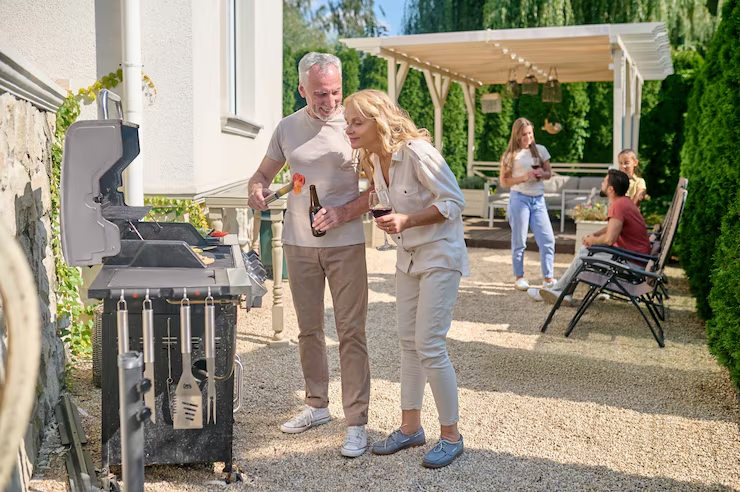
The pungent smell of burning charcoal and bourbon-glazed ribs permeated the thick July air of Atlanta’s most exclusive neighborhood. The Patterson mansion’s sprawling backyard—two acres of perfectly manicured lawn, imported Italian stone pathways, and a custom-built gazebo that had been featured in Southern Living—was packed with forty guests milling between the buffet tables and the Olympic-sized pool.
I stood beside the drinks table holding a glass of iced tea I hadn’t touched in twenty minutes, watching my husband hold court like the king he believed himself to be. The pale blue floral dress I wore had been Mark’s choice three years ago—he’d said it made me look “appropriate for a CEO’s wife.” Today, he’d told me it looked “old-fashioned and dowdy.” I’d worn it anyway.
My name is Elena Morales Patterson, though I’d be dropping that last name soon enough. Thirty-four years old, raised in the Georgia foster care system, college graduate on a full scholarship, former forensic accountant. For the past five years, I’d been Mrs. Mark Patterson, wife of the CEO of Patterson Logistics, a woman expected to smile prettily at charity galas and never ask questions about where the money actually went.
Mark stood in the center of a circle of admirers—business partners in golf shirts, neighbors who drove German cars, distant relatives who only appeared when there was free premium alcohol. He was holding court with a bottle of craft beer, his handsome face flushed with heat and ego, laughing at his own jokes about quarterly earnings and commercial shipping routes. At forty-two, Mark Patterson still had the athletic build of his college football days, the charm of a born salesman, and the moral compass of a broken slot machine.
Seated in the most prominent position under the gazebo was Barbara Patterson, my mother-in-law, perched in a white wicker throne like a duchess surveying her domain. Even in ninety-degree heat, she wore her signature Chanel suit and Dior sunglasses, her silver hair styled in the same helmet she’d maintained since the Reagan administration. Through those dark lenses, I could feel her contemptuous gaze tracking my every movement, the same look she’d given me the first time Mark brought me home six years ago.
“An orphan,” she’d said, not to me but about me, as if I were a piece of furniture being evaluated. “How… charitable of you, Mark.”
She’d never forgiven me for not being Katherine Beaumont, the debutante daughter of the Beaumont textile fortune, the girl she’d picked out for her son before I’d inconveniently appeared with my scholarship education and complete lack of generational wealth.
The Setup
The party had been Barbara’s idea, of course. “A summer celebration,” she’d called it, insisting we host despite Mark’s and my barely concealed hostility toward each other. I knew exactly what it was—a stage, carefully set for a performance I’d been anticipating for three months.
I’d known this moment was coming since March, when I’d discovered the hotel receipt in Mark’s suit pocket while sorting laundry. The Ritz-Carlton, Presidential Suite, two-night stay, charged to Patterson Logistics corporate card. The date had been significant—our fifth wedding anniversary weekend, which Mark had told me he’d spent at a logistics conference in Birmingham.
I’d called the hotel, affecting the brisk efficiency of an executive assistant confirming expense reports. The concierge had been helpful, even mentioning the champagne and strawberries Mr. Patterson had requested for his guest on the Friday evening. When I’d asked if Mrs. Patterson had enjoyed them, there’d been a telling pause before the concierge had carefully said, “The lady with Mr. Patterson seemed very pleased, yes.”
I hadn’t confronted Mark. I’d learned in foster care that confrontation without leverage is just noise—it makes you feel better for five minutes and then you lose everything. Instead, I’d gone to my laptop and started a spreadsheet, something I hadn’t done since leaving my accounting career five years earlier.
I’d hired Marcus Webb, a private investigator who specialized in domestic cases, a former police detective with contacts in all the right places. The retainer had cost me three months of grocery money I’d been secretly saving. The photos he’d brought back two weeks later—Mark and Tiffany Romano dining at Canoe, walking through Piedmont Park, entering her apartment building at 11 PM on a Tuesday—those had been worth every penny.
But infidelity alone wasn’t enough. Georgia is a no-fault divorce state, and the prenuptial agreement Barbara had insisted on would still leave me with almost nothing. I needed something bigger, something that would crack open the entire structure of Mark’s carefully curated life.
So I’d hired Sterling & Associates, the forensic accounting firm where I’d once worked as a junior auditor. They owed me a favor—I’d once caught an embezzlement scheme that had saved their biggest client from bankruptcy. I’d cashed in that favor and asked them to look at Patterson Logistics with the kind of scrutiny usually reserved for Ponzi schemes.
What they’d found had exceeded even my suspicions. The gambling debts. The mistress’s penthouse. The pension fund theft. The forged signatures. The tax fraud. It was a house of cards built on top of a foundation of lies, and Mark had gotten away with it because everyone assumed his wife was too stupid to read a balance sheet.
For three months, I’d played the perfect, oblivious spouse while the investigation quietly unfolded. I’d smiled at dinner parties. I’d nodded when Mark complained about my inadequacies. I’d let him believe his script was working, that I’d break down and accept whatever scraps he chose to leave me.
All while I built the case that would make the IRS weep with joy and send federal prosecutors scrambling for indictments.
The Performance
“Everyone! May I have your attention, please!”
Mark’s voice cut through the buzz of conversation and classic rock drifting from the outdoor speakers. He was tapping a spoon against his beer bottle, the metallic clink silencing the crowd with Pavlovian efficiency. Someone killed the music.
Mark stepped up onto the wooden platform of the gazebo, his loafers clicking against the cedar planks. He looked around at the gathered faces with the satisfied smile of a man about to deliver a punchline to a joke only he knew. Then his gaze settled on me—cold, calculated, triumphant.
“Today, I want to share some important news with all of you,” Mark announced, his voice carrying across the lawn with the practiced projection of a man accustomed to boardroom presentations. “Everyone here knows that I’ve always valued excellence in every aspect of my life. My business, my investments, my reputation in this community.”
I tightened my grip on the sweating glass of iced tea. My heart was beating steadily, calmly. I’d rehearsed this moment in my mind a hundred times.
“Unfortunately,” Mark continued, pausing for effect, “my personal life hasn’t lived up to those standards lately. So I’m here to announce that Elena and I are getting a divorce.”
The collective gasp was audible. Forty faces turned toward me in perfect synchronization, a choreographed moment of social theater. Whispers erupted like wildfire through dry grass.
Mark raised his hand in a magnanimous gesture, as if granting his audience permission to be shocked. “Now, now, don’t be too surprised. I’ve tried my best to make this marriage work. God knows I’ve tried. But Elena…” He pointed directly at me, his finger like a prosecutor’s accusation. “She’s been a burden from the start. She lacks the sophistication to support my career at the level I’ve reached. She’s boring, unambitious, and frankly… she embarrasses me every time we attend an important function.”
I stood perfectly still. No tears. No trembling. No lowered gaze of shame.
I’d learned long ago, in the third foster home where the family’s biological daughter had delighted in public humiliation, that the only way to win these games was to refuse to play your assigned role.
“Finally!” Barbara leaped to her feet, her Chanel-clad figure practically vibrating with vindictive joy. She began clapping, slow and deliberate at first, then faster, more enthusiastic. “My son deserves so much better than this! I told you from the beginning, Mark, that this girl wasn’t right for our family! Thank God you’ve finally seen the light!”
Following Barbara’s lead, a few of Mark’s relatives joined the applause—his cousin Derek, who’d borrowed fifty thousand from Patterson Logistics and never paid it back; his aunt Melissa, who’d always sniffed at my “common” background. Then others joined in, a cascade of clapping that celebrated the public destruction of a marriage as if it were a graduation ceremony.
Mark’s smile grew wider. He was feeding off the energy, soaking in the validation. He looked at me with naked expectation, waiting for the finale of his carefully orchestrated performance. He wanted to see me cry. He wanted to see me beg. He wanted to watch me flee through the back gate in humiliation while his guests whispered about the gold-digging orphan who’d finally been put in her place.
He’d already consulted three divorce attorneys. I knew because I’d intercepted the bills. He had a strategy prepared to leverage the prenuptial agreement his mother had insisted on—the one that would leave me with almost nothing if I was found to be “at fault” in the dissolution of the marriage. He’d been building a case of my supposed inadequacies for months, documenting my “failures” as a wife in a leather journal his lawyer had recommended.
But I didn’t cry. I didn’t bow my head. I didn’t run.
Instead, I set down my iced tea with a soft clink against the glass table. I smoothed the skirt of my “old-fashioned” dress. And I smiled.
It was a radiant, genuine smile of pure relief, and I watched it hit Mark’s face like cold water, extinguishing his triumphant expression in an instant.
The Revelation
I walked slowly across the lawn toward the gazebo where Mark stood, my low heels sinking slightly into the perfect grass with each measured step. Every eye tracked my movement. The silence was so complete I could hear the buzz of cicadas in the oak trees and the distant hum of traffic on Peachtree Road.
“You’re absolutely right, Mark,” I said, my voice clear and steady, pitched to carry to every corner of the backyard. “I agree completely. This marriage has been a burden. For both of us.”
Mark’s face flushed red. This wasn’t in the script. The spurned wife wasn’t supposed to agree with her own humiliation.
“However,” I continued, reaching under the fruit basket on the buffet table where I’d carefully placed an item two hours earlier, during setup, “I think you should look at this before we discuss the details of our divorce.”
I pulled out a large yellow envelope, the kind used for legal documents, and held it out to him.
“What is this?” Mark snatched it from my hand, his lips curling into a sneer. “A property claim? Don’t even dream about it, Elena. The prenuptial agreement clearly states—”
“Open it,” I interrupted calmly. “It’s not a divorce petition.”
Mark tore open the envelope with rough, aggressive movements, the paper ripping loudly in the silent garden. He pulled out a thick document, professionally bound, pages crisp and white, carefully tabbed with colored markers.
The first page didn’t bear the seal of the Fulton County Courthouse.
It bore the logo of Sterling & Associates: Financial Investigation and Forensic Accounting.
I watched Mark’s eyes scan the title page. The sneer on his face froze, then slowly melted like wax near a flame. The color drained from his face in stages—from angry red to pale pink to ash white to a grayish shade I’d only seen on people receiving very bad news from doctors.
“This… this is…” He stammered, his voice cracking.
“It’s an independent forensic investigation I commissioned six months ago,” I said, turning to address not just Mark but Barbara and the entire crowd of guests who were now leaning forward, straining to hear every word. “You see, Mark accused me of being a burden, of being inadequate, of embarrassing him. But this report tells a very different story.”
I paused, letting the tension build, watching Mark’s hands tremble as they gripped the document.
“The report shows that you, Mark, are the one carrying a significant burden. Specifically, a gambling debt of $847,000 accumulated over the past two years at an underground poker club in Buckhead, and approximately $2.5 million in expenses related to maintaining your mistress in the lifestyle to which you’ve made her accustomed.”
The crowd’s gasp this time wasn’t polite shock—it was the hungry intake of breath that precedes really good gossip.
“You lying bitch!” Mark hissed, his hand rising as if to tear the document to shreds. “This is slander! I’ll sue you for—”
“Tear up that copy if you’d like,” I said with a shrug. “I have seventeen more in my attorney’s office, plus digital copies stored in three separate cloud services. But before you destroy evidence, you might want to look at page fifteen.”
I waited while Mark, his hands shaking violently now, flipped through pages with increasing desperation.
“Page fifteen contains a detailed transaction history,” I continued, my voice taking on the professional tone I’d once used when presenting audit findings to corporate boards. “Wire transfers from Patterson Logistics’ operating account to the personal account of Miss Tiffany Romano. Your executive assistant. The one you hired eight months ago despite her having zero logistics experience and a resume that couldn’t be verified because, as we discovered, it was largely fabricated.”
I turned to look directly at Barbara, whose face had gone the color of old milk.
“Mother Patterson, did you know that the $2.5 million Mark withdrew from the company’s employee pension fund—the fund that you co-manage as board chair—was used to purchase a penthouse condominium in Miami Beach? The deed is in Tiffany’s name, but the payments come from Patterson Logistics. That’s on page eighteen, if you’d like to verify.”
Barbara’s crystal wine glass slipped from her fingers and shattered against the Italian tile surrounding the pool. The red wine spread like blood across the white stone.
“Two and a half… million?” Barbara whispered, her voice strangled. She looked at her son with the expression of someone watching their house burn down. “Mark? Tell me this isn’t true. Tell me this woman is lying.”
“Mom! Don’t listen to her!” Mark’s voice had climbed an octave, panic stripping away his CEO polish to reveal something desperate and cornered underneath. “She’s making this up! She hired some fraud company to fabricate evidence because she’s angry I’m leaving her!”
“That’s not all,” I said calmly, enjoying the moment more than I probably should have. “Turn to page twenty-two, Mark. You’ll find copies of amended tax returns you filed with the IRS—returns that significantly underreported company revenue for the past three years. You did this to hide the pension fund deficit you created when you started stealing from it.”
I let that sink in for a moment before delivering the final blow.
“And page thirty-one documents something particularly interesting. To cover the shortfall and keep the embezzlement hidden from the auditors, you forged your mother’s signature on bank loan applications. Three loans, totaling $1.2 million, all in Barbara Patterson’s name, all secured against company assets, all taken out without her knowledge.”
I looked at Barbara, then back at Mark.
“In legal terms,” I said, my voice gentle but clear, “you made your mother an unwitting accomplice to embezzlement, pension fund fraud, federal tax evasion, and bank fraud. The Sterling report estimates her potential criminal liability at—” I pretended to consult a page I’d memorized weeks ago, “—seven to twelve years if prosecutors can’t prove she was an innocent party.”
The garden fell into a silence so profound it felt like being underwater. Even the cicadas seemed to have stopped their buzzing. I could hear someone’s ice clinking in their glass three tables away.
Mark backed up until he hit one of the gazebo’s support posts. He looked at his mother, whose face had contorted into an expression of dawning horror. He looked at me. He looked at the document in his hands as if it were a live snake.
He’d been so confident in my ignorance. He’d counted on me being exactly what Barbara always claimed I was—an unsophisticated orphan girl who’d gotten lucky, someone who knew nothing about money beyond spending it on groceries. He’d forgotten—or perhaps never really known—that before I’d met him at that charity gala six years ago, I’d been a forensic accountant for one of Atlanta’s most prestigious firms. I’d uncovered embezzlement schemes, traced money through shell corporations, testified as an expert witness in federal fraud cases.
I’d quit that job when we got married because Mark said it would look bad for the CEO of Patterson Logistics to have a wife who worked. “It suggests I can’t provide for my family,” he’d said. I’d been young enough, naive enough, to think that meant something about love rather than control.
“You…” Mark’s voice came out as a rasp. “Why would you do this? Why would you investigate me?”
“Because you wanted a divorce,” I said simply. “I’m just helping you understand exactly what assets we have to divide. Though I should mention that your assets currently consist primarily of debt, pending criminal charges, and legal fees that will run into the seven figures. The prenuptial agreement you’re counting on? It becomes void if either party is convicted of a felony. That’s in section twelve, subsection C. Your mother’s lawyer was very thorough.”
The Arrest
That’s when we all heard it—the distinctive wail of sirens, multiple vehicles, coming fast up the private drive.
Mark’s eyes went wide. The document slipped from his fingers, pages scattering across the gazebo floor like oversized confetti, lifting and tumbling in the breeze from the approaching storm that had been building all afternoon.
“Police! Nobody move!”
Three Atlanta PD patrol cars and one unmarked black sedan with federal plates screeched to dramatic halts in the circular driveway visible through the garden’s entrance gate. Car doors slammed. Six officers emerged—three in APD uniform and three in the dark suits and conservative ties that screamed federal agents.
They didn’t need to search or ask directions. I’d sent them detailed information about the layout of the property, along with photos of Mark and Barbara, an hour before the party started.
They walked directly toward Mark with the purposeful stride of people executing a warrant they were confident would hold up in court.
“Mark Patterson?” The lead FBI agent, a woman in her forties with steel-gray hair and the kind of face that had seen every lie humans could invent, held up her credentials. “I’m Special Agent Reeves, FBI Financial Crimes Division.”
Mark nodded mutely, all the fight draining out of him as he stared at the handcuffs on her belt.
“You’re under arrest for embezzlement, wire fraud, pension fund theft, federal tax evasion, and bank fraud. You have the right to remain silent. Anything you say can and will be used against you in a court of law. You have the right to an attorney—”
The metal handcuffs clicked around Mark’s wrists with a sound that seemed impossibly loud. Cold, final, irrevocable.
Mark was led across the perfect lawn in front of forty guests—the same people who’d applauded his announcement ten minutes earlier. Now they stared at him with the universal human expression of watching someone else’s disaster with a mixture of horror and relief that it wasn’t happening to them.
“Mother! Call David! Call the attorney!” Mark’s voice broke as he was guided toward the patrol car, his CEO composure completely shattered. “Mom, please! Get me out of this! Call the lawyer right now!”
Barbara stood frozen, a marble statue of a woman in a Chanel suit. She was staring at the scattered pages on the ground, at the numbers and documents and bank statements that detailed how her beloved son had stolen her money, forged her name, and made her legally liable for crimes she hadn’t known existed.
She wasn’t just losing her son to handcuffs. She was watching the empire her late husband had built—Patterson Logistics, established 1962, pillar of Atlanta’s business community—collapse in real time. The company would be seized, assets frozen, reputation destroyed. Her social standing, carefully cultivated over four decades, would evaporate overnight.
And the only person she could blame, the only outlet for her rage and terror, was me.
Barbara lunged at me with surprising speed for a woman in heels and pearls. Her face was contorted with fury and desperation, mascara already starting to run despite her waterproof claims.
“You!” she shrieked, her finger jabbing toward my face like a weapon. “You called the police! You planned this! You’ve destroyed this family!”
“I reported crimes,” I corrected gently. “There’s a difference.”
“You’re not my daughter-in-law!” Her voice had climbed to a register I’d never heard from her—raw, uncontrolled, stripped of all her country club refinement. “You were never my daughter-in-law! You’re a traitor! You’re a Judas! Someone arrest her! She’s an informant! She’s—”
I looked at this woman who’d spent five years making sure I knew I wasn’t good enough, wasn’t refined enough, didn’t come from the right background. She wasn’t angry that her son had committed crimes. She was angry that I’d exposed them. That was the core truth of the Patterson family—better to maintain a beautiful lie than face an ugly truth.
“You’re absolutely right,” I said, my voice ice-cold and clear. “I’m not your daughter-in-law. From the moment Mark announced our divorce in front of these witnesses, I became legally separated. And a private citizen has not just the right but the civic duty to report federal crimes to the appropriate authorities.”
Special Agent Reeves turned and looked at Barbara with professional assessment.
“Mrs. Patterson,” she said, her voice neutral but firm. “We’ll need you to come to the field office as well. We need to verify whether the signatures on these loan documents were forgeries or if you were a willing participant. Until we can establish that you were a victim of identity theft, you’re a potential person of interest in the fraud investigation.”
Barbara’s legs seemed to give out. She sank to the ground, her Chanel suit bunching, her Dior sunglasses falling off to reveal eyes that had gone completely blank with shock.
“No,” she whispered. “No, no, no. This can’t be happening. This is my home. This is my family. This is—”
But it was happening. Two officers helped Barbara to her feet and guided her toward the second patrol car with the kind of professional courtesy they use for people who might be victims but might also be accomplices.
The Aftermath
The BBQ party dissolved like sugar in rain. Guests scattered toward their cars, avoiding eye contact with me, desperate to escape before they became witnesses who might be called to testify. The perfectly grilled ribs sat abandoned on their platters. The craft beer Mark had spent two hundred dollars on went warm in the sun.
Within fifteen minutes, I stood alone in the massive backyard. The smell of charcoal and bourbon glaze had faded, replaced by the ozone scent of the approaching thunderstorm and something else—the smell of endings, of structures collapsing, of carefully maintained illusions finally shattering.
I picked up my iced tea, now diluted to nothing by melted ice, and drained it anyway.
I pulled out my phone and dialed David Chen, the attorney I’d retained three months ago.
“David? It’s Elena. Yes, it’s done. Both Mark and Barbara have been taken into custody. You can start the emergency filing for the property division before the asset freeze. According to Georgia law, I’m entitled to fifty percent of jointly held marital property acquired during the marriage before criminal forfeiture proceedings begin. The house is in both our names, so we need to move fast.”
I paused, listening to David’s efficient response.
“Yes, I have all the documentation. No, I’m not concerned about the prenuptial agreement—it’s void due to fraud in the inducement, since Mark was already committing the crimes when we signed it. File the petition Monday morning. I’ll be in your office at eight.”
I hung up and allowed myself one moment of pure, unadulterated satisfaction.
Mark had called me a burden. But he’d failed to understand that the real burden was the mountain of secrets and lies he’d been carrying. And when that burden is finally lifted, when all those carefully hidden crimes see daylight, they don’t just disappear—they crush the person who’d been struggling under their weight.
I walked through the garden gate, leaving the Patterson mansion behind without a single backward glance. My car was parked on the street—a modest Honda Civic I’d bought with my own money, saved from the “household allowance” Mark had given me, money he’d resented providing because it meant I had some tiny measure of independence.
I slid behind the wheel and sat for a moment, hands on the steering wheel, breathing in the freedom of it all.
Six Months Later
Six months later, I sat in my new office—modest but mine, located in a renovated warehouse in the Old Fourth Ward, far from the country club elegance of the Patterson world. The sign on the door read “Morales Forensic Accounting: Truth in Numbers.”
I’d used my share from the forced sale of the Patterson mansion to start the business, specialized in helping people—usually women—navigate the financial complexities of divorce from wealthy spouses who thought they could hide assets behind corporate structures and offshore accounts.
My phone buzzed with a news alert. I glanced at the screen.
“Patterson Logistics CEO Sentenced to Seven Years Federal Prison for Embezzlement and Fraud. Mother Avoids Charges After Cooperation.”
I read the article. Mark had refused to take a plea deal, convinced his expensive lawyers could get him acquitted. He’d been wrong. Barbara had provided evidence against him in exchange for immunity, throwing her son to the wolves to save herself. The company had been sold to a competitor. The Patterson name, once prestigious, was now synonymous with scandal.
There was a knock on my office door. My first client of the day—a woman who’d found hotel receipts in her husband’s car, a CEO who thought his wife knew nothing about money because she’d devoted fifteen years to raising their children.
“Come in,” I called, setting my phone aside.
The woman entered tentatively, expensive purse clutched like a shield, eyes red from crying.
I smiled at her. Not the smile I’d given Mark at the BBQ party—this was different. This was the smile of someone who’d walked through fire and come out the other side holding a sword.
“Have a seat,” I said. “Tell me everything. And don’t leave anything out, no matter how small it seems. We’re going to find the truth together.”
She sat down and began to talk. Behind her, through my office window, I could see Atlanta spreading out in the afternoon light—a city full of secrets, full of lies, full of people who thought they could hide things if they were just clever enough.
They were wrong. Numbers don’t lie. Bank records don’t forget. And the women they’d underestimated were learning to read the language of money, learning to find the truth hidden in spreadsheets and wire transfers.
I opened my laptop and started a new file.
The burden Mark had talked about at that BBQ party? He’d been right that it existed. He’d just been wrong about who was carrying it. I’d been carrying the weight of his lies, his crimes, his contempt.
But I’d set that burden down six months ago on a perfect Atlanta afternoon, and I’d walked away light as air, leaving him to be crushed under the weight of his own choices.
And now I helped other women do the same thing.
One spreadsheet, one investigation, one truth at a time.