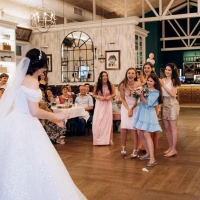
The Housekeeper’s Exit
Chapter 1: The Badge
My name is Henley, and the night everything ended began with a name badge that read, Henley, Housekeeper.
I was standing in the grand lobby of The Pines at Genesee, high in the foothills west of Denver, where the air smells like pine even inside marble halls. The woman at the check-in table slid the badge across the counter like she was passing me a death notice. My mother-in-law, Kora, appeared at my elbow in a champagne silk gown, smiling the way people smile when they finally get to say the quiet part out loud.
“You’re just staff tonight, dear,” she said, loud enough for the circle of hedge fund wives to hear. “No seat at the table, no plate. Family only.”
My husband, Lucas, arrived a moment later, already loosened by whiskey. He looked at the badge clipped to my dress, at the empty space where my chair should have been, and he laughed. A real laugh. Warm and easy. The same one he used when a deal closed in his favor.
“Relax, Hun,” he said, reaching past me for a glass of wine meant for someone else. “Food’s for family.”
Five years of marriage. Three years of waking before dawn to save failing companies while he slept. Eighteen months of quietly rescuing his father’s manufacturing business from bankruptcy so his family name wouldn’t die in shame.
And I wasn’t family enough for a chair.
I reached for the ring he’d put on my finger the day he told me I was the smartest woman he’d ever met. Two carats, chosen more to impress his partners than to please me. The metal was warm from my skin. I slid it off slowly, deliberately, letting the chandeliers catch every facet as it left my hand.
The soft click it made when it touched the linen tablecloth was louder than the string quartet.
“Then I’m no longer yours,” I said. Calm. Clear. Steady enough that the words carried to the farthest tables.
Lucas’s laugh died in his throat. Three hundred of Denver’s wealthiest people suddenly had front-row seats to the exact moment a marriage ended.
I turned and walked out past the valet stands, past the Bentleys and the Range Rovers, past the whispers already starting to spread like wildfire down the mountain. My heels were steady on the gravel. My hands didn’t shake. Not yet.
In the car, driving down the winding road with the city lights flickering on below me, I felt something inside my chest crack wide open. Not rage—not yet. Just a cold, crystalline clarity. They thought they had put me in my place. They had only just handed me the keys to leave it forever.
That was the night I stopped pretending I belonged at their table. And it was only the beginning.
Chapter 2: The Invisible Fixer
I knew it was coming long before the badge. It lived in the small things first.
It was in the way my husband called my consulting firm “your little project,” while I pulled all-nighters turning around restaurants and factories that employed hundreds of people. It was in the way my mother-in-law introduced me as “Lucas’s wife, who keeps busy,” while wearing the diamond earrings I’d paid for after I quietly saved their family business from foreclosure. The way they both smiled when they said it, like the joke was too obvious to need explaining.
I grew up in Pueblo, raised by a single mom who cleaned motel rooms so I could eat. I paid for college waiting tables and studying accounting at night. I learned early that competence doesn’t announce itself with noise. It just keeps the lights on when everyone else is panicking.
That’s what I did for them. I kept the lights on.
A few years ago, when the market crashed the second time, my father-in-law sat in their kitchen and cried because the manufacturing company his grandfather started was weeks from shutting down. Two hundred families were about to lose everything. Lucas was in Aspen closing some private equity deal and “didn’t want to be disturbed.”
So I did it.
I worked sixteen-hour days for eighteen months. I renegotiated union contracts, pivoted production lines, and found buyers for equipment we no longer needed. I did it for pennies compared to what the big firms wanted. I never put my name on anything. I just handed the company back to them—breathing, profitable, alive.
My father-in-law died six months later believing his son had saved it. Lucas never corrected him. He thanked me once in bed, half-asleep, like I’d picked up his dry cleaning. Then he rolled over and told me I should wear more color to the next partner dinner so I didn’t look “so serious.”
I kept the evidence anyway. Not because I thought I’d need it, but because I’m wired that way. Every discrepancy in the private equity fund he managed. Every personal expense slipped into a portfolio company. Every investor dollar rerouted to a vacation, or a watch, or a hotel suite that smelled like someone else’s perfume.
I photographed it. Encrypted it. Stored it in a folder I named Insurance.
I told myself marriage was protection, even from someone’s worst version of themselves.
Then came the night I let myself into our Wash Park townhouse carrying grocery bags and heard Lucas on speakerphone in the bedroom.
“She actually thinks her little consulting gigs matter,” he was saying, laughing that warm, easy laugh again. “The housekeeper badge at Zuri’s engagement party is going to be perfect. Time she learned the difference between real money and playing dress-up.”
My mother-in-law’s voice floated through the speaker, delighted. “Exactly. Help is help, no matter how well-dressed.”
I stood in the hallway holding milk and eggs and felt the last thread of hope snap. I set the bags down without a sound. I walked to my office, opened the Insurance folder, and started compiling the evidence that would end his career.
While they planned my humiliation, I planned their reckoning. And I did it the way I do everything: quietly, thoroughly, and without raising my voice.
Chapter 3: The Black Dress
The week before the party, I stopped sleeping. I’d sit at my desk in the dark, two monitors glowing, spreadsheets open for a failing brewery in Fort Collins, while the Insurance folder waited in the background like a loaded gun.
I’d catch my reflection in the black window and barely recognize the woman staring back. Eyes too wide, mouth set too hard. Someone holding herself together with nothing but willpower and caffeine.
I kept thinking, If I just work harder, save one more company, make one more perfect lemon tart for Thursday dinner, maybe they’ll finally see me.
But they never saw me. They saw what I did for them, never who I was.
Some nights I’d walk through the townhouse after Lucas was asleep and touch the things that were supposed to prove we belonged together. The framed photo from our wedding where he’s looking at the camera and I’m looking at him. The watch I gave him the year I turned the family company around. The closet full of his pressed shirts. I still starched exactly one inch of the collar because that’s what a “good wife” does.
I’d stand there in the quiet and feel the weight of every morning I woke up at five to make his coffee the way he liked it, while I reviewed profit and loss statements for strangers who at least said thank you.
I started crying in the shower so he wouldn’t hear. I cried for the girl from Pueblo who thought love would feel like safety. I cried for the woman who had saved two hundred jobs and still wasn’t family enough for a chair.
I cried because part of me still wanted him to walk in, see me folding his shirts with tears running down my face, and finally ask what was wrong.
He never did.
Instead, the night before the party, he came home late smelling like someone else’s perfume and told me not to overdress tomorrow.
“You don’t want to pull focus from Zuri,” he said, already scrolling his phone. “Keep it simple, Henley.”
I stood in our bedroom doorway holding the black dress I’d chosen. Simple, elegant. The kind you could wear to a celebration or a funeral. I felt something inside me go very still.
I realized I wasn’t protecting him anymore. I was protecting the version of myself who still believed I needed their approval to be whole. That version died quietly that night, somewhere between the smell of Chanel No. 5 that wasn’t mine and the soft click of his phone screen going dark.
When I hung the dress up, my hands didn’t shake. When I opened the Insurance folder again and reviewed the files one final time, I didn’t hesitate. I wasn’t doing this because I was angry. I was doing it because I was finished asking to be seen. And because some debts can only be settled when the people who owe them finally understand what they threw away.
Chapter 4: The Pines at Genesee
The Pines at Genesee sits high above the city, all glass and timber and money pretending to be rustic. That night, the mountain air was sharp, but inside the ballroom, it felt airless.
I arrived alone. Lucas had left hours earlier for “drinks with the guys,” which meant I drove myself up the winding road in silence, the black dress moving against my skin like water.
At the check-in table, the girl hesitated, then slid the badge across.
Henley, Housekeeper.
My mother-in-law was waiting, radiant in champagne silk.
“Perfect,” she said, loud enough for the lobby to hear. “Staff use the side entrance, dear.”
People turned. Phones lifted. Someone whispered, “That’s the one who saved their company, right?”
Another voice answered, “Guess not anymore.”
I clipped the badge to my dress and walked straight into the ballroom. Our table was front and center, close enough to matter, far enough to control the view. Eight place settings. Seven chairs.
I stood beside the empty space they had so carefully preserved and felt three hundred pairs of eyes settle on me like weights.
Lucas arrived twenty minutes later, cheeks flushed from whiskey and triumph. He saw the badge, saw the missing chair, saw his mother’s satisfied smile, and he laughed again. That same warm, easy laugh that used to make me feel safe.
“Relax, Hun,” he said, lifting someone else’s wine. “Food’s for family.”
The room waited for me to shrink. To cry. To run to the bathroom and fix my mascara like a good, embarrassed wife.
I didn’t.
I reached for my ring. I slid it off slowly and set it in the exact center of the empty place setting. The soft click silenced the quartet.
“Then I’m no longer yours,” I said. Just loud enough. Just calm enough.
The laughter stopped like someone pulled a plug.
I turned and walked out. No rushing. No tears. Just the steady click of my heels across marble, past tables of people who would talk about this night for years. Behind me, I heard my mother-in-law hiss, “Lucas, do something!” and his stunned silence in answer.
In the parking lot, the valet tried to hand me my ticket stub with trembling fingers. I smiled at him—small, polite, final—and drove down the mountain alone.
Halfway home, I pulled over on a turnout where you can see the whole city glittering below. I opened the car door, let the cold night in, and finally let myself shake. Not from fear. From relief so sharp it felt like grief.
Then I took out my phone and texted Marcus Reed, my second-in-command.
Execute everything. Tonight.
Three words. That was all it took.
Chapter 5: The Collapse
By the time I reached Wash Park, the first emails were already sent. By morning, the SEC had the files. By noon on Monday, the partners at Lucas’s firm were calling an emergency meeting they would never invite him to again.
I never raised my voice. I never had to. The truth did it for me.
Marcus had been thorough. Every falsified expense report. Every personal charge run through portfolio companies. Every investor dollar diverted to pay for hotel suites and watches and trips to places Lucas claimed were business but smelled like betrayal.
The evidence was ironclad because I’d been collecting it for years—not out of malice, but out of the same instinct that made me keep receipts and backup files for everything. I was an accountant before I was a consultant. I knew that numbers don’t lie, and neither do bank statements.
Lucas’s fall was quieter than anyone expected. There were no screaming matches, no drunken porch scenes. Just a man watching everything he thought defined him disappear. Accounts frozen. Equity seized. Name removed from the letterhead.
He called once, three days after the party. I let it go to voicemail.
“Henley, please. We need to talk. This is insane. You’re my wife. You can’t just—” His voice cracked. “Please call me back.”
I deleted it without listening to the end.
My mother-in-law tried a different approach. She showed up at my office unannounced, wearing sunglasses indoors like grief was a fashion choice.
“You’ve destroyed him,” she said, standing in my doorway like an avenging angel who’d forgotten her wings. “He’s lost everything because of you. His reputation, his career, his future. And for what? Because you didn’t get a seat at one dinner?”
I looked at her for a long moment. “He destroyed himself. I just stopped cleaning up the mess.”
“You’re vindictive,” she hissed. “You always were. I told Lucas you came from nothing, but he thought he could fix you. He thought you’d be grateful.”
“I was grateful,” I said quietly. “Until I realized gratitude was just another word for complicity.”
She left without another word. I heard later that she’d lost the Greenwood Village house, the country club membership, the carefully curated life she’d built on other people’s money. I don’t know where she landed. I stopped keeping track.
Chapter 6: The Sister-in-Law
Months later, on a quiet winter morning with snow dusting the windows of my new LoDo office, Zuri showed up unannounced.
She stood in the doorway wearing a simple wool coat, no designer labels, no three-carat engagement ring. Just my sister-in-law—the only one who ever felt like a sister—holding two paper cups of coffee and eyes that had learned how to look straight at things.
“I left them,” she said, handing me a cup. “For good this time.”
We sat on the floor of my office because the furniture hadn’t arrived yet, backs against the wall, watching snow fall over the city.
She told me everything. How Connor’s startup collapsed two weeks after the engagement party—all those investors discovering the user base was mostly bots, the partnerships fabricated, the projections fantasy. How her mother tried to force her to stay engaged anyway “for appearances.” How she’d finally understood that the people who laughed at my missing chair had never once asked if she was okay when Connor screamed at her for wearing the wrong dress to investor meetings.
“I chose the wrong family,” she said quietly. “I want to choose the right one now.”
I didn’t cry. I just reached over and took her hand.
“You already did,” I said.
That was the day I stopped being the woman who saved everyone except herself. And the day Zuri stopped being the girl who believed love was supposed to hurt.
Chapter 7: The New Table
Nexus Advisory grew faster than I ever imagined. Not because of who I knew in boardrooms, but because word spread about the consultant who could save a business without destroying the people in it.
CEOs started calling from Detroit, Cleveland—places the coasts had written off. Manufacturing plants on the edge of closure. Family restaurants three generations old and one bad quarter from shutting down. They didn’t care where I went to school or who my husband used to be. They cared that I showed up, listened, and fixed what was broken.
Marcus became my COO. Zuri joined after finishing her MBA, specializing in corporate ethics and fraud detection—teaching other women how to spot the quiet kind of betrayal that hides behind charm and expensive suits.
We built something real. Not flashy. Not designed to impress people at country clubs. Just solid, sustainable, honest.
Last I heard, Lucas was living in his childhood bedroom in Colorado Springs, answering phones for someone else’s private equity shop. Not because I kept him from working—I never did that. But because reputation is currency, and his was worthless after the SEC finished their investigation.
He wrote once—a short letter that arrived forwarded from the old townhouse address.
Henley, I know you probably won’t read this, but I need to say it anyway. I’m sorry. Not for the party, though I am. For all of it. For not seeing you. For taking and taking and never asking what you needed. You deserved better than I gave you. I hope you found it.
– Lucas
I read it twice. Folded it neatly. Put it in my desk drawer, not the trash. Not forgiveness exactly. Just acknowledgment that people can grow, even when it’s too late to matter.
Some nights I walk through the office after everyone’s gone home. On the wall between my degree and the first check I ever earned consulting, hangs the housekeeper badge. Professionally framed.
Clients always ask about it. I tell them the truth.
“They tried to tell me where I belonged,” I say. “Turns out they were right. Just not the way they meant it.”
I belong at the table I built myself, surrounded by people who don’t need me to shrink to feel tall. People like Marcus, who stayed when others would have run. Like Zuri, who’s already teaching other women how to value themselves beyond what men decide they’re worth. Like the brewery owner in Fort Collins who sends me a case of his best stout every Christmas because I kept his grandfather’s dream alive.
That empty chair at The Pines at Genesee wasn’t punishment. It was permission.
Permission to stop waiting for people to make room for me and start building my own damn table. Permission to value my work as much as I valued their approval. Permission to finally understand that the only validation that matters is the kind you give yourself.
Epilogue: Five Years Later
Five years after that night on the mountain, I’m standing in a different ballroom. This one’s in downtown Denver, filled with small business owners, nonprofit leaders, and the kind of people who build things rather than just managing other people’s money.
I’m here to accept an award I didn’t ask for—Colorado Small Business Champion of the Year. The plaque is heavy in my hands, the speech I’ve prepared sits folded in my jacket pocket, and for a moment I think about the girl from Pueblo who used to clean her work uniform in motel bathroom sinks.
Zuri is here, sitting at our table with Marcus and his wife, with the brewery owner from Fort Collins, with a dozen other people whose businesses we’ve saved and lives we’ve touched. There’s an empty chair at the table, but it’s not a punishment. It’s for my mom, who passed last year but who got to see me accept the Small Business Administration’s turnaround consultant certification before she did.
As I walk to the podium, I pass a table near the back. Lucas is there with a date I don’t recognize, working for a firm that does community development lending—smaller stakes, but honest work. Our eyes meet for half a second. He nods. I nod back. Not enemies. Just people who used to know each other in a different life.
I unfold my speech at the microphone, but I don’t read it.
Instead, I reach into my other pocket and pull out the housekeeper badge. I hold it up so the room can see.
“Five years ago,” I begin, “someone tried to tell me I wasn’t family. Wasn’t worthy of a seat at their table. Wasn’t deserving of respect.”
The room is silent.
“They were wrong about the family part. But they were right that I didn’t belong at their table.”
I set the badge down on the podium.
“Because I was busy building my own.”
The applause starts slow, then builds. But I’m not listening to it. I’m looking at Zuri, who’s crying and laughing at the same time. At Marcus, who’s grinning like he just closed the deal of a lifetime. At the empty chair that holds my mother’s memory.
Sometimes losing everything isn’t the end. It’s the first time you’re finally free to choose yourself.
And sometimes the people who try to make you small do you the biggest favor of your life—they show you exactly who not to become.
I belong here. At this table. With these people. In this life I built from nothing but competence, integrity, and the willingness to walk away from anyone who couldn’t see my worth.
The housekeeper badge stays on my office wall, a reminder that the worst thing anyone ever did to me became the best thing that ever happened.
Because that empty chair wasn’t punishment.
It was freedom.