The Documents in the Snow
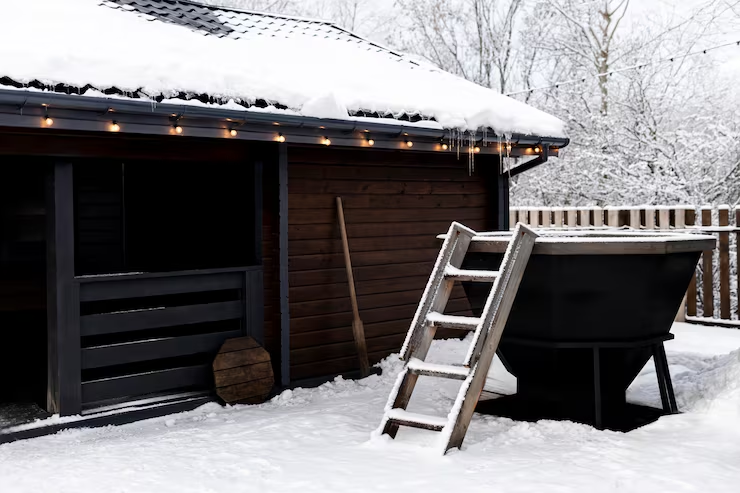
It was minus fifteen degrees. The snow crunched underfoot, the air sliced into my lungs like shards of glass. This dacha was fifty kilometers from the city—no neighbors, no transport, no cell service. The perfect place to dispose of a wife.
I stood there in an old jacket, clutching a folder of documents in my hands, silently watching my husband hurriedly unload a bundle of damp firewood and a sack of grain from the trunk of his black SUV. He did everything quickly, nervously—as if he were afraid to stay near me even one minute longer.
“Here are clothes and food for a week,” he said, throwing a plastic bag onto the snow-covered porch. “I’m flying off on vacation with Irina, and I’m taking the children with me.”
The children were sitting in the back seat. Misha, nine years old, and Katya, seven. They didn’t look at me. Everything had already been explained to them—in his own way. Probably that Mama needed time alone. Probably that Mama was tired and needed rest. Certainly not that Papa was abandoning her in the middle of winter at a remote house with no way to leave.
“I changed the locks in the apartment!” Dmitry shouted from the driver’s seat, his face red with something that might have been guilt or anger or both. “You won’t be able to come home anymore! This is your home now!”
He slammed the door shut. The SUV lurched forward, wheels spinning in the loose snow, sending up white clouds. The car slowly disappeared around the bend between the pines, leaving behind only tire tracks and the smell of exhaust.
I stood there in the brutal cold, watching until the red taillights vanished completely. Then I looked down at the folder in my hands—the one Dmitry thought contained my identification documents, my passport, the deed to this old dacha.
And I smiled.
Because my husband and his mistress had no idea what kind of surprise awaited them at the airport.
The Life Before
My name is Marina Volkov. I’m thirty-four years old, and until three days ago, I believed I had a decent marriage. Not perfect, certainly—Dmitry worked long hours as a regional sales manager for a pharmaceutical company, traveled frequently, came home exhausted. But we had two beautiful children, a comfortable apartment in Moscow, a routine that felt stable if not particularly exciting.
I should have seen the signs earlier. The way he started going to the gym obsessively. The new cologne. The business trips that seemed to multiply. The phone calls he took in another room. But I was busy with the children, with managing the household, with my part-time bookkeeping work that I did from home.
It wasn’t until I found the plane tickets that everything crystallized.
Two weeks ago, I’d been looking for our daughter Katya’s birth certificate for a school registration form. Dmitry kept all our important documents in a locked drawer in his home office, but I knew where he kept the spare key—taped to the underside of his desk, predictable as always.
I found the birth certificate quickly enough. But underneath it was a folder I’d never seen before. Inside were two plane tickets to Phuket, Thailand. Departure date: February 14th. Valentine’s Day. First class seats. Hotels booked. Total cost: nearly 400,000 rubles.
The tickets were in Dmitry’s name and someone named Irina Sokolova.
I sat there in his office chair for a long time, staring at those tickets. My hands were shaking. My vision blurred. Everything I thought I knew about my life rearranged itself in my mind like puzzle pieces that had been forced into the wrong places.
Irina Sokolova. I’d heard that name before. She was a sales representative at Dmitry’s company, a twenty-six-year-old with long blonde hair that she posted constantly on social media. I’d seen her at the company New Year’s party two months ago, laughing too loudly at Dmitry’s jokes, touching his arm when she talked to him.
I’d ignored it then. Told myself I was being paranoid.
I wasn’t paranoid. I was just late to understanding the truth.
I could have confronted him immediately. Could have thrown the tickets in his face, demanded explanations, screamed and cried and made him feel the weight of what he’d done. But something stopped me. Some cold, calculating part of my brain that said: wait. Watch. Understand the full scope of this betrayal before you act.
So I put everything back exactly where I’d found it. And I started paying attention.
Over the next week, I noticed everything. The way he took phone calls from “clients” at odd hours. The way he came home smelling of perfume that wasn’t mine. The way he’d started talking about how the children needed to learn independence, how maybe they should go on more trips with him, how I seemed “stressed” and could probably use some time alone.
He was building a narrative. Preparing everyone for my absence.
The dacha had been his parents’ before they died. It was old, isolated, heated only by a wood stove. We came here occasionally in summer, but never in winter. Last week, Dmitry had suddenly announced we needed to winterize it, make sure the pipes hadn’t frozen, check on the property.
“You should come with me,” he’d said casually. “Get away from the city for a bit. Clear your head.”
I’d agreed. Because by then I understood what he was really planning.
He was going to leave me here. In the middle of winter. In the middle of nowhere. Take the children, change the locks on our apartment, go on vacation with his mistress, and by the time I managed to get back to Moscow—if I could get back—everything would be different. Our accounts would be emptied. Our apartment would be locked. My access to our children would be through lawyers and courts, if at all.
He would remake his life with Irina while I was trapped fifty kilometers from civilization with no phone service and minimal supplies.
It was a clean plan. Almost elegant in its cruelty.
But Dmitry made one critical mistake.
He didn’t search my bags when I packed for this trip to the dacha.
The Night Before
The night before we left, I waited until he was asleep. The apartment was dark and quiet. I could hear his snoring from the bedroom—the deep, unconscious breathing of someone who thought everything was going exactly according to plan.
I went to his office. Found his travel bag, already packed for Thailand. His passport was there, along with Irina’s travel information, their tickets, hotel confirmations, a stack of cash in various currencies, his credit cards, his driver’s license—everything he’d need for the trip.
I took it all. Every single document. Every card. Every piece of identification.
I replaced them with blank paper stuffed into the passport cover to give it weight. Put everything back in his bag exactly as I’d found it. Then I took all his documents and wrapped them carefully in plastic, sealing them in a waterproof freezer bag.
The next morning, we drove to the dacha. Dmitry was cheerful, talking about the Valentine’s trip with the children, explaining how educational it would be for them. Misha and Katya were excited—they’d never been on an international trip before.
“What about Mama?” Katya had asked from the back seat.
“Mama needs some alone time,” Dmitry said smoothly. “She’ll be fine at the dacha. It’ll be good for her.”
I said nothing. Just looked out the window at the passing landscape, the waterproof bag hidden in my coat pocket.
When we arrived at the dacha, Dmitry immediately started his performance. The bag of old clothes. The damp firewood. The sack of grain—as if I were some kind of farm animal being left to fend for itself. The announcement about changing the locks. The dramatic exit.
And then he was gone, and I was alone in the snow.
I picked up the plastic bag of clothes he’d thrown on the porch. Inside were my oldest sweaters, worn jeans, thermal underwear. Nothing fashionable. Nothing that would allow me to present myself professionally if I somehow made it back to Moscow.
The sack of grain turned out to be buckwheat and rice—basics that would keep me alive but hardly comfortable. The firewood was barely enough for three days if I was careful.
He’d calculated everything. Just enough to keep me from freezing to death immediately, but not enough to be comfortable. Not enough to make escaping easy.
I carried everything inside. The dacha was freezing. My breath formed clouds in the air. The old wood stove sat cold and empty in the corner of the main room.
I should have felt panic. Should have felt despair. Should have felt the crushing weight of betrayal.
Instead, I felt calm. Focused. Almost amused.
The Waiting Game
I lit the stove, watching the flames catch on the newspaper and kindling. The heat spread slowly through the small space. I made tea using melted snow and sat down at the rough wooden table with the folder I’d been holding—the one Dmitry thought was mine.
Inside was every document he would need at the airport. His passport. His tickets. His money. His cards.
I spread them out carefully on the table, admiring my handiwork. Then I took out my phone—no service, as expected—and waited.
The flight to Thailand was scheduled to leave at 11:45 p.m. from Sheremetyevo Airport. Dmitry would want to arrive at least two hours early for an international flight. That meant he’d get there around 9:30 or 9:45.
Check-in would be easy enough. He’d use the electronic kiosk, scan his ticket, print his boarding pass. The children would be excited, asking questions, looking at the departure boards. Irina would be there in her expensive clothes, her designer luggage, playing the part of the sophisticated mistress who’d won the prize.
They’d go through security. The children would go first, their Russian passports sufficient for the trip. Then Irina.
Then Dmitry would reach for his passport.
And his whole world would collapse.
I sipped my tea and checked my watch. 7:15 p.m. They’d be driving to the airport now. Dmitry would be excited, talking about the resort, the beaches, the adventures they’d have. The children would be tired but wired with anticipation. Irina would be checking her makeup, posting subtle pre-vacation selfies.
None of them knew.
By 8:00 p.m., the snow was falling harder. I added more wood to the stove and ate some of the rice I’d cooked. The dacha was warming up slowly, becoming almost cozy. Outside, the darkness was complete—no streetlights, no houses, nothing but wilderness and snow.
I tried my phone again. Still no service. But I wasn’t worried. I had time.
At 9:45 p.m., I imagined them arriving at the airport. The excitement. The bustle. Dmitry parking in the expensive lot, pulling out the luggage, Irina linking her arm through his while the children ran ahead toward the bright terminal.
At 10:15, they’d be at the check-in kiosks. Tickets scanned. Boarding passes printed. Everything going smoothly.
At 10:30, they’d be at security. That’s when it would happen.
I closed my eyes and pictured it: the security officer asking for his passport. Dmitry reaching into his bag confidently. Opening the passport cover. Finding blank paper.
The confusion. The panic. The growing horror as he searched through his bag, through his pockets, through everything, finding nothing.
The security line backing up behind him. Other passengers growing impatient. Irina’s face changing from anticipation to irritation to cold anger as she realized what was happening.
The children asking questions: “Papa, what’s wrong? Why can’t we go?”
The security officer explaining that without proper identification, he couldn’t board an international flight. That he’d need to step aside. That he was holding up the line.
The Call
At 11:00 p.m., my phone finally rang.
The signal was weak but present—must have been the weather conditions shifting, creating a temporary window of connectivity. I let it ring three times before answering.
“Where are you?!” Dmitry’s voice was shaking with rage. “Where are my documents?!”
I could hear everything in the background. The noise of the airport. Flight announcements. The hysterical whisper of a woman—Irina—saying something sharp and angry. The confused voices of my children.
“What are you talking about?” I asked calmly.
“There’s NOTHING in the folder! My passport, money, cards—EVERYTHING IS GONE!” He was almost screaming now. “What did you do?!”
I took a sip of my tea, letting the silence stretch.
“What did I do?” I repeated slowly. “I think you mean, what did you do, Dmitry? You drove your wife to a remote house in the middle of winter. You left her with barely any supplies. You changed the locks on your shared apartment. You took her children away. You planned to abandon her while you vacationed with your mistress.”
He went silent. I could hear him breathing hard.
“Has Irina already passed security?” I asked pleasantly.
The silence deepened. That silence was sweet.
“She’s flying alone,” he finally hissed. “The tickets were non-refundable. She… she said she couldn’t wait. That I should have been more prepared. She’s already at the gate.”
I almost laughed. Of course Irina had abandoned him. She’d wanted a vacation with a successful man, not a crisis at airport security with two confused children and a partner who couldn’t even manage his own documents.
“And the children?” I asked.
“They’re here with me. They’re asking questions. They don’t understand. Marina, you can’t do this—”
“I can’t do this?” My voice remained calm but something sharp entered it. “You tried to dispose of me. You tried to trap me. You tried to take my children away and start a new life. And now you’re upset because I’m not making it easy for you?”
“Where are you? Where are my documents?”
I looked at the dark window, at the snow falling silently in the blackness.
“I’m exactly where you left me,” I said. “The documents are here too. Come and get them if you want them.”
I hung up.
For a moment, I sat there in the warm dacha, feeling the satisfaction settle over me like a blanket. Then I went to the bag I’d packed secretly—the one Dmitry hadn’t searched. Inside were my actual passport, my wallet, my credit cards, my phone charger, warm clothes, food I’d brought, and most importantly: a copy of the deed to this dacha in my name only.
Dmitry’s parents had left it to both of us, but I’d gone to the notary two years ago to have the paperwork officially transferred solely into my name. Dmitry had signed it without reading carefully, thinking it was just routine property maintenance documentation.
This place was mine. Legally, completely mine.
I also had copies of our bank statements showing every purchase for this “vacation”—the flights, the hotels, all paid from our joint account. Screenshots of Dmitry’s text messages with Irina that I’d recovered from the cloud backup he didn’t know I had access to. A recording of him explaining to the children that Mama “needed alone time” while they went on an “educational trip” with Papa’s “colleague.”
Evidence. Documentation. Proof of abandonment, adultery, misuse of marital funds, and attempted isolation of a spouse.
I plugged my phone into the portable battery pack I’d brought and opened my email. The message I’d drafted three days ago was still there, ready to send. It was addressed to my lawyer, Svetlana Petrova—a sharp, ruthless divorce attorney I’d consulted quietly last week.
The email contained everything. All the evidence. All the documentation. Instructions to file for divorce immediately, to freeze all joint accounts, to file for emergency custody of the children, to pursue charges of spousal abandonment.
I hit send.
Then I sent another email to my sister in Moscow, who I’d arranged to stay with. She was expecting me. She had a spare room ready. She’d already contacted a locksmith who could get me back into my apartment if needed.
I wasn’t trapped here. I’d never been trapped.
I’d chosen to come here, chosen to let Dmitry think his plan was working, because I needed him to act. I needed him to fully commit to his betrayal, to document it with his own actions, to trap himself completely.
And he had.
The Return
Around midnight, I heard a car engine in the distance. Headlights cut through the darkness, growing brighter. A vehicle was approaching the dacha.
Dmitry had come back.
I wrapped Dmitry’s documents carefully in a plastic bag and placed them on the porch, right where he’d left my bag of clothes. Then I locked the door from the inside and waited.
The SUV pulled up, engine still running. I heard the car door slam, heard boots crunching through the snow. Dmitry’s voice calling my name, angry and desperate.
“Marina! Marina, open the door! I need my passport! The children are freezing in the car!”
I looked out the window. Misha and Katya were indeed in the back seat, looking tired and confused. They shouldn’t be out in this cold. But that was Dmitry’s choice, not mine.
I opened the window slightly—just enough to speak through.
“The documents are on the porch,” I said. “In the plastic bag where you can see them.”
Dmitry ran to the porch, grabbed the bag, tore it open. I watched his face as he verified everything was there. The relief. Then the anger as he realized I’d had them all along.
“You bitch,” he snarled. “You planned this. You wanted me to fail.”
“No,” I said calmly. “You planned to abandon me. I just made sure you couldn’t. There’s a difference.”
“Let me in. We need to talk about this—”
“There’s nothing to talk about. You can leave now. Go home to the apartment you changed the locks on. Except you won’t be able to get in, because I had my sister call a locksmith an hour ago. The locks are changed again, this time with only my name on the authorization. You’ll find your belongings in storage unit 247 at the Public Storage on Leninsky Prospekt. The key is in the mailbox.”
His face went pale. “You can’t do this. This is my home—”
“It’s my home. I paid half the mortgage with my bookkeeping income. I maintained it. I raised our children there. And you just forfeited your right to it when you tried to dump me in the wilderness.”
“The children need their father—”
“The children need a father who doesn’t abandon their mother. My lawyer has already filed emergency custody papers. You’ll get supervised visitation until the divorce is settled. If you cooperate, it might become shared custody. If you fight me, I have enough evidence of abandonment to ensure you get very little.”
I could see him calculating, seeing his options collapse one by one.
“Marina, please—”
“Take the children home,” I said. “Take them to your mother’s house. She’ll take care of them tonight. Tomorrow, you’ll receive official documentation about the divorce proceedings. I suggest you hire a lawyer.”
“How are you even getting back to Moscow?” he asked, and there was something almost pitiful in his voice. “You’re stuck here. You have no car—”
“I’m not stuck. My sister is picking me up in the morning. I have everything I need. Unlike you, I actually planned ahead.”
I closed the window.
Dmitry stood there in the snow for a long moment. Then he walked back to the SUV, got in, and drove away. I watched the taillights disappear into the darkness for the second time that night.
But this time, I wasn’t the one being abandoned.
Morning After
I slept surprisingly well that night. The wood stove kept the dacha warm, and I was wrapped in the good sleeping bag I’d secretly brought. In the morning, the snow had stopped. The world outside was pristine white, peaceful, almost beautiful.
My sister Olga arrived at 10:00 a.m. in her reliable sedan, chains on the tires for the snowy roads. She’d brought hot coffee, fresh pastries, and a fierce hug.
“Are you okay?” she asked, searching my face for trauma.
“I’m fine,” I said. And I meant it.
We drove back to Moscow together. On the way, my phone filled with messages as we got back into cell range. Some from Dmitry—angry, pleading, threatening in turns. Some from his mother, demanding to know what was happening. Some from my lawyer with updates on the legal proceedings.
And one from an unknown number. I opened it cautiously.
This is Irina. I just want you to know that I had no idea he was married. He told me he was divorced. When I found out the truth at the airport, I left immediately. I’m sorry for my part in this. You deserve better.
I stared at that message for a long time. Part of me wanted to be angry at her, but I couldn’t quite manage it. She’d been lied to as well. Dmitry had deceived both of us, just in different ways.
I didn’t respond. There was nothing to say. Her apology didn’t undo anything, but at least she’d had the courage to offer it.
By the time we reached Moscow, the reality of my situation was becoming clear. I was about to be a single mother, fighting for custody, rebuilding my life from scratch. It would be hard. It would be exhausting. There would be court dates and lawyer fees and difficult conversations with my children.
But I wasn’t scared.
Because I’d already survived the worst thing Dmitry could do to me. I’d survived his betrayal, his cruelty, his attempt to erase me from my own life. And not only had I survived—I’d turned his own plan against him.
Olga pulled up in front of my apartment building. The locks were changed, just as I’d arranged. My key worked perfectly.
“Thank you,” I said, hugging my sister. “For everything. For believing me. For helping me.”
“Always,” she said. “Now go rest. Tomorrow we start fighting for real.”
I went upstairs to my apartment—my apartment now, not ours. The space felt different. Emptier without Dmitry’s presence, but also cleaner. Freer. The air was easier to breathe.
The Legal Battle
I spent the rest of the day organizing. I gathered every piece of evidence I had—the bank statements, the screenshots, the emails, the recording. I prepared a detailed timeline of events for my lawyer. I documented everything Dmitry had said and done, everything that proved his intention to abandon me.
That evening, my lawyer called.
“I’ve reviewed everything you sent,” Svetlana said. “It’s excellent documentation. Very thorough. We have a strong case for divorce based on adultery and abandonment. The emergency custody hearing is scheduled for next week. Based on what you’ve provided, I’m confident we can demonstrate that you’re the stable parent and he’s a flight risk.”
“And the apartment?” I asked.
“Since the deed has your name and you can prove you’ve been contributing to the mortgage, you should be able to keep it in the divorce settlement. Especially given his actions last night—attempting to lock you out constitutes illegal eviction. We can use that.”
After we hung up, I sat in the quiet apartment and let myself feel everything I’d been holding back. The anger. The grief. The betrayal. The sadness for my children, who would grow up in a broken home because their father had chosen selfishness over family.
But underneath all of that was something stronger: relief.
I’d taken control of my own story. I’d refused to be the victim of someone else’s cruelty. I’d fought back with intelligence and planning rather than just emotion. And I’d won.
The next few months were exactly as hard as I’d anticipated. The custody battle was brutal. Dmitry hired an expensive lawyer who tried to paint me as vindictive and unstable. They brought up the incident at the dacha, trying to spin it as evidence of my psychological manipulation.
But the facts didn’t support their narrative. I had documentation proving Dmitry had deliberately driven me to a remote location and abandoned me there with minimal supplies. I had his own text messages discussing his plans with Irina. I had bank records showing he’d spent marital funds on a vacation with another woman. I had testimony from Olga about receiving my call for help.
Most damaging of all, I had the children’s own statements. In private sessions with the court-appointed child psychologist, both Misha and Katya confirmed that Papa had told them Mama “needed to stay at the old house” while they went on vacation. They described how Papa had seemed angry and rushed when he dropped Mama off. They talked about how confused they’d been when they couldn’t fly to Thailand.
The judge was not sympathetic to Dmitry.
The final custody arrangement gave me primary custody with Dmitry receiving visitation every other weekend, provided he attended co-parenting classes and therapy. The apartment stayed in my name. The divorce settlement required him to pay child support and reimburse me for half the money he’d spent on the Thailand trip.
It wasn’t perfect. It wasn’t the family I’d imagined having. But it was justice, and that was enough.
One Year Later
A year later, I was standing in the kitchen of my apartment—my apartment—making dinner for my children. Misha was helping me chop vegetables, talking about his school day. Katya was at the table doing homework, her math book open, her tongue sticking out in concentration the way it always did when she was thinking hard.
This was my life now. Smaller than before, but also fuller. More honest. Built on truth rather than on the lies I’d been living without knowing it.
My bookkeeping business had grown. I’d started taking on more clients, building a reputation for reliability and attention to detail. The money wasn’t amazing, but it was enough. We were comfortable. More than comfortable—we were happy.
Dmitry saw the children every other weekend. He’d moved in with his mother after the storage unit incident. Irina had indeed left him—I’d heard through mutual acquaintances that she’d gone back to dating other men from the company, apparently having learned her lesson about married co-workers.
Sometimes Misha and Katya asked questions about what had happened. Why Papa didn’t live with us anymore. Why that night at the airport had been so strange. Why everything had changed.
I told them the truth, adjusted for their ages. That Papa had made some bad choices. That he’d hurt Mama and broken their family. That sometimes adults make mistakes that have big consequences. But that Papa still loved them, even if he and Mama couldn’t be together anymore.
They seemed to understand. Children are more resilient than we give them credit for.
On the anniversary of that night at the dacha, Olga came over for dinner. We opened a bottle of wine after the children went to bed, and we sat in the living room talking.
“Do you ever regret it?” she asked. “The way you handled everything? Some people would say you should have confronted him directly, given him a chance to explain.”
I thought about it for a moment, swirling the wine in my glass.
“No,” I said finally. “I don’t regret it. If I’d confronted him, he would have lied. He would have denied it, or made excuses, or convinced me to give him another chance. And then he would have been more careful next time. He would have hidden his tracks better. Eventually, he would have left anyway, but I would have been in a weaker position to fight back.”
“So you waited. You let him trap himself.”
“I waited. I documented everything. I let him commit fully to his plan so there could be no doubt about his intentions. And when the moment came, I used his own cruelty against him.”
Olga raised her glass. “To surviving. And to fighting smart.”
I clinked my glass against hers. “To fighting smart.”
Reflections
Later, after Olga left, I stood at my window looking out at the Moscow night. The city lights stretched out endlessly, millions of lives being lived, millions of stories unfolding.
This was my story. Not the one I’d planned when I married Dmitry twelve years ago. Not the one I’d imagined when I first held my babies. But mine nonetheless.
I’d been left in the snow by someone who was supposed to love me. I’d been abandoned, dismissed, treated as disposable.
But I hadn’t let that be the end of my story. I’d refused to be a victim. I’d fought back with intelligence and planning and careful documentation. I’d turned his trap into his downfall.
And I’d survived.
More than survived—I’d built something new. Something honest. Something that belonged only to me and my children.
The documents that had been meant to free Dmitry from his marriage had instead freed me from a man who didn’t deserve me. The cold that was supposed to break me had instead hardened my resolve. The isolation that was meant to trap me had given me clarity.
Sometimes the best revenge isn’t loud or dramatic. Sometimes it’s quiet and calculated. Sometimes it’s simply refusing to be destroyed by someone else’s cruelty.
I turned away from the window and went to check on my children one last time before bed. Misha was sleeping with one arm thrown over his head, his face peaceful. Katya had kicked off her blankets as usual, and I covered her gently.
These were the people who mattered. This was the life worth fighting for.
And I had fought. And I had won.
Not because I’d destroyed Dmitry—though his reputation had certainly suffered when word got around about what he’d done. Not because I’d taken revenge in some dramatic, satisfying way.
But because I’d refused to let his cruelty define me. I’d taken control of my own story. I’d protected my children and myself. I’d demanded justice and received it.
The documents in the snow had been more than just passports and tickets. They’d been symbols of power, of control, of one person trying to erase another person from their life.
But you can’t erase someone who refuses to disappear.
You can’t destroy someone who knows their own worth.
And you certainly can’t abandon someone who’s already ten steps ahead of you.
As I closed the children’s bedroom door and walked back to my own room, I felt something I hadn’t felt in years: peace.
Real, genuine, hard-won peace.
The kind that comes not from the absence of struggle, but from surviving it. From facing the worst someone can do to you and coming out stronger on the other side.
I climbed into bed, set my alarm for the morning, and closed my eyes.
Tomorrow would bring new challenges. But tonight, I could rest knowing that I’d fought for myself and won.
The snow had long since melted. Spring was coming. And I was ready for whatever came next.