The Shoes
It began with the shoes.
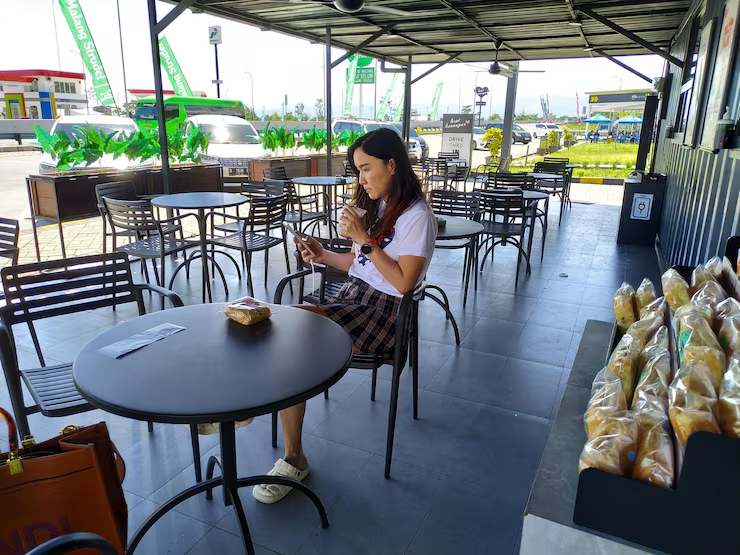
They were cheap canvas sneakers, gray with grime, the rubber soles peeling away from the fabric at the toe. I stared at them, trying to reconcile the image with the memory of the Italian leather boots I had bought my daughter for her thirtieth birthday. My gaze traveled up the frayed hem of the black trousers, past the faded green apron of the Grocery Outlet, to the nametag that hung crookedly from a safety pin.
Sophia.
She was sitting alone at a laminate table in the food court of the Westfield Mall, counting out nickels and dimes to pay for a small black coffee.
I almost walked past her. My daughter, who drove the pearl-white Highlander I’d helped her negotiate two years ago. My daughter, the registered nurse who used to send me selfies from brunch with her polished, handsome husband.
Now, she looked like a ghost haunting the neon-lit purgatory of a Wednesday afternoon mall. Her hair, usually a glossy chestnut curtain, was pulled back in a messy bun that hadn’t seen a brush in days. Her skin was the color of parchment.
“Sweetheart?”
The word stuck in my throat, scratching like broken glass. I walked up to the table, my shadow falling over her meager pile of coins.
Sophia flinched. It wasn’t a start of surprise; it was the physical recoil of a frightened animal. She looked up, and the devastation in her eyes nearly brought me to my knees. The dark circles were bruises against her pale skin.
“Mom?” She tried to smile, but her lip trembled, ruining the illusion. She swept the coins into her palm, hiding them. “What are you doing here?”
“I was meeting a client,” I lied smoothly. I had been retired for three years, but old habits of evasion were useful now. I slid into the plastic chair opposite her. “Where’s Emma? It’s Wednesday. Isn’t she usually with you on your day off?”
My four-year-old granddaughter. The light of my life.
Sophia’s gaze darted toward the mall entrance, her pulse visible in the hollow of her throat. “Emma’s with Richard and his mother. Diane wanted to take her to the park. A picnic.”
“And you didn’t go?”
“I… I had errands.”
“Errands,” I repeated, glancing at the empty chair beside her. “Where is your car, Sophia? The Highlander?”
Her smile faltered, shattering completely. She looked down at her coffee, the steam rising between us like a barrier. “Richard needed it for work. His truck broke down last month. The transmission.”
“For a month?” I kept my voice level, the same tone I used when cross-examining a hostile witness during my thirty-three years as a real estate attorney. “So, how did you get here?”
“The bus.” She shrugged, a jerky, unnatural motion. “It’s fine, Mom. Saves on gas. Helps the environment.”
“Sophia.” I reached across the table and covered her hand with mine. Her skin was ice cold, despite the sweltering California afternoon. “Look at me.”
She didn’t want to. She fought it. But eventually, she lifted her eyes.
“You’ve lost weight. You look exhausted. You’re wearing a uniform for a job you never told me you had. You’re a nurse, Sophia. Why are you bagging groceries?”
She pulled her hand back as if I had burned her. “I picked up extra shifts. Nursing is… stressful right now. I just needed a break. I really have to go, Mom. I have to catch the three-fifteen bus.”
She stood up abruptly, her chair screeching against the tile.
“I’ll drive you,” I said, standing with her.
“No!” The word exploded out of her, sharp and panicked. She flinched again, lowering her voice. “No, Mom. Please. The bus is fine. I like the downtime.”
We stood there in the middle of the food court, surrounded by the banal noise of families eating pizza and teenagers laughing. But in the space between us, the air was vibrating with terror. My daughter looked at me with eyes that were begging me to stop, to look away, to let the lie stand.
But I am Helen Mitchell. I didn’t spend three decades dismantling fraudulent contracts and exposing liars to let my own daughter disappear before my eyes.
“Sit down,” I said. I used my Mother Voice—the one that could stop a toddler or a judge in their tracks. “Sophia Marie, sit down. I am buying you lunch, and you are going to eat it.”
She hesitated, her body poised for flight. Then, the fight drained out of her, and she sank back into the chair.
Chapter 1: The Truth
I went to the Chinese counter and ordered enough food for three people. When I returned, she was staring at her phone, her thumb hovering over the screen, terrifyingly still.
“He’s checking up on you, isn’t he?” I asked, placing the tray down.
She didn’t answer. She just picked up the chopsticks and began to eat. She ate mechanically, quickly, with the desperate hunger of someone who hadn’t seen a full meal in days.
“Talk to me,” I commanded softly. “Your father and I didn’t raise a liar.”
She stopped chewing. She put the chopsticks down. And finally, the dam broke.
“Mom, I can’t,” she whispered, tears spilling over her lashes. “If I tell you, it will make everything worse. Diane… she has a lawyer. She told me she has a file ready.”
“A file?”
“She says I’m an unfit mother because I work too much. She says if I try to leave, or if I tell anyone what’s happening, she’ll take Emma. She promised me, Mom. She said I’ll never see my daughter again.”
The noise of the mall faded into a dull roar. The only thing I could hear was the pounding of my own heart, a war drum calling me to battle.
“When did this start?” I asked, my voice terrifyingly calm.
Sophia wiped her face with a rough napkin. “Six months ago. Richard said he lost his job. I don’t even know if that’s true anymore. Everything is a haze of lies.”
She took a shaky breath. “Diane convinced him that we should move in with her to ‘save money’ until he got back on his feet. The day we moved out of our house on Maple Street, Richard changed the locks behind my back. He told me he rented it out. He said the checks go into an account to pay the mortgage, but I’ve never seen a penny.”
I narrowed my eyes. “The house is in both your names. I drafted the deed myself.”
“He told me I signed a waiver,” she said, looking down. “He put a stack of papers in front of me one night when I was coming off a twelve-hour shift. He said it was for insurance. I just signed, Mom. I trusted him.”
“And the money?”
“They took my credit cards first. Diane said I was ‘reckless’ with spending. Then Richard took my car keys. Then… then they made me set up a direct deposit for my nursing checks into a ‘family trust’ Diane controls. They give me twenty dollars a week cash allowance.”
My fingernails dug into the plastic tray. “Twenty dollars?”
“That’s why I took the grocery job,” she confessed. “They don’t know about it. It’s the only money I have access to. I hide it in my locker at work. But last month, Diane went through my purse. She found forty dollars. She told Richard I was stealing from the family. They… they locked me out of the house for three days.”
“Locked you out?”
“I sleep in the garage, Mom.”
The words hung in the air, heavy and toxic.
“Where?” I asked, though I didn’t want to know the answer.
“The detached garage. They gave me an air mattress and a space heater. Diane says I can’t sleep in the main house until I prove I can be ‘financially responsible.’ Emma’s room is upstairs. I can only see her when Diane allows it. Usually just an hour before bed, if I’ve done my chores.”
“Chores?”
“I clean the house. I do the laundry. If I don’t, I don’t see Emma.”
“Did you go to the police?”
She let out a broken, hysterical laugh. “I went three weeks ago. The officer at the desk asked if he hit me. I said no. He said since Richard is my husband and I signed the papers granting access to the accounts, it’s a ‘civil matter.’ He told me to get a lawyer.”
“And you have no money for a lawyer.”
“I can barely afford the bus fare, Mom. I’m trapped. Diane takes pictures of the garage. She’s documenting it to show the court that I chose to live there. She’s twisting everything. I’m so tired. I can’t think straight.”
I looked at my daughter—this shell of a woman who had been ground down to dust by two sociopaths—and I felt a cold, hard resolve settle over me. It wasn’t anger. Anger is hot and messy. This was ice.
“Listen to me,” I said, leaning forward. “I need you to do exactly what you’ve been doing. Go back to the garage. Act obedient. Don’t tell Richard or Diane about this lunch. Can you do that?”
“Why?” Panic flared in her eyes. “Mom, you can’t go over there. They’ll punish me.”
“I’m not going over there,” I promised. “Not yet.”
“What are you going to do?”
I smiled. It was a smile I used to wear when I found a loophole that would bankrupt a corrupt developer.
“I was a real estate attorney for thirty-three years, Sophia. Do you know what I specialized in?”
She shook her head.
“Fraud,” I said. “Coercion. Undue influence. I have dismantled men far smarter and wealthier than Richard Reynolds. They think they’re playing a game of chess with a pawn. They don’t realize the Queen just entered the board.”
She grabbed my hand. “Diane is mean, Mom. She’s cruel.”
“Sweetheart,” I said, squeezing her fingers. “So am I.”
Chapter 2: The Investigation
The next morning, I didn’t drink coffee. I drank adrenaline.
I made three calls before eight o’clock.
The first was to Margaret Chen, my former paralegal who now ran the office for the most ruthless family law attorney in Los Angeles County.
“Margaret,” I said. “I need a war room. And I need Catherine Park.”
“Helen?” Margaret’s voice warmed. “Is everything okay?”
“No. I need you to pull property records for a house on Maple Street. And then I need an emergency appointment.”
The second call was to James Rodriguez, an ex-cop turned private investigator who owed me a favor for keeping his brother out of jail in ’98.
“James,” I said. “I need surveillance. High priority. Financial fraud, child endangerment, and evidence of living conditions.”
“Name the target, Helen.”
The third call was to the bank where I had helped Sophia open her original savings account ten years ago. As a cosigner on that original document—which Richard had likely overlooked—I still had query access.
By noon, the picture was clear, and it was damning.
That evening, I sat in my sedan two houses down from Diane’s McMansion in Sherman Oaks. The house was a testament to nouveau-riche bad taste—too many columns, too much stucco.
At seven forty-five, I saw Sophia’s white Highlander pull into the driveway. Richard stepped out, wearing a suit, looking fed and happy. He walked through the front door.
Twenty minutes later, the garage door rolled up halfway.
I raised my camera, the telephoto lens zooming in. The image on the viewfinder made bile rise in my throat.
It was a cement box. There was a heap of blankets in the corner on a deflated air mattress. A plastic bin served as a table. And there was Sophia, sitting on the cold floor, eating a sandwich out of a paper wrapper under the harsh glare of a single exposed lightbulb.
My daughter. Living like a stray dog in the home of the woman who stole her life.
I took photos. I took videos. I zoomed in on the extension cord running to the space heater—a blatant fire code violation.
Then I called James. “Accelerate the timeline. I need the bank trace by tomorrow morning.”
Chapter 3: The Evidence
The next week was a blur of calculated devastation.
Margaret discovered that the house on Maple Street was indeed still in both names. The “waiver” Sophia signed was a forgery—and a bad one. Richard had rented the house out for forty-two hundred dollars a month. That money was flowing into a private account in his name only. That was theft of marital assets.
James delivered the coup de grâce. He had audio from a directional microphone aimed at the backyard.
Diane’s voice, shrill and piercing: “Your mother doesn’t want to see you, Emma. She prefers sleeping in the garage because she doesn’t love us enough to behave.”
Emma’s voice, small and crying: “I want Mommy.”
Parental alienation. Emotional abuse.
I met with Catherine Park on Thursday. She reviewed the binder of evidence I had compiled—the photos, the bank ledgers, the forged deed, the transcripts.
Catherine closed the binder and looked at me. “Helen, this isn’t just a divorce case. This is systematic exploitation. We have fraud, forgery, larceny, child endangerment, and coercive control. We can get an emergency order for custody today.”
“No,” I said, staring at the photo of Sophia in the garage. “Not today. Tomorrow is Friday. I want them in the room. I want to see their faces when the walls fall down.”
“It’s risky,” Catherine warned.
“It’s necessary,” I countered. “Sophia needs to see them break. She needs to see that they aren’t gods. They’re just criminals.”
I texted Sophia one instruction: Wear the black dress. Meet me at the courthouse at 8:00 AM. Do not say a word to them.
Chapter 4: The Confrontation
Friday morning broke with the crisp, unforgiving light of judgment.
I picked Sophia up at the corner bus stop near Diane’s house. She was shaking, wearing the black dress that hung loosely on her skeletal frame.
“Mom,” she hyperventilated. “Diane knows I’m gone. She’s blowing up my phone.”
“Turn it off,” I said. “We’re done answering to her.”
We walked into the Los Angeles Superior Court hallway at eight forty-five. Richard and Diane were already there, flanked by a young, ill-fitting lawyer who looked like he had graduated law school fifteen minutes ago.
Richard looked shocked. Diane looked murderous.
“What is the meaning of this?” Diane hissed, marching toward us, her heels clicking aggressively on the marble. “Sophia, you get in the car right now. You are in serious trouble, young lady.”
Sophia flinched, stepping behind me.
I stepped forward, blocking Diane’s path. I am five-foot-four, but in that moment, I felt ten feet tall.
“Step back, Diane,” I said softly.
“Excuse me?” Her eyes bulged. “Who do you think—”
“I said step back,” I repeated, my voice hardening into steel. “Or I will have the bailiff arrest you for harassment within thirty seconds.”
“Actually,” Catherine Park stepped out from behind us, smoothing her blazer. “We’re going to do this in Conference Room B. My client has filed for an emergency dissolution of marriage and immediate sole custody.”
“Your client is broke!” Richard laughed nervously. “She can’t afford you.”
“Her mother can,” I said, locking eyes with him. “And her mother has spent the last two weeks documenting every single felony you’ve committed.”
We moved into the conference room. We sat on one side; they sat on the other. Their lawyer looked bored—until Catherine opened the binder.
She laid it out like a royal flush.
The photos of the garage. The timestamped video of Sophia eating on the floor. The bank records showing the stolen rental income. The forged deed with the handwriting expert’s affidavit attached. The transcripts of Diane telling a four-year-old her mother didn’t love her.
“This is…” Richard’s lawyer picked up the photo of the garage, his face draining of color. He looked at his clients. “Is this accurate? Is she living in your garage?”
“It’s a guest suite!” Diane sputtered. “She chose it! She’s mentally unstable!”
“We have a psych evaluation from yesterday,” Catherine interjected. “Sophia is sound. Exhausted, malnourished, and traumatized by abuse, but sound. You, however, Mrs. Reynolds, are on tape committing child abuse.”
“That’s a lie!” Diane shrieked.
“It’s on tape,” I said. “James Rodriguez is very thorough.”
Catherine leaned forward. “Here is the offer. You sign over full legal and physical custody of Emma to Sophia immediately. You vacate the house on Maple Street by noon today. You return the car. You repay the twenty-four thousand dollars in stolen rental income plus the fifteen thousand you siphoned from her nursing wages.”
“Or what?” Richard sneered, though his hands were trembling.
“Or,” I said, sliding a manila envelope across the table, “I walk down the hall to the District Attorney’s office. I have already drafted the criminal complaint. Fraud. Forgery. Grand larceny. False imprisonment. Child endangerment.”
I looked at Richard. “You’ll do five years, minimum. Diane will likely do three as an accomplice. And Emma will go into the foster system until Sophia gets her back.”
The room went silent. The hum of the air conditioner sounded like a jet engine.
Their lawyer closed his file. He turned to Richard and Diane.
“Sign the papers,” he said quietly. “Right now.”
“But—” Diane started.
“Sign them,” the lawyer snapped. “Or I’m walking away, and you’re going to jail.”
Richard looked at his mother. Then he looked at Sophia. For the first time, he saw her not as a victim, but as a survivor standing behind a fortress.
He picked up the pen.
Chapter 5: Going Home
We left the courthouse at eleven-thirty with a court order signed by a judge.
The drive to Diane’s house was silent, but it was the silence of decompression. We had a police escort—two officers following us to ensure the “civil standby” went smoothly.
When we pulled into the driveway, Diane was waiting on the porch, arms crossed. But when she saw the uniformed officers step out of the cruiser, she shrank. She deflated like a punctured balloon.
“I want my daughter,” Sophia said. Her voice wasn’t shaking anymore.
“She’s inside,” Richard muttered, not meeting her eyes.
Emma came running out the front door, wearing her favorite purple pajamas.
“Mommy!”
The sound of that scream broke me. Sophia dropped to her knees on the pavement, catching Emma as she barreled into her. They clung to each other, a tangle of tears and hair and desperate relief.
“I’ve got you, baby,” Sophia sobbed. “I’ve got you. We’re going home.”
“To the garage?” Emma asked innocently.
“No,” Sophia said, standing up and glaring at Richard. “To our real home. Just you, me, and Grandma.”
We packed their things in twenty minutes. It didn’t take long; they had left Sophia with nothing.
As we loaded the trunk of the recovered Highlander, Richard stood in the driveway.
“Sophia,” he started, stepping forward. “I’m sorry. Mom said it was the best way to get us back on track financially. I didn’t mean…”
Sophia turned. She looked at the man she had married, the man who had watched her sleep on concrete for six months.
“You chose your mother over your wife,” she said, her voice ice-cold. “You stole my life. You are a thief, Richard. And you are a coward. Do not speak to me. Speak to my lawyer.”
She slammed the trunk.
We drove to Maple Street. The tenants had been notified by the courier service Catherine used; they were confused but cooperative, agreeing to vacate in forty-eight hours in exchange for their deposit back. But for tonight, we stayed at a hotel. The Ritz-Carlton.
I ordered room service. Burgers, fries, milkshakes, champagne.
Sophia sat on the plush bed, watching Emma jump on the mattress. She looked at me, holding a flute of champagne, her eyes wide.
“It’s over,” she whispered. “It’s actually over.”
“It’s just beginning,” I corrected her. “Now, we rebuild.”
Chapter 6: Six Months Later
The oak tree in the front yard of the Maple Street house was in full bloom.
We were celebrating Emma’s fifth birthday. The yard was filled with laughter. There were kids from Emma’s preschool, neighbors, and friends Sophia had reconnected with.
Sophia was manning the grill. She looked like a different person. The weight was back, filling out her cheeks. Her hair shined. She had been promoted to Charge Nurse at the hospital, and with the restitution money Richard had been forced to pay, she had hired a nanny to help with the hours.
Richard was currently in court-mandated therapy. He saw Emma every other Saturday for four hours, supervised. He was trying, but the road back was long, and the bridge was burnt. Diane had attempted to sue for visitation. Catherine Park had sent a single letter referencing the audio tapes, and we hadn’t heard from her since.
I sat on a lawn chair, watching Emma chase bubbles.
“Grandma!” she yelled. “Look at me!”
“I see you, baby!” I called back.
Sophia walked over and handed me a slice of cake. She sat on the grass beside me, leaning her head against my knee.
“What did you wish for?” she asked, looking at Emma.
“When?”
“When you were her age.”
I laughed. “A bicycle. Freedom.”
Sophia smiled. “I used to wish for a prince. Stupid, right?”
“Not stupid,” I said, stroking her hair. “Just… unfinished. You didn’t need a prince, Sophia. You needed a fortress.”
She looked up at me. “You were the fortress, Mom.”
“No,” I shook my head. “I just gave you the blueprints. You built the walls back up yourself.”
The sun filtered through the leaves, dappling the grass in gold. I thought about the food court. The gray sneakers. The fear. And then I looked at my daughter now—strong, solvent, safe.
Family isn’t just about blood. It’s not about enduring abuse because of a marriage certificate. Family is about who stands beside you when the roof caves in. It’s about who hands you the hammer to build it back.
Richard and Diane thought they could break her because she was quiet. They forgot that the quietest people are often the ones observing, waiting, and preparing.
And they forgot one crucial rule of nature:
Never, ever come between a mother bear and her cub. Especially when the mother bear knows the law.
“Mom?” Sophia asked.
“Yes, honey?”
“Can we order pizza for dinner? I burnt the burgers.”
I laughed, a full, chest-deep sound. “Whatever you want, sweetheart. We can have whatever we want.”
She smiled, and it was the brightest thing in the garden.
“Yeah,” she said. “We really can.”