The Wrong House
Chapter 1: The Capacity Limit
“Sorry, Jessica. Strict capacity limit. We didn’t get your RSVP in time.”
My mother’s voice was a whisper, but it cut through the freezing Wisconsin air like a blade. I stood on the porch of the massive lakeside lodge, holding my six-year-old son Benjamin’s hand. His little grip tightened in mine, a silent signal of confusion and hurt.
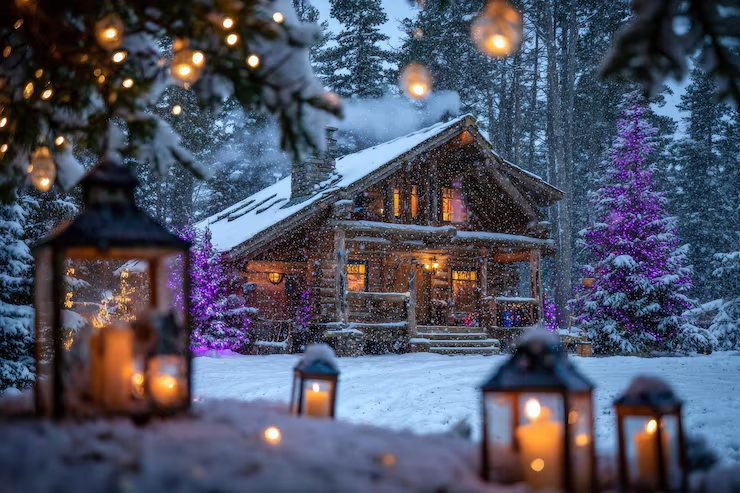
Inside, I could hear laughter, the clinking of crystal glasses, the warmth of a crackling fire. It was the sound of my family—my parents, my brother, my aunts and uncles—celebrating Christmas Eve. But here, outside the heavy timber door, the wind off Lake Geneva bit into our faces, turning our cheeks raw.
“Mom,” I said, my voice steady despite the shock vibrating through my bones. “It’s Christmas Eve. Grandma invited us. I RSVP’d three weeks ago.”
“Capacity limit,” she repeated, her eyes cold, devoid of any recognition that I was her daughter or that Benjamin was her grandson. “Go home, Jessica. There’s no room for you here.”
And then she shut the door.
The sound of the latch clicking into place echoed in the sudden silence like a gunshot.
I stood there for a moment, staring at the grain of the wood, unable to process what had just happened. My mother had just turned us away from a family gathering. On Christmas. In fifteen-degree weather.
I didn’t cry. I didn’t beg. I didn’t even knock again. I just turned around, picked Benjamin up, and walked back to my car.
The walk was silent, save for the crunch of snow under my boots and the distant sound of carolers from a neighbor’s house. Benjamin was sobbing quietly against my shoulder.
“Grandma hates me,” he whispered, his voice muffled by my coat. “I made her a card.”
“No, baby,” I said, my voice dangerously calm. “She doesn’t hate you. She loves you.”
But how do you explain to a six-year-old that the cruelty of adults has nothing to do with him? How do you explain that he is just collateral damage in a war he didn’t start?
I buckled him into his car seat, handing him his tablet to distract him. Then I got into the driver’s seat and just sat there for a moment, gripping the steering wheel until my knuckles turned white.
My phone was in my purse, silent. I knew if I checked it, there would be no messages from my mother apologizing. No texts from my father asking where we were. No calls from my brother Tyler wondering why his sister wasn’t at the party.
Because this wasn’t an accident. This was the pattern.
For years, I had dragged around an invisible chain. It was heavy, made of hope and guilt and the desperate need for validation. I had convinced myself that if I just tried harder, if I was just more successful, more compliant, more perfect, they would finally see me.
I had paid for my own college while they funded Tyler’s three failed startups. I had bought my own car while they leased Tyler a luxury SUV. I had built a successful event planning business from scratch while Tyler managed my father’s investments—poorly. And every Christmas, I would show up with expensive gifts, a smile plastered on my face, hoping this would be the year I wasn’t the punchline. This would be the year I wasn’t the afterthought.
But tonight, standing on that porch, freezing while my mother lied to my face, something snapped. The chain didn’t just break; it shattered.
I started the car. The heater hummed to life, blowing cold air that matched the chill inside my chest.
“We’re going home, Ben,” I said. “We’re going to have our own Christmas.”
I put the car in drive and pulled away from the lodge, leaving the warmth and the laughter behind. I was done. I was finally, truly done.
Chapter 2: The Command
I was about ten minutes down the winding, pine-lined driveway when my phone rang. The sound was loud in the quiet car, startling me. I glanced at the screen.
Grandma Mary.
My stomach dropped. Part of me wanted to ignore it, to keep driving and never look back. But another part—the part that still loved the woman who had taught me to bake and read me stories—couldn’t do it.
I pulled over to the side of the road and answered. “Hello?”
“Jessica?” Grandma Mary’s voice was sharp, laced with confusion. “Where are you? Dinner is about to be served.”
“We left, Grandma,” I said, my voice tight. “Mom told us… she said there was a strict capacity limit. She said we weren’t on the list.”
There was a silence on the other end so profound I thought the call had dropped. Then Grandma Mary spoke again. Her voice was low. Dangerous. It was a tone I had never heard directed at me.
“Turn the car around,” she commanded. “Right now.”
My husband, John, was sitting next to me in the passenger seat. He hadn’t said a word since we left the porch, his jaw set in a hard line. He heard Grandma’s voice through the speaker. He put his hand on my shoulder.
“Do it,” he said softly.
I looked at him, then back at the road ahead. The lodge was behind us, but Grandma’s command hung in the air. I could still feel the phantom cold of the porch, the sting of my mother’s rejection. Every instinct screamed at me to keep driving, to protect myself and my son from more pain.
But Grandma Mary wasn’t like my parents. She was the one who had taught me that respect is earned, not demanded. She was the one who had built that lodge with her own money, her own grit. If she was angry, she wasn’t angry at me.
I turned the car around.
The drive back felt longer than the drive away. The anticipation was a heavy weight in my stomach. Benjamin had stopped crying and was now watching me with wide, worried eyes.
“Are we going back to the party?” he asked.
“Yes, baby,” I said. “Grandma Mary wants to see us.”
We pulled up to the lodge again. This time, Grandma Mary was waiting on the porch. She stood under the warm glow of the lanterns, wrapped in a thick wool coat, her silver hair shining in the light. My parents were nowhere to be seen.
As we got out of the car, Grandma Mary walked down the steps, her gaze fixed on me. She didn’t look angry. She looked formidable.
“Jessica,” she said, pulling me into a hug that smelled of lavender and woodsmoke. Then she knelt down to Benjamin’s level. “I am so sorry I wasn’t at the door to greet you, my little man. I was busy in the kitchen. But I am so happy you’re here.”
Benjamin’s face lit up, the tears forgotten. “I made you a card!”
“I can’t wait to see it,” she said, taking his hand. “Come inside. It’s too cold out here.”
She led us into the lodge.
Chapter 3: The Interrogation
The music stopped as we entered. The conversation died down.
My mother, father, and brother Tyler were standing near the fireplace, drinks in hand, looking like the picture-perfect family they pretended to be. When they saw us, their smiles faltered. My mother’s face went pale.
Grandma Mary didn’t hesitate. She walked straight to the center of the room, still holding Benjamin’s hand, and raised her voice.
“Everyone, may I have your attention, please?”
The silence was absolute. Even the fire seemed to quiet down.
“Tiffany,” Grandma said, turning to my mother. Her voice wasn’t loud, but it carried to every corner of the room. “Would you please join me?”
My mother walked forward, her heels clicking nervously on the hardwood floor. She glanced around at the guests as if searching for an escape route. “Yes, Mother?”
“I have a question for you,” Grandma said, her eyes locking onto my mother’s. “Who told you there was a capacity limit for this dinner?”
My mother’s eyes widened. She stammered, looking from Grandma to me and back again. “I… well, I assumed… with the caterers and the seating…”
“You assumed,” Grandma repeated, her voice dripping with disdain. “Or did you lie?”
“I didn’t lie!” my mother protested, her voice rising in panic. “I just wanted everything to be perfect. It was a misunderstanding!”
“A misunderstanding,” Grandma said. She reached into her pocket and pulled out her phone. “Strange. Because I checked the security camera footage from the front porch while Jessica was driving back.”
She tapped the screen and held the phone up to a nearby microphone stand that the band had been using.
The sound of my mother’s voice filled the room. Clear. Cruel.
“Strict capacity limit. We didn’t get your RSVP in time. Go home, Jessica. There’s no room for you here.”
The gasp from the room was audible. Guests exchanged horrified glances. My father looked at the floor. Tyler took a sip of his drink, looking bored. But my mother stood frozen, her face a mask of humiliation. The social veneer she had spent her life polishing was shattered in seconds.
Grandma Mary looked at her, then at the silent room.
“There is always room for family in this house,” she said, her voice shaking with suppressed rage. “Unless that family decides to close the door on their own blood.”
She turned to me, her expression softening. “Jessica, you and Benjamin and John sit here next to me.” She pointed to the seats of honor at the head of the table.
My mother sat down, weeping into a napkin. It was a performance I had seen a thousand times. The martyr. The victim of her own good intentions.
“I was just so stressed!” she sobbed, looking around for sympathy that wasn’t there. “I wanted tonight to be perfect for you, Mother! I thought… I thought if there were too many people, it would be overwhelming. I made a mistake. I’m only human.”
My father moved to comfort her, placing a hand on her shoulder. “She’s been under a lot of pressure, Mom,” he said to Grandma. “Let’s just move past this. We’re all here now.”
“Yes,” Tyler piped up, swirling the ice in his glass. “Can we eat? I’m starving.”
Chapter 4: The Silver Service
Grandma Mary didn’t sit. She remained standing at the head of the table, her hands resting on the polished wood. She looked at my mother, then at my father, and finally, her gaze landed on Tyler.
“We are not eating yet,” she said. Her voice was calm, but it had a weight to it that made the air in the room feel heavy. “Because we aren’t done with the truth.”
She turned to face Tyler directly. “Tyler, would you be a dear and fetch the antique Georgian silver service for the table? The one your grandfather bought in London. We should use the best for Christmas.”
The room went still. I frowned. The silver service was massive—a tea and coffee set worth easily fifty thousand dollars. It was kept in a locked display cabinet in the library. I knew every inch of it because growing up, I was the only one allowed to polish it. Tyler wasn’t allowed near it because he was clumsy and careless.
Tyler froze. He blinked rapidly, a bead of sweat appearing on his temple despite the chill in the lodge.
“Uh… the silver?” he stammered. “I… I don’t think we need it, Grandma. It’s a hassle to get out.”
“I want it,” Grandma said. “Go get it.”
“It’s… it’s not there,” he mumbled, his eyes darting to my parents.
My father stiffened. My mother stopped crying instantly, her face going from flushed to gray.
“Not there?” Grandma asked. “Where is it?”
“I sent it out!” my father interjected quickly, his voice too loud. “For… for professional cleaning. As a surprise for you, Mom. We wanted it to shine.”
“Professional cleaning,” Grandma repeated.
She reached into the pocket of her wool coat again. This time, she didn’t pull out a phone. She pulled out a slip of pink paper. She slid it across the table toward my father.
“Is ‘Fast Cash Pawn & Loan’ a professional cleaner, Zachary?”
My father looked like he’d been punched in the gut. Tyler dropped his glass. It shattered on the hearth, the sound exploding in the quiet room.
“I found this in Tyler’s room this morning,” Grandma said, her voice like steel. “Fifty thousand dollars’ worth of heirlooms. Pawned for four thousand dollars. To cover what? More gambling debts? Another ‘investment’?”
She turned to my mother. “And you knew. That’s why you didn’t want Jessica here tonight.”
The realization hit me like a physical blow. It wasn’t just about capacity. It wasn’t just about me being the scapegoat.
“I would have noticed,” I whispered. “I always check the cabinet. I always polish the silver on Christmas Eve.”
“Exactly,” Grandma said. “You needed Jessica gone not because she’s ‘difficult.’ But because she is the only one in this family with enough integrity to notice a crime. You turned away your own daughter to protect a thief.”
The silence in the room was no longer just awkward. It was disgusted. The wealthy guests, the neighbors, the friends—they were looking at my parents and brother not as peers, but as pariahs. They weren’t just mean; they were criminals.
Tyler stood up, his face red. “It was my inheritance anyway! I just took an advance!”
“It was not your inheritance,” Grandma snapped. “It was my legacy. And you sold it for scrap.”
Chapter 5: The Reckoning
The weight of Tyler’s words hung in the air like smoke. He stood there, chest heaving, face flushed with a mixture of anger and shame. Around the room, guests shifted uncomfortably in their seats. Some stared at their plates. Others exchanged glances that said everything: This family is toxic.
Grandma Mary didn’t raise her voice. She didn’t need to. When she spoke, every person in that room leaned forward to hear.
“Tyler,” she said, her voice carrying the quiet authority of someone who had built an empire from nothing, “you have stolen from me. You have lied to me. And worst of all, you have taught your parents to sacrifice their daughter to protect your crimes.”
She turned to my father. “Zachary, you are my son. I raised you to be better than this. I gave you opportunities, education, a home. And you have squandered every gift by enabling this boy’s entitlement.”
My father opened his mouth to speak, but Grandma held up her hand.
“I am not finished.”
She turned to my mother. “Tiffany, you have spent years treating Jessica like an inconvenience. Like a problem to be managed. Tonight, you turned away my great-grandson on Christmas Eve because you were more afraid of your crimes being exposed than you were concerned about doing the right thing.”
My mother’s tears had stopped. Her face was pale, her lipstick smudged. She looked small sitting there—not physically, but spiritually. Diminished.
“And Jessica,” Grandma said, turning to me with eyes that were suddenly warm, “has spent her entire life trying to earn a place at this table that should have been hers by birthright. She has worked harder, achieved more, and loved more deeply than any of you. And for that, you punished her.”
The room was silent except for the crackling of the fire.
Grandma Mary straightened her shoulders. “Zachary, Tiffany, Tyler—you are no longer welcome in this house. Not tonight. Not tomorrow. Not ever.”
“Mom, please—” my father started.
“The guest cottage,” Grandma continued, as if he hadn’t spoken, “where you have lived rent-free for ten years, treating it as your personal vacation home, is no longer yours. You have until midnight to remove your belongings. Anything left behind will be donated.”
“You can’t do this!” my mother shrieked, standing up so quickly her chair toppled backward. “This is family property! We have rights!”
“You have no rights,” Grandma said coldly. “The property is in my name. The cottage is in my name. Everything you think you own is actually mine. And I am taking it back.”
She pulled a folded document from her coat pocket and set it on the table. “This is a restraining order. If any of you set foot on this property after midnight tonight, you will be arrested for trespassing.”
My father’s face had gone from pale to red. “You’re doing this? On Christmas? To your own son?”
“You did this,” Grandma said quietly. “The moment you chose protecting a thief over protecting your daughter. The moment you turned away my great-grandson in the freezing cold. You made this choice, Zachary. I’m simply enforcing the consequences.”
She looked at Tyler, who was now slumped in his chair, all the bravado drained from him.
“As for you,” she said, “I am removing you from my will as of tomorrow morning. Everything—the land, the investments, the trust funds—goes to Jessica. You will inherit nothing but the consequences of your actions.”
Tyler’s head snapped up. “That’s not fair! I’m your grandson! I’m family!”
“You are a thief,” Grandma said. “And thieves do not inherit what they’ve already tried to steal.”
The silence that followed was profound. It was the kind of silence that comes when there’s nothing left to say, when all the masks have been stripped away and only the ugly truth remains.
My mother grabbed her purse and stood. “Fine. We’ll leave. But don’t think for one second that this family will ever forgive you for choosing her over us.”
She pointed a trembling finger at me.
“She’s nobody,” my mother spat. “She’s just Jessica. She doesn’t have what it takes to manage an estate like this. She’ll run it into the ground within a year, and then you’ll see. You’ll see what a mistake you made.”
I looked at my mother. For years, her words would have cut me. They would have burrowed into my chest and nested there, feeding on my insecurities.
But tonight, standing in the warmth of my grandmother’s home, with my son safe beside me and my husband’s hand on my shoulder, her words had no power.
“You’re right,” I said quietly. “I am just Jessica. And that’s all I’ve ever needed to be.”
My mother’s face twisted. She looked around the room, searching for allies, for someone to validate her outrage. But the guests looked away. No one was coming to her rescue.
“Let’s go,” my father said, his voice hollow. He took my mother’s arm and guided her toward the door. Tyler followed, his shoulders slumped, his expensive shoes dragging on the floor.
They walked past me without another word. The heavy timber door opened, letting in a blast of cold air, and then closed behind them with a decisive click.
The room remained silent for several long seconds.
Then Benjamin’s small voice broke the quiet. “Grandma Mary, can we have dinner now? I’m really hungry.”
The tension shattered like glass. Several guests laughed—not cruel laughter, but the kind of relieved laughter that comes after a storm has passed.
Grandma Mary smiled and ruffled Benjamin’s hair. “Yes, my dear. Let’s eat.”
Chapter 6: The New Beginning
The dinner that followed was unlike any Christmas Eve I’d ever experienced. The guests—neighbors, old friends, people I’d known my entire life but had never really talked to—approached me throughout the evening. They hugged me. They told me they’d always known I was being treated unfairly. They apologized for not speaking up sooner.
“We didn’t want to interfere,” Mrs. Henderson from the neighboring estate said, squeezing my hand. “But we saw it. We all saw it.”
I wanted to be angry at them for their silence, but I couldn’t. Because I understood. Families are complicated. Dysfunction hides behind closed doors and polite smiles. And sometimes, the person suffering most is the last one to see it clearly.
John and I stayed at the lodge that night. Benjamin fell asleep in one of the guest rooms, his handmade card for Grandma Mary still clutched in his little hand. John and I sat by the fire with Grandma Mary, the three of us sipping hot cocoa in comfortable silence.
“I should have done this years ago,” Grandma finally said. “I knew they were mistreating you. I knew Tyler was a parasite. But I kept hoping they would change. That if I gave them enough time, enough chances, they would become the people I wanted them to be.”
She looked at me, her eyes glistening. “I’m sorry, Jessica. I’m sorry I let them hurt you for so long.”
I reached over and took her weathered hand in mine. “You did what you thought was right. You gave them chances. That’s not a character flaw, Grandma. That’s love.”
“But love without boundaries isn’t love,” she said. “It’s enabling. And tonight, I drew the boundary I should have drawn years ago.”
The next few weeks were a whirlwind. True to her word, Grandma Mary filed the paperwork to change her will. She sat me down with her lawyers and accountants and walked me through every aspect of the estate—the investments, the properties, the trusts. It was overwhelming at first, but I quickly realized something: I was good at this.
Years of running my own business had taught me how to manage finances, negotiate contracts, handle difficult people. The skills I’d developed while being dismissed by my family were exactly the skills I needed to manage what they’d always claimed I couldn’t handle.
My parents and Tyler moved into a small apartment in Milwaukee. Through mutual friends, I heard that my mother was telling anyone who would listen that I had “stolen” her inheritance, that I had manipulated a sick old woman, that I was vindictive and cruel.
The irony wasn’t lost on me. The same woman who had turned me away in the freezing cold was now playing the victim.
I didn’t respond. I didn’t defend myself. I didn’t engage.
Because the people who mattered—the people who had been there that night—knew the truth.
Tyler tried to reach out once, three months after Christmas. He sent a long email claiming he’d changed, that he was in therapy, that he wanted to make amends. He asked if I could “loan” him twenty thousand dollars to get back on his feet.
I deleted it without responding.
Some bridges aren’t meant to be rebuilt.
Chapter 7: One Year Later
The fire in the lodge crackled, warm and bright. The smell of cinnamon and roasting turkey filled the air. Benjamin was sitting on the rug, tearing open a present, his laughter ringing out clear and happy.
The lodge looked different. John and I had spent the last year renovating, stripping away the heavy, dark drapes my mother had loved, letting in the light. We had turned the guest cottage—the one my parents had occupied—into an art studio for Benjamin and a workshop for John.
The property felt lighter somehow. As if the physical removal of toxic people had lifted a spiritual weight.
Grandma Mary sat in her favorite chair by the fire, a contented smile on her face. She was slower now, her health declining gradually, but she was at peace. She’d done what she needed to do. She’d protected the people who deserved protecting.
Around the room sat people who actually cared about us. Friends from my business. John’s family. Neighbors who had become like family. And Benjamin, the center of it all, surrounded by love instead of judgment.
My phone buzzed. I glanced at it and saw a text from an unknown number.
“Merry Christmas, Jessica. I hope you’re happy with yourself. You destroyed this family. – Mom”
I stared at the message for a moment. A year ago, it would have ruined my day. It would have sent me into a spiral of guilt and self-doubt.
Now, I felt… nothing. Not anger. Not sadness. Just a kind of distant pity for someone who still couldn’t see that she had destroyed herself.
I deleted the message and blocked the number.
John looked over at me. “Everything okay?”
“Everything’s perfect,” I said.
And I meant it.
Because for the first time in my life, I wasn’t standing on a porch in the cold, begging to be let in. I wasn’t twisting myself into shapes that might finally earn approval. I wasn’t dragging around the weight of a family that had never valued me.
I was home. Not in a house I’d inherited, but in a life I’d chosen. With people who saw me, loved me, and welcomed me without conditions.
Epilogue: A Message
If you’re reading this and it feels familiar—if you’ve ever stood on a porch in the cold while the people who are supposed to love you shut you out, if you’ve ever been the scapegoat, the problem, the one who’s “too sensitive” or “too difficult”—I need you to hear this:
You are not the problem.
You are not too much or not enough. You are not difficult. You are not broken.
You are simply in the wrong house.
Those people—the ones who make you feel small, who criticize everything you do, who turn you away while welcoming others—they are showing you who they are. Believe them.
Stop standing on the porch. Stop waiting for them to finally see your worth. Stop freezing yourself trying to warm people who are committed to staying cold.
Turn around. Walk away. Build your own fire.
Because the thing about toxic families is that they will make you think leaving is cruel. They will make you feel guilty for choosing yourself. They will tell you that blood is thicker than water and family is forever and you’re abandoning them.
But here’s what they won’t tell you: The full quote is “The blood of the covenant is thicker than the water of the womb.” The bonds you choose are stronger than the bonds you’re born into.
And sometimes, the most loving thing you can do—for yourself and for the people who actually value you—is to walk away from people who will never change.
I didn’t lose a family when I left that porch. I lost people who were only family in name. People who saw me as a tool, a scapegoat, an inconvenience.
And what did I gain?
I looked around the room—at my son laughing with his great-grandmother, at my husband building a fire, at the friends who had become my chosen family.
I gained everything.
Peace. Joy. Self-respect. A home where I was wanted, not tolerated.
So if you’re standing on that porch right now, shivering in the cold, waiting for someone to let you in—stop.
Turn around. Get in your car. Drive away.
Because you deserve a home where the door is always open. Where you don’t have to earn your place at the table. Where love isn’t conditional on your usefulness.
You deserve warmth.
And you will never find it by freezing for people who don’t care that you’re cold.
The lodge is warm. The fire is crackling. Benjamin is laughing.
And the door? The door is locked. Not to keep me out, but to keep the cold from getting back in.
This is my home now. And nobody—not my mother, not my father, not anyone—can ever make me stand on the porch again.
I’m done begging for a seat at tables where I’m not wanted.
I built my own table. And everyone here chose to sit at it.
That’s not just survival. That’s freedom.
And it’s yours for the taking—if you’re brave enough to walk away from the wrong house and find your way home.