When I walked into the courtroom, my dad looked calm, my mom adjusted her pearls, and my brother grinned. They thought I had nothing, until the safe was opened. When your family decides that you are expendable, the pain does not subside, it hardens. My name is Emily Johnson, and ten years ago, with every dollar I had, I saved my family’s business. The next morning, they erased my name from it and from their lives. I stood there and watched as my father handed me out of the company I had built, while my mother smiled as if she was doing me a favor. My brother didn’t even look up. That day I learned that blood is not loyalty, and silence can be the most expensive lie ever told.
When I entered the courtroom ten years later, they smiled again. They thought I had lost, they had no idea what I was about to show the judge. The air in the Denver District Court was colder than outside. Neon light poured over the marble floor and was reflected in polished shoes and restless eyes. Each step healed again, like a reminder that someone was about to be condemned. My mother sat in the front row, her lips twisted into that perfect, practiced smile that she wore all my life, and that deceived everyone but me. It wasn’t kindness, it was control, disguised as grace. The cameras flashed from the press tribunes, eager to capture the moment when the Johnson’s disgraced daughter looked her downfall in the eye. David sat next to our father and tapped his thumb on his cell phone as if it didn’t matter. My father didn’t look at me, he never did. His eyes were open on the judge’s bench. The same calm look that froze me as a child. That look once meant that I wasn’t enough. Today it didn’t mean anything, because I wasn’t the one who was on trial.
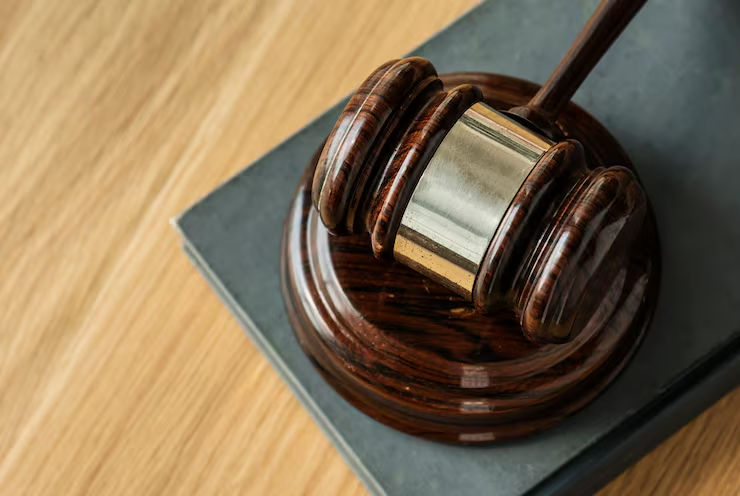
It was there. The voice of the clerk of the court cut through the murmur and called out the case number that bore the name of my family. My heartbeat followed the rhythm of the hammer that struck wood. In the opposite corridor, my mother crossed her legs, her pearls glittering like drops of ice. I used to think that shine meant power. Now I realized what it was, a highly polished reflection of darkness. They thought I had lost. They had no idea what I had uncovered.
The judge turned to me. Miss Johnson, are you ready to continue? I lifted my chin and straightened it up. Yes, your honor, I said. I’ve been ready for ten years.
The winter of 2010 felt like a slow collapse. When the Silver Pines project lost money and investors pulled out, I did the only thing I could do. I sold the small startup I had built and transferred $400,000 to the company account so that the bank could no longer repay the loan. I slept at my desk for three months. Bookings, cash flow, spreadsheets, nightly calls plugging holes. When the accounts were balanced and the project revived, I expected a different reception. The staged celebration at the Flagstone with candles and applause revealed a slight aftertaste. My father praised my efforts in a polite tone and then suggested that I resign, as someone with a stronger vision would be needed for the next phase. My mother smiled and talked about calm and balance, turning her dismissal into a saw.
I left the falling snowflakes and the smeared city lights on the wet asphalt with the only USB stick in my hand, on which my summer backups were lying. Her handling of family history, sorted me out, simply ignored my role in the company fuss. The small stick felt absurd in my hand, too tiny to measure the weight of what it contained. And yet it was the only proof that everything I had done had once been real. I told myself that they had made a mistake. I told myself that I would continue. But the stick lay in my pocket like a pulse, something that couldn’t be ignored.
Four years later, a gray package arrived in an apartment made of rubble with maple leaves on the balcony without a sender. Inside was a letter in handwriting that I hadn’t seen in seven years, and a compact hard drive wrapped in simple foam. The note explained that the letter was from my grandfather, that I had been appointed as his intended successor in the original will, and that the lawyer who administered the estate had been forced to change the document. The lawyer admitted to keeping a copy and instructed me to protect it. The hard drive contained more than just a will. There was a project file labeled Everline Project, detailed plans for affordable housing that my grandfather had assigned to me as director, and an audio file in which the lawyer urged whoever heard it to keep the truth, as it had cost others their safety.
My throat tightened. The room seemed too small for the story contained in the files. I was just about to call the lawyer because the headlines reported that Walter Grant had died in the house. Stroke my age got cold chance felt like a warning the only man who could get this evidence was P.L. Gon. I shoved the letter into the little safe, twisted the door, and looked out at the blurred line of the Rocky Mountains. If her verb was built on L, then the work of making it had to start with me. Denver, early 2019. The air was rough and dry; snow clung to the gutters like forgotten ashes. I sat in a corner of the cafe I always visited after work, my laptop open, my eyes on the folder with the inscription Everline Project, reported. The drive that Walter Grant had left me didn’t just contain the will. It was a vault with ledgers, invoices and balance sheets going back decades. One file stood out, GRV, XLSX. The name didn’t belong to any department I remembered. A quick search made my pulse pound. GRV Consulting had been investigated years ago for falsifying audits and producing falsified tax documents before it quietly disappeared from the state company register.
I roughly deepened and traced old invoices that were buried in the archive. There I met the first ghost, Charles Heeler, my grandfather’s chief accountant. He disappeared in 2011, just three weeks after the will was amended. No pension documents, no obituary, just a faded hotel receipt from a town in Wyoming, dated the day someone last saw him. I sent the data to Brian, an old colleague from the JDG banking department. Two days later, his answer came by encrypted email. Emily’s transfers from JDG between 2011 and 2013 went through an anonymous account under the name E-Consulting. The numbers match exactly. The approval signature it belongs to your father. The words hit me like cold metal. In my head, border warnings hold again. The truth has already made people disappear.
That night a black sedan was idling across the street from my apartment, the headlights cutting through the darkness. No one got out when I pulled down the blinds. My phone rang. A voice I didn’t know, rough and deep. “Stop digging, Emily. People who know too much don’t live long.” Then silence. The police dismissed it as a prank call. I knew better.
Three days later, I met my mother at a charity gala. She shone in white, every hair in its place, a symbol of grace and deception. She gently took my hand, her voice siren-like. “Everyone is worried about you. Your father says you’re losing perspective. Maybe you should talk to someone.” I looked her firmly in the eyes. “If justice drives me crazy, then I probably am too.” Her smile froze. “You destroy everything,” she whispered, “and if it falls apart, no one will believe you.”
That night I found an old line in a letter from my grandfather. “If you feel alone, it means you’re on the right track. Truth rarely travels in company.” Leaning coolly against the window, I watched the snow fall in the lantern light. For the first time in years, I wasn’t cold. I was angry, and that anger finally had a direction.
Autumn 2020. One evening my mother called, her voice was unusually quiet. “Your father wants to talk, we’re tired of arguing with Emily.” I hesitated, torn between mistrust and a weak, last desire for peace. In the end, curiosity won out. Evergreen Lodge shone like a postcard, hidden between tall pines and a silence that was too perfect to be real. The interior of the dining room shimmered in candlelight and crystal. My father sat at the head of the table, his posture as if carved out of stone. David stood behind him, pouring wine and avoiding my gaze. The moment I entered, I knew that this was not reconciliation. It was choreography.
My father was the first to start, calm and deliberate. “This can end quietly. Sign, withdraw your claims. We set up a fund, a comfortable life away from chaos.” My mother leaned forward, her voice low and tender. “You’ve been through enough, my darling. Let’s protect you from yourself.” I glanced at the document on the table. Above waver of claims, confidential agreement. I smiled faintly, and so everything just disappeared, as Charles Heeler did. The room froze, David’s glass clinked in his hand. “Dad looked after this accountant years ago, just sign the damn thing.” It became quiet. My father looked at him angrily, but the damage was done. Under the table my cell phone display lit up faintly. The dictaphone had been running since I had come in.
I got up slowly. “So it’s true, you didn’t just lie to me, you buried him, you buried grandpa’s truth.” My mother’s mask cracked. Her voice became sharper. “We built this name with our lives, and you tear it down.” I said quietly, “Keep it.” I turned around and left before my doors could catch the light. Lightning flashed through the camera bulbs of the bee. They had called the press in the hope of portraying me as an ungrateful and ungrateful daughter. But they didn’t know that the shot I was carrying in my bag would end their performance for good. In my car, I pressed play. David’s voice kept out of the loudspeakers. Dad had looked after this accountant years ago. Then the quiet warning of my father: “Shut that mouth, David.” These words destroyed any illusion of family that I had left. I didn’t cry out of fear. Since I had proof, keys to justice, I cried.
The next morning, every headline called me a disgrace. I didn’t care. To silence me, they planned the stage. I used it as proof. When they set up a play to keep me quiet, I learned how to make silence my weapon. One recording was enough, and it was enough to trigger a war.
February 2021. The old mansion in Boulder stood still under a gloomy sky. Even as a child, I roamed these corridors. This time I was looking for truth, not nostalgia. After dinner at Evergreen Lodge, I sent the recording to Laura Myers, a federal investigator and old friend. Hours later, she called. This was no longer inheritance fraud. That was a federal crime.
Days later, we entered my grandfather’s abandoned estate with a search warrant. The air smelled of dust and pine wood. Each picture frame felt like a witness. Then I noticed it. The picture from the desk squinted very slightly, the frame impeccably clean. In the background, a rusted, locked safe.
First his birthday, then his wedding anniversary. Nothing. Then I turned the knob to my own May 14, 1986. A soft click. Inside, diary, black USB stick and an envelope, strictly confidential. EJ, the video showed how my father forced the grandfather to revise his will and threatened to cut off my grandmother’s care. Like eternal betrayal, pen on paper, an unforgettable sound. At the black screen, Laura whispered, proof of everything buried of senior torment.
Two months later, I came home and found my apartment ransacked. Curtains torn, laptop smashed. On the table were four words written in ink: “legacy is loyalty.” They hadn’t stolen any money, only my hard drive. Laura was suspended that same evening. Someone powerful had buried the case. I gave my last paper copies to Thomas Quinn, a reporter I trusted. He promised me that if something happened, the world would know.
Snow was falling at dawn when I read a message on my cell phone: “Tell the reporter to drop it or you’ll end up with the accountant.” I didn’t even flinch. Justice was not done. It had to be preserved, no matter who tried to take it away from me.
In May 2022, the federal courtroom in Denver was full. Every seat was occupied, the aisles were crowded with cameras. The name Johnson had become a headline, a scandal that spread throughout the state. They say justice measures truth. But for me, it always felt like a scalpel. It cuts through flesh before it heals.
My father sat next to his lawyer Carl Benson, calm but pale. My mother’s pearls caught the light like frost, their practiced gentleness hiding the steel underneath. David lowered his eyes and pretended he didn’t exist. Again Laura stood there, upright, restored, steadfast. In front of me was the thickest file of my life: the real will, my grandfather’s diary, the video and the recording of Evergreen Lodge.
When the judge entered the room, he fell silent. Label claimed that I had invented everything to harm my parents. Her lawyer pointed at me in a raised voice, perhaps I loved attention more than justice. I didn’t react, I waited. Laura stepped forward, her voice cut clearly through the noise. The court watched as the video was played. The weak voice of my grandfather announcing his decision. My father’s threat to use my grandmother’s name as a ransom. The pen scratched. Then silence. A glass shattered. My mother’s hand trembled. David stared at the floor.
The defense argued with manipulations, but Laura presented the forensic report to untainted evidence. Then came the audio recording that dad had supervised as an accountant years ago. David’s voice was clear and undeniable. The judge turned to me. “Miss Johnson, would you like to address the defendants?” I rose. My voice did not tremble. He should know that I didn’t want to be destroyed. I just wanted to rebuild my great truth. He believed that I had that name W today. I agreed with him two weeks later.
The courtroom looked unclear. But the air became heavier charged with anticipation. Outside, F camera crews, the steps and on all the screens in Denver the same headline was shown: “Day of the Verdict. The Johnson in court,” quotation marks. Inside, the audience sat motionless as Judge McKay entered and adjusted his glasses. The silence was so complete that I could hear the hum of the lamps.
After examining the evidence and testimonies, he spoke a firm and cold voice: “The court finds the defendants Richard Johnson, Caroline Johnson and David Johnson guilty of document phishing, coercion of the elderly, and obstruction of justice. My mother let out a soft gasp before burying her face in her hands. My father slumped back and held his chest. His complexion turned gray. David lowered his head and didn’t move anymore.
In addition, the judge stated that all shares of the Johnson Development Group are to be transferred to the plaintiff, Emily Johnson, in accordance with Raymond Johnson’s original will. A murmur broke out in the room, swelling like a wave. My body felt light, almost unbound. For the first time in years, breathing didn’t hurt anymore. Justice, I realized, was not sweet. There was just air in my lungs again.
In the evening, the news spread throughout the room. Reporters uncovered years of covert fraud and money laundering at JDG. Investors withdrew overnight. The company’s empire collapsed within a few days. My mother was expelled from all the charities she had used as a stage. My father was placed under medical supervision. David was banned from holding any leadership position for a decade. The world that had once silenced me had finally become quiet itself.
Days later, as I packed the papers from the old office into boxes, I found a yellowed envelope deep in my grandfather’s desk drawer, inscribed with his familiar handwriting: “for my granddaughter. If the truth comes out.” I carefully unfolded it. Emily, it said, you can lose everything if you tell the truth, but you will find yourself again. This empire never needed heirs. It took courage. Tears blotted the ink. When I finished reading, for the first time since this all began, I felt forgiveness, not for her, but for myself. I had passed on my grandfather’s faith more than he ever could.
At the sentencing, Judge McKay quoted a line from this letter for the record. This case proves that integrity outlasts inheritance. And for once, everyone in the courtroom stood not for power, but for truth.
The spring of 2024 bathed Denver in such a bright light that it almost felt like new. The air was filled with the warmth of things that had been rebuilt, not just survived. I was standing on the edge of another courtroom, different walls, different faces, but the same pulse of justice hummed under the floor. I no longer had the title of CEO, and I didn’t want it back. Instead, I had built something quieter, more consistent: the Integrity Trust Fund, a foundation for victims of financial fraud and women whose stories had been cleared out of the way. Every case that landed on my desk bore a trail of the woman I had used to be, a reminder that once the truth once spoken never really dies.
The courtroom filled up slowly. The babble of voices was quiet but expectant. A young woman on the witness stand trembled when the usher swore her in. It reminded me of myself. Her eyes were wide open, her shoulders tense with shame she couldn’t bear. When she faltered, I stepped closer and put a hand on her shoulder. “They’ll try to silence you,” I whispered so softly that only she could hear it. “Don’t let them happen. The truth is the only thing they can’t buy.” Her breathing calmed down. She nodded once and looked ahead. When the judge entered, I felt no fear this time, only determination. No one in the room looked at me with contempt or doubt, only believing that justice can be done, even by imperfect hands.
Before the trial began, I stepped into the hallway, where sunlight shone through the high windows. On the blackboard in front of the intern’s room, I wrote three words that had carried me through the fire: Legacy is integrity. The chalk dust stuck faintly to my fingers as I placed only my grandfather’s bag on the table next to me. The hands still pointed to the exact hour in which the verdict had been read out a year earlier. It didn’t feel like a relic anymore. It felt like a promise kept.
They laughed when I came in, but they didn’t laugh anymore when I left. The sunlight poured over the floor and was reflected in the faint scratches of the court benches. I closed my eyes and breathed in the silence. I was no longer the broken daughter of a broken empire. I was his correction, his proof of life that the truth can outlast even blood. And this time, I didn’t just defend justice. I was guarding its legacy.