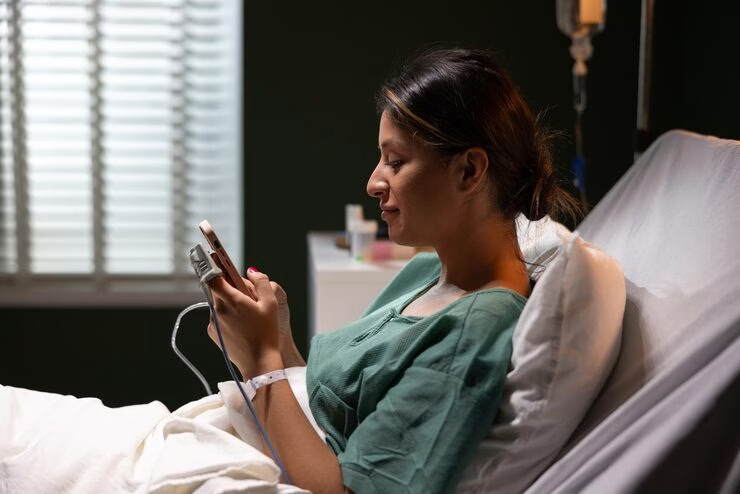
The Text Message
The text message arrived at 4:47 p.m. on a Tuesday afternoon, the kind of ordinary moment that becomes extraordinary only in hindsight. I had just finished arranging the nursery for what felt like the hundredth time that week, my nesting instinct in full overdrive despite ankles so swollen I could barely see them and a back that ached with every movement. My phone buzzed against the changing table where I’d set it down, and I reached for it with a smile, expecting Marcus to tell me he was picking up dinner on his way home from the construction site.
Instead, the words on the screen made my blood run cold: Don’t come home tonight. My family is staying over and we need privacy.
I read it three times before the meaning actually penetrated the fog of my pregnancy brain. My hand moved instinctively to my enormous belly where our daughter had been kicking enthusiastically all afternoon, as if she could sense my sudden anxiety. Nine months pregnant, due literally any day now based on what my doctor had said at my last appointment, and my husband was telling me not to come home to my own house. To the nursery I’d spent months preparing. To the place where I was supposed to give birth to our child in the safety and comfort of familiar surroundings.
I called him immediately, my fingers trembling as I pressed his contact photo—the one from our wedding day three years ago when we’d both been smiling, happy, convinced we were building something that would last forever. The phone rang four times before he picked up, and I could hear his mother’s voice in the background, that familiar shrill laugh that had grated on my nerves since the day Marcus first introduced us.
“Marcus, what’s going on?” I asked, trying to keep my voice level even as panic started creeping up my throat. “I’m already home. What do you mean I can’t be here?”
“Exactly what I said, Rebecca.” His voice was cold, distant, transformed into something I barely recognized. This wasn’t the man who had kissed me goodbye that morning, his hand resting briefly on my belly as he told our daughter to behave for Mommy. “My parents and my sister drove in from Pennsylvania. They need a place to stay for a few days, and frankly, we all need some space without you hovering around making everything about you.”
The words hit me like a physical slap. “Hovering? Marcus, I live here. This is my home. I’m about to have our baby any second now, and you want me to just leave? Where exactly am I supposed to go?”
“You’ll figure something out. You always do.” His tone was dismissive, almost bored, as if we were discussing something as inconsequential as what to have for dinner. “Stay with your parents or get a hotel room. I honestly don’t care where you go. Just make yourself scarce for a while so we can have some family time without the drama.”
“My parents are in Europe—you know that. They won’t be back for another ten days. And what drama are you even talking about? I haven’t—”
The line went dead before I could finish. He’d hung up on me. My husband, the father of my unborn child, had just hung up on me while telling me to leave my own home.
The Empty Nursery
I stood there in the yellow-painted nursery we’d created together, surrounded by the crib we’d assembled on a Sunday afternoon two months ago, the rocking chair my grandmother had refinished and given us as a baby shower gift, the tiny clothes I’d washed in special baby detergent and folded with such care and excitement. The mobile hanging above the crib swayed slightly in the breeze from the air conditioning, casting dancing shadows across the walls.
None of this made any sense.
Marcus had been acting strangely for the past two months—more withdrawn, more irritable, spending more time with his mother—but I’d chalked it up to stress about becoming a father and the financial pressure of a new baby. His mother, Diane, had never warmed to me in our three years of marriage, but I never imagined it would escalate to this level of cruelty.
My parents were indeed in Europe celebrating their thirty-fifth wedding anniversary, somewhere between Paris and Rome with spotty cell phone service. I had no siblings to turn to, and my closest friends from college had all moved out of state for jobs or relationships. The reality of my isolation hit me like a wave, leaving me gasping for air.
That’s when the first contraction seized me, wrapping around my abdomen like an iron band.
It started as a deep tightening sensation, uncomfortable but not unbearable at first. I’d been having Braxton Hicks contractions on and off for weeks, so I tried to stay calm and breathe through it the way they’d taught us in the childbirth class Marcus had attended exactly twice before claiming he was too busy with work. But this contraction felt different—deeper, more insistent, radiating from my lower back around to the front in a way that made me catch my breath.
I counted slowly, watching the second hand sweep around the clock on the nursery wall. The contraction lasted forty-five seconds before gradually releasing its grip.
Five minutes later, another one came, and this time there was no mistaking it for false labor.
The Call
I grabbed my phone with shaking hands and called Marcus again, praying he would answer, that he would hear the fear in my voice and remember that he was supposed to love me, to protect me, to be there for the birth of our child. He answered on the first ring this time, his voice sharp with impatience and annoyance.
“What now, Rebecca? I told you—”
“Marcus, I think I’m in labor.” I tried to keep my voice steady, but panic was setting in fast, making my words come out in a rush. “The contractions are getting closer together and they’re really strong. I need you to come home right now. We need to go to the hospital.”
There was a long, terrible pause. In the background, I heard Diane say something I couldn’t quite make out, her tone mocking, followed by his sister Heather’s distinctive laugh—that mean-spirited sound I’d heard directed at me too many times at family gatherings.
My husband’s next words felt like ice water injected directly into my veins.
“Figure it out yourself, Rebecca. My family is more important than your drama right now. You’re always exaggerating everything anyway, making yourself the center of attention. It’s probably just false labor like you had last week. Stop being so needy and leave us alone.”
“Marcus, please, I’m begging you—”
“I said figure it out. And stop calling me. We’re trying to have a nice family evening and you’re ruining it like you ruin everything.”
He hung up again, and this time I knew with absolute certainty that he wasn’t coming back. That I was completely, terrifyingly alone.
Another contraction gripped me, this one strong enough to make me gasp and lean heavily against the doorframe, my knuckles white as I clutched the wood. Seven minutes since the last one. This was real labor, progressing exactly the way the books and classes said it would, and I was facing it entirely by myself because my husband had chosen his mother over his own child being born.
The Hospital
I forced myself to move, to think practically despite the fear threatening to overwhelm me. I managed to grab the hospital bag I’d packed three weeks ago, my hands trembling as I double-checked for my insurance card, phone charger, and the carefully chosen going-home outfit for our daughter—a soft pink sleeper with tiny elephants on it that I’d found at a boutique and fallen in love with immediately.
The drive to Mercy General Hospital was the longest twenty minutes of my life. Contractions came every five to six minutes now, each one forcing me to pull over to the side of the road and grip the steering wheel until my knuckles turned white and the pain passed enough for me to see clearly again. Other drivers honked as I sat at green lights, trying to breathe through the waves of agony that radiated through my entire body.
I called Marcus one final time as I pulled into the hospital parking lot, my voice shaking so badly I could barely form words as I left what I knew would be an ignored voicemail.
“Marcus, I’m at Mercy General Hospital. I’m having our baby. If you have any decency left at all, any shred of the man I thought I married, you’ll come. Please.”
He never showed up. Not during the fourteen hours of labor that followed. Not when I was screaming for pain relief. Not when the doctor said there were complications with the baby’s position. Not for the actual birth. Not ever.
The nurses at Mercy General were incredibly kind, their sympathy almost painful in its sincerity when I checked in alone at the emergency entrance, my face streaked with tears and my entire body shaking with both pain and the shock of abandonment. A young nurse named Sophie with kind eyes and a gentle touch stayed with me through the worst of it, holding my hand during contractions when I had no one else, coaching me through breathing exercises, wiping the sweat from my forehead with cool cloths.
Labor lasted fourteen brutal hours. Fourteen hours of indescribable pain that came in waves, each one building higher than the last. Through it all, I kept glancing at the door to my hospital room, some foolish, desperate part of me still hoping Marcus would walk through it, apologizing profusely and explaining that this had all been some terrible misunderstanding.
He never came.
My daughter, Emma Grace Sullivan, entered the world at 8:23 a.m. on Wednesday morning, weighing seven pounds and two ounces of absolute perfection. She had a full head of dark hair that stood up in adorable tufts and her father’s nose—a detail that made my heart ache even as I fell completely in love with her.
When the doctor placed her on my chest for the first time, her tiny body warm and impossibly soft against my skin, I broke down completely, sobbing with joy and heartbreak in equal measure.
I sent Marcus a photo of Emma shortly after she was born, her eyes squeezed shut and one tiny fist pressed against her cheek, along with a message: Your daughter was born this morning. She’s beautiful and healthy. Her name is Emma Grace.
The message showed as “Read” almost immediately, but he never responded.
The Discovery
On Friday morning, the hospital prepared to discharge us. Sophie helped me load Emma’s car seat into my vehicle, her expression troubled as she watched me struggle with the base installation.
“Rebecca, do you have somewhere safe to go?” she asked quietly, one hand on my shoulder. “Because if you need resources—support services, a shelter, anything—I can make some calls.”
“I’m going home,” I told her, though the word “home” felt hollow and meaningless now.
The drive back felt surreal, like moving through a dream where nothing quite made sense. I kept checking the rearview mirror to look at Emma sleeping peacefully in her car seat, this tiny human who depended entirely on me now.
I pulled into our driveway at 11:30 a.m. Marcus’s truck wasn’t there, but I immediately noticed Diane’s silver SUV parked in what was usually my spot. Anger flared hot and bright in my chest, cutting through the exhaustion.
I carefully lifted Emma’s carrier from the car and walked toward the front door. The door was unlocked.
“Marcus, we need to talk about what happened,” I called out as I pushed the door open. “You can’t just—”
The words died in my throat.
The living room was empty. Not messy. Not rearranged. Empty. Completely, utterly, impossibly empty.
The couch where I’d spent countless evenings with my hand on my belly, feeling Emma kick, was gone. The coffee table my mother had refinished for us as a wedding gift had vanished. The bookshelf that held my collection of novels and framed family photos no longer stood against the wall.
I walked through the house in a daze, Emma’s carrier hanging from my numb hand, each room revealing the same devastating truth. The dining room table and chairs had disappeared. Our bedroom furniture, including the antique dresser my grandmother had left me in her will, was nowhere to be found. The nursery I’d so carefully prepared stood completely bare except for rectangular marks on the carpet where the crib had been.
Every room told the same impossible story. Years of accumulated possessions, memories captured in photographs and objects—all of it gone.
Photo albums from my childhood. My grandmother’s jewelry box. My late father’s watch collection. My laptop containing all my work files. Even basic necessities—kitchen appliances, dishes, towels, bedding—had been taken.
In the center of the empty living room floor, a single piece of paper lay face-up.
I set Emma’s carrier down carefully and picked up the note. The handwriting was Diane’s, all sharp angles and oversized loops.
Consider this your eviction. We sold everything you owned. The house is in Marcus’s name alone, and you were never wanted here anyway. Don’t bother trying to contact us. You and that bastard baby are on your own now. Good riddance to bad rubbish.
I sank to the floor, my legs simply giving out. Emma started to cry in her carrier, her tiny wails echoing through the empty house. I lifted her out with shaking hands and held her against my chest, rocking back and forth on the floor as my mind struggled to process what had happened.
They had robbed me. While I was in the hospital alone, giving birth to Marcus’s child, his family had systematically stripped my home of everything I owned.
Justice
My hands shook as I dialed 911. Two police officers arrived within fifteen minutes. Officer Chen was older, with kind eyes that reminded me of my father. His partner, Officer Rodriguez, took notes as I explained the situation.
“And your husband arranged this?” Officer Chen asked carefully.
“I don’t know exactly what he arranged, but his mother left this note.” I handed him the paper, watching his jaw tighten as he read Diane’s words.
“Ma’am, this is significantly more than just a robbery,” Officer Rodriguez said. “We’re going to need detailed statements, and we’ll be bringing in detectives.”
Over the next three hours, sitting on the floor of my empty house with Emma in my arms, I told them everything. Detective Foster and Detective Park arrived, both carrying themselves with quiet authority.
“Mrs. Sullivan, I need you to walk me through your assets in as much detail as possible,” Detective Foster said.
I started listing items. My grandmother’s jewelry. My father’s watch collection. My laptop containing years of work. The furniture. The nursery items. The list went on and on.
“The antique dresser—can you provide documentation that it belonged to you specifically?” Detective Foster asked.
“It was my grandmother’s. She left it to me in her will five years ago. I should have a copy in my email.”
They asked me to remain in the house while they began their investigation. Officer Rodriguez brought me a folding chair and bottles of water. “You need to keep your strength up for your baby,” she said kindly.
Marcus finally answered his phone when Detective Foster called him. I heard his voice through the speaker, sounding irritated.
“What do you want now?”
“Mr. Sullivan, this is Detective Foster with the police. I need you to return to your residence immediately. We have serious questions regarding the removal of property while your wife was in the hospital.”
There was a long pause. “I don’t know what you’re talking about. Rebecca must be confused. She just had a baby—hormones make women crazy.”
“Sir, your wife returned from the hospital today to find the house completely empty and a note from your mother claiming responsibility. I strongly suggest you come home now, or we’ll be issuing a warrant for your arrest.”
He arrived forty minutes later with his parents and sister in tow. The moment Diane stepped out and saw the patrol cars, her face went pale.
Marcus walked toward the house, his face a mask I barely recognized.
“Rebecca, what the hell is—”
“Don’t.” I cut him off. “Don’t say a word to me.”
Detective Park stepped between us. “Mr. Sullivan, I need you and your family to explain why this house has been emptied and why your mother left a note claiming to have sold your wife’s possessions.”
“That’s ridiculous,” Diane sputtered. “Marcus told us we could take whatever we wanted. The house is his property.”
“Mrs. Sullivan’s personal belongings inherited from family members are not your son’s property,” Detective Foster said coldly. “And this note makes it very clear that you knew exactly what you were doing.”
Diane had plenty to say, words spilling out in a torrent.
“She’s been nothing but a burden on my son since day one. Always complaining, always needy. Then she trapped him with that baby. We did Marcus a favor clearing out her junk so he could start fresh with someone who actually deserves him. That Kelly girl from his office is much better suited—”
“Mom, shut up,” Marcus hissed. “Stop talking right now.”
But Diane continued. “We sold most of it already. Got pretty good money for that antique furniture—almost three thousand dollars. Marcus deserves that money more than she does.”
“That’s enough,” Officer Chen’s voice cracked like a whip. “Mrs. Diane Sullivan, you’re under arrest for grand theft, conspiracy, and criminal property damage.”
As they handcuffed her, Diane’s voice rose in hysteria. “You can’t arrest me! This is police harassment!”
Marcus finally looked at me then, and what I saw wasn’t remorse. It was resentment.
“This is your fault,” he said flatly. “You always had to make everything dramatic. My family was just trying to help me. Now look what you’ve done to my mother.”
Something inside me hardened into diamond-sharp clarity.
“Space from your newborn daughter,” I said quietly. “Space from your wife while she was in labor. What kind of father does that make you?”
He had no answer.
Rebuilding
The investigation moved swiftly. Detective Foster tracked down the pawn shops and secondhand stores where Diane and Heather had sold my belongings. My grandmother’s dresser had been sold for three hundred dollars to an antique dealer who cooperated fully once he learned it was stolen. Security footage showed Diane and Heather bringing in jewelry and watches over two days.
What I didn’t expect was how quickly the community rallied. Detective Foster mentioned my case to a local reporter, and within days my story was front-page news. The headline read: “New Mother Abandoned During Labor, Returns Home to Find Everything Stolen by In-Laws.”
The article included a photograph of Diane’s note.
My phone started ringing constantly with offers of help. Former classmates reached out with furniture and baby supplies. Neighbors brought casseroles and diapers. The church my grandmother had attended organized a donation drive.
A woman named Catherine Morris appeared at my door three days later, carrying a box and wearing fierce determination in her eyes.
“We haven’t met,” she said gently, “but I read about what happened. My daughter went through something similar years ago.”
Inside the box were handmade baby clothes, blankets, and an envelope containing a check for five thousand dollars.
“I can’t possibly accept this,” I protested.
“You can and you will,” Catherine said firmly. “Everyone needs help sometimes. There’s no shame in accepting it.”
The outpouring continued. A furniture store owner donated a complete bedroom set and living room furniture. My mother arrived the day after, furious that I’d tried to handle everything alone.
“You are my daughter and that is my granddaughter,” she said. “You don’t go through something like this without your mother.”
The legal proceedings unfolded over the following months. Diane was charged with multiple felonies. Heather accepted a plea deal in exchange for testifying against her mother. Marcus tried to claim ignorance, but detectives found messages between him and his mother going back three months, discussing how to “get rid of” me.
The preliminary hearing happened six weeks after Diane’s arrest. I attended to give a victim impact statement.
“Diane Sullivan stole more than just furniture from me,” I began. “She stole irreplaceable pieces of my family history. My grandmother’s dresser that had been in our family for three generations. My father’s watch collection, including his military watch. These weren’t just objects—they were connections to people I loved and lost.”
Diane’s lawyer started to object, but the judge silenced him.
“But more than that, Diane Sullivan deliberately targeted me at my most vulnerable moment. She waited until I was alone in a hospital giving birth to execute her plan. My daughter’s first days should have been filled with joy. Instead, they were filled with police reports and empty rooms.”
The courtroom was silent when I finished.
Judge Martinez sentenced Diane to three years in prison. “This case represents one of the most callous thefts I’ve encountered in my twenty years on the bench.”
The divorce proceedings were equally brutal for Marcus. His affair with Kelly from his construction company became public record. I received seventy percent of the proceeds from the house sale as compensation. He was granted only supervised visitation with Emma, with explicit conditions that Diane was never to be present.
Most of my stolen belongings were eventually recovered, though some were lost forever. My father’s military watch had been sold to a private collector who refused to return it. That loss still aches.
Four Years Later
Emma is four years old now as I write this. She’s happy and healthy and completely unaware of the drama surrounding her birth. She knows her father through court-mandated video calls twice a month—brief, awkward conversations. She’s never met Diane.
Marcus eventually lost his construction business when word spread about his abandonment. He moved to another state, effectively abandoning his visitation rights entirely.
I never remarried, though I’ve dated occasionally. Trust doesn’t come easily anymore. I’ve learned to be happy with just Emma and me, supported by friends who showed up when it mattered.
My graphic design business flourished after the divorce. The publicity, while traumatic, led to connections with organizations that needed design work. Within two years, I had more work than I could handle and hired assistants.
Catherine Morris became a dear friend. Sophie, the nurse from the hospital, stayed in touch. They celebrate my victories and offer wisdom during difficult moments.
I kept Diane’s note. I have it framed in my home office now, hung where I can see it while I work. A reminder of how far I’ve come.
Consider this your eviction, it says.
I did consider it. I considered it the eviction of toxicity from my life, the removal of people who saw Emma and me as disposable.
They thought they could throw me away while I was at my most vulnerable. They thought they’d won.
Instead, they gave me the greatest gift: freedom from a family that never deserved us.
Marcus and Diane tried to break me at my lowest point. Instead, they forged me into something absolutely unbreakable.