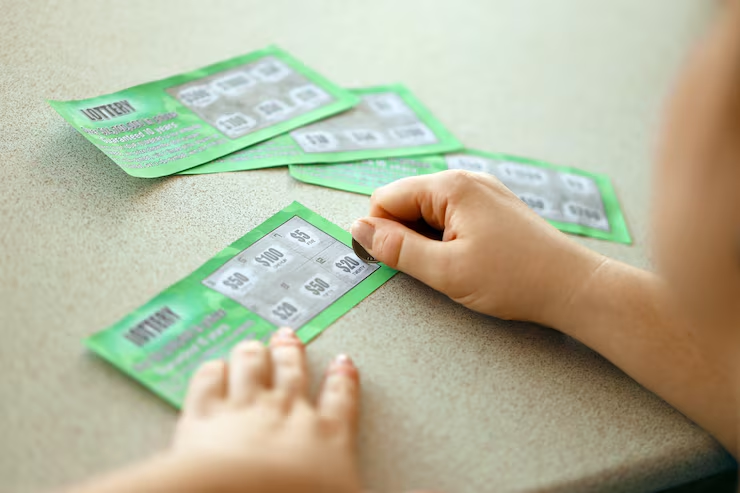
The Lottery Test
“Mom, figure it out. Not my problem. You’re sick,” my own daughter said, her voice dripping with annoyance before the line went dead.
I stared at the black screen of my smartphone, the silence of the kitchen amplifying the thudding of my heart. In my other hand, trembling slightly, I held a crumpled piece of paper worth $333 million.
Ashley had just failed the most important test of her life, and she didn’t even know it.
You are probably wondering how a sixty-seven-year-old grandmother from Ohio ended up with a fortune the size of a small country’s GDP, testing her own children like the antagonist in some twisted fairy tale. To understand the ending, I must take you back to the beginning. Back to a Tuesday morning three weeks ago that irrevocably altered the trajectory of my life.
The Numbers
My name is Sandra Williams, and for fifteen years, I have played the same lottery numbers: my late husband’s birthday, our anniversary, and the day my grandson, Jake, was born. Call it sentiment, call it stupidity, but those numbers were a tether to the people I loved.
Frank, my neighbor, always joked that I was throwing away good coffee money. “Sandra,” he’d say, leaning over the fence as I walked to Miller’s Corner Store, “the odds of winning are worse than getting struck by lightning while being eaten by a shark.”
That Tuesday started with the mundane rhythm of a life lived alone. I was nursing my morning coffee, the steam curling against the windowpane, watching the local news. The announcer’s voice was a drone in the background until I heard the first number.
Fourteen.
Then Twenty-three. Then Thirty-one.
My ceramic mug hit the table with a clatter, coffee sloshing over the rim. I scrambled to the refrigerator, snatching the ticket from under the magnet shaped like a pineapple. My eyes darted between the screen and the paper. All six numbers matched.
Three hundred and thirty-three million dollars. Even after the government took their generous slice, I was looking at over $200 million. It was more money than I could spend in ten lifetimes. It was enough to buy this entire neighborhood and turn it into a park.
My first instinct, visceral and immediate, was to call Derek, my son. Then Ashley, my daughter. Then little Jake—well, not so little anymore at twenty. I wanted to scream, to cry, to share this miracle with the blood of my blood.
But as my thumb hovered over Derek’s contact name, a cold, heavy feeling settled in my gut. It wasn’t joy. It was hesitation.
Memory has a funny way of intruding when you least expect it. I remembered last Christmas, overhearing Ashley whisper to her boyfriend about “finally getting some decent inheritance when the old lady kicks the bucket.” I remembered Derek’s constant, nagging hints about me selling the house—the house his father built—because it was “too big” and I should move into a “sensible” facility.
I lowered the phone. A terrifying thought took root: If I tell them now, will they love me, or will they love the money?
I decided to wait.
The Plan
For three weeks, I moved through my life like a ghost carrying a nuclear secret. I met with high-powered lawyers in glass towers downtown. I hired financial advisors who wore suits that cost more than my car. I set up the Williams Trust. I planned.
And then, I initiated the experiment.
The premise was simple. I would call my children, feign distress, and claim I couldn’t afford my heart medication. It wasn’t a total lie; I do take pills for my blood pressure, and they are exorbitantly expensive. But with my new bank balance, I could buy the pharmaceutical company.
I needed to know if they would help me when I had nothing to offer but my gratitude.
I called Ashley first. Her rejection was swift, brutal, and devoid of empathy. But that phone call wasn’t even the worst part of my test. Derek’s response was a knife twisted into my back.
When I called him, breathless and pleading, he didn’t even let me finish.
“Mom, I can’t keep enabling this behavior,” he said, using that patronizing, clipped tone he had perfected since becoming a branch manager at the bank. “You need to learn to live within your means.”
“Enabling this behavior?” I repeated, my voice barely a whisper. I almost laughed. This was the woman who had worked double shifts at the diner to pay for his college degree. This was the mother who had quietly paid off his student loans five years ago so he could buy a house.
“Derek, I’m not asking for much,” I said, trying to keep the tremor out of my voice. “Just enough to cover the prescription until my Social Security check arrives.”
“Look, Mom, this is exactly what Ashley and I were talking about. You’re getting older, and maybe it’s time to consider some changes. Have you looked into those senior communities we mentioned? They handle all your medications, meals, everything.”
Ashley and I were talking about. So, they had been conspiring behind my back. Discussing how to manage the ‘problem’ of their mother.
“Let me think about it,” I said, my heart turning to lead.
“And Mom,” Derek added, delivering the final blow, “I’m going to have to block your number for a while. Ashley thinks we’re being too soft. Sometimes, tough love is what people need to face reality.”
The line went dead.
I sat in my kitchen, the silence deafening. The same kitchen where I had bandaged Derek’s scraped knees, where I had held Ashley through her divorce. My own son had blocked me rather than part with a hundred dollars.
I looked at the lottery ticket on the table. It felt heavy, like a loaded gun. I had the means to change their lives, but they had just proven they didn’t deserve to be in mine.
There was one number left to call.
The Golden Thread
Jake.
My grandson was Ashley’s son, but he was an anomaly in our family tree. He had inherited none of his mother’s vanity or his uncle’s arrogance. He was the one who called just to ask how my garden was growing.
I dialed his number, my fingers shaking. If Jake failed me, I didn’t think I could survive the heartbreak.
“Grandma Sandra! What’s up?” His voice was warm, loud, and accompanied by the rushing sound of wind.
“Jake, honey, I hate to bother you,” I began, reciting the script I had used on his mother and uncle. “I’m in a bit of a pickle with my medication…”
There was a pause. My stomach clenched. I braced myself for the excuse, the lecture, the rejection.
“How much do you need?”
The words were immediate. Urgent.
“I’ve got about five hundred in my savings,” he continued, his voice rushing. “I can drive down this weekend. Are you okay? Do you need me to take you to the doctor right now? I can leave class.”
Five hundred dollars. That was likely every penny he had saved from sweeping floors at the campus bookstore. He was offering me his entire safety net without a second of hesitation.
Tears, hot and fast, streamed down my face. “Oh, sweetie, I couldn’t take your money.”
“Grandma, stop,” he said firmly. “You’ve never asked me for anything. I’m coming down. No arguments.”
I hung up the phone and wept. Not out of sadness, but out of relief. Jake had passed. He was the golden thread in a tapestry of disappointment.
But as for his mother and uncle? They were about to learn a very expensive lesson in family loyalty.
The Gift
That weekend, I bought Jake a car.
It wasn’t just any car. I knew his old beater had finally died last month, forcing him to take the bus. I went to the dealership and bought a brand-new, silver Honda Civic with every safety feature available.
You should have seen the look on Ashley’s face when she pulled into my driveway that Sunday afternoon. She saw the gleaming silver sedan parked next to my rusted Toyota, and she nearly drove her Mercedes—which I knew she was three months behind on payments for—into the mailbox.
Jake was in the driveway, washing the new car, grinning from ear to ear.
“Whose car is that?” Ashley demanded, slamming her car door. She didn’t even say hello.
“Mine!” Jake called out, dropping the soapy sponge to come give me a hug. “Mom, Grandma bought it for me! Can you believe it?”
I watched Ashley’s face cycle through a kaleidoscope of emotions: confusion, suspicion, and finally, a cold, hard anger. Her perfectly styled blonde hair was stiff with hairspray, immobile in the breeze.
“Mom, can we talk?” Ashley’s voice was tight, like a violin string about to snap.
Before I could answer, Derek’s SUV pulled up. He stepped out, adjusting his tie, and froze when he saw the Civic. His expression mirrored his sister’s perfectly.
The Confrontation
We gathered in the living room. It was the same room where they had opened Christmas presents for thirty years. Ashley perched on the edge of the sofa as if the fabric might contaminate her designer dress. Derek paced.
“Where did you get the money for a car?” Derek demanded, dispensing with pleasantries. “Last week, you were calling us, begging for help with prescriptions.”
“Was I begging?” I asked, tilting my head, genuinely curious about his revisionist history. “I thought I was asking my children for assistance. Silly me.”
“Don’t play games, Mom,” Ashley snapped. “How much did that car cost? Twenty thousand? Twenty-five? Where did the money come from?”
I settled into my favorite armchair, the one my husband had bought for our twentieth anniversary. I smoothed my skirt. “Well, I decided not to buy my heart medication this month. Apparently, cars for loving grandsons are more important than keeping this old ticker beating.”
Ashley gasped, a theatrical hand flying to her chest. “Mom, that’s crazy! You can’t stop taking your medication!”
“Oh,” I said, my voice dripping with saccharine sweetness. “Now you’re concerned about my health. How thoughtful.”
Derek stopped pacing. He ran a hand through his thinning hair. “This is insane. Jake! Get in here!”
My grandson appeared in the doorway, still beaming, wiping his hands on a rag. At twenty, he had his mother’s dark eyes, but they were filled with a kindness she had lost long ago.
“Jake, you can’t accept this car,” Derek said, his voice authoritative. “Your grandmother clearly isn’t thinking straight. She stopped taking her medication to buy you a vehicle. That’s not love. That’s… mental decline.”
“Uncle Derek, what are you talking about?” Jake looked confused. “Grandma’s fine. We stayed up until midnight talking about college and the economy. She’s sharper than all of us combined.”
“Son, your grandmother called us last week begging for money,” Ashley chimed in, her voice shrill. “Now suddenly she has twenty-five grand for a car? Something doesn’t add up.”
Jake’s expression shifted. He was a smart boy—scholarship to Ohio State, studying business. I watched him put the pieces together. He looked at his mother, then at his uncle, and a shadow of understanding darkened his eyes.
“You called them asking for help?” he asked me quietly.
“I did,” I replied. “I told them I needed help with my medication costs.”
“And what did they say?”
Derek and Ashley suddenly found the pattern of the carpet fascinating. The silence stretched, thick and suffocating.
“They said no, didn’t they?” Jake’s voice rose. “My own mother and uncle refused to help you with medicine you need to stay alive?”
“Now Jake, it’s not that simple—” Derek started.
“But when I offered to help,” Jake interrupted, turning to me with wonder, “you bought me a car instead.” He paused, his eyes widening. “This whole thing… it was a test, wasn’t it, Grandma?”
Smart boy.
The Truth Emerges
“A test?” Ashley’s voice hit a pitch that likely pained the neighborhood dogs. “Are you seriously telling me this was all some elaborate scheme?”
I looked at the woman I had given birth to. “Scheme is such an ugly word, Ashley. I prefer to think of it as a character assessment.”
“This is manipulation!” Derek shouted, his face reddening. “Pure and simple manipulation!”
“Is it manipulation when someone shows you their true colors?” I asked calmly. “I made a simple request for help. Jake offered everything he had. You, Derek, lectured me about ‘enabling behavior’ and blocked my number. Ashley told me it wasn’t her problem. Those were your choices. I just provided the scenario.”
“We had valid concerns!” Derek protested. “You’ve been struggling financially!”
“Have I?” I stood up, my knees popping slightly, and walked to my desk. I pulled out a manila folder I had prepared for this exact moment.
“Let’s talk about finances. Derek, remember that motorcycle you bought two years ago? The one you couldn’t afford? Who quietly paid off your credit card debt so you could get financing?”
Derek’s face went pale.
“And Ashley,” I turned to her. “That ‘wellness retreat’ in Bali after your divorce. Who do you think covered your rent for three months while you ‘found yourself’?”
“How did you—” Ashley started, then stopped.
“I know about all of it,” I said, my voice hardening. “Every emergency loan you never paid back. Every favor you forgot to acknowledge. Every time you took my help for granted while planning what you’d inherit when I’m gone.”
I sat back down. “Did you really think I was going to spend my remaining years being treated like a convenient ATM by my own children?”
“You guys have been taking money from Grandma while complaining about your finances to me?” Jake asked, looking at his mother with disgust. “You told me we couldn’t afford my textbooks!”
“That’s different!” Ashley cried. “We’re adults with responsibilities!”
“I’m a college student with a part-time job,” Jake shot back. “And Grandma taught me the value of working for what you want.”
“So what now?” Derek sneered, realizing he had lost the moral high ground. “You’re cutting us off? Choosing Jake over your own children?”
“I’m choosing kindness over entitlement,” I corrected. “Jake has never asked me for anything. Yet when I needed help, he offered everything. You two have asked for plenty and offered nothing.”
“Grandma,” Jake said softly, “can I ask you something?”
“Of course, sweetheart.”
“Just… how rich are you?”
I smiled. It was time for Phase Two.
The Revelation
“Jake, what would you say if I told you that your dear old grandmother won the lottery three weeks ago?”
The room went dead silent. You could hear the grandfather clock ticking in the hallway.
Derek snorted. “Mom, be serious. How much? A scratch-off? Five thousand?”
“Try again.”
I walked to the refrigerator and retrieved the ticket. It had been hanging there, innocuous and potent, for twenty-one days. I handed it to Jake.
“Read the numbers, sweetheart.”
Jake looked at the ticket. Then he pulled out his phone. His thumb moved rapidly. Then he looked back at the ticket. All the color drained from his face.
“Grandma… these are… this is the winning ticket for the Mega Millions jackpot.” He looked up, his eyes huge. “$333 million.”
Derek lunged for the ticket, but Jake pulled it back, tucking it into his pocket.
“Let me see that!” Ashley screamed.
“The ticket is just a souvenir now,” I said calmly. “The money has already been claimed. It’s currently sitting in a diversified portfolio of investments and trusts.”
I watched the realization hit them like a physical blow. Derek’s mouth opened and closed like a fish out of water. Ashley looked like she was going to faint.
“Two hundred million,” Derek whispered. “After taxes.”
“Give or take a few million in investment returns this week,” I added. “The market has been very kind to me.”
“Mom,” Ashley stammered, tears suddenly welling in her eyes. “I… we had no idea! If we had known—”
“If you had known I was rich, you would have helped me?” I finished for her. “Ashley, do you hear yourself? You would have helped your mother only if you knew there was a payout at the end.”
“That’s not what I meant!”
“Isn’t it?” I turned to Derek. “Son, if I were still living on my Social Security check and really needed that heart medication, would you help me right now?”
Derek’s hesitation was brief, but it was there. It was enough.
“I see,” I said. “Well, I think this conversation has been illuminating.”
“Grandma, I can’t accept this car,” Jake said, his voice shaking. “Not if… I mean, this is too much.”
“Jake, you offered me your life savings,” I said, reaching over to squeeze his hand. “That car isn’t charity. It’s a ‘thank you’ gift. And believe me, compared to what I have now, it’s pocket change.”
The Investigation
“Mom, please,” Derek said, his voice cracking. “We can work through this. We’re family.”
“Family?” I laughed, a sharp, bitter sound. “Let me show you what ‘family’ has been up to.”
I walked to my desk again and pulled out a thick, black binder. “Do you want to know what I did during the three weeks I was waiting to claim the money? I hired a private investigator. A man named Mr. Henderson.”
Ashley went dead white.
“I wanted to know exactly how my ‘struggling’ children were spending their money.” I opened the binder. “Derek, your motorcycle payment is six hundred a month. Ashley, your spa visits average four hundred. Between the two of you, you spent two thousand dollars at restaurants last month alone.”
“You… you had us investigated?” Derek whispered.
“You see, when you’re worth two hundred million dollars, you have to protect your assets,” I said coldly. “But Mr. Henderson found something else. Something far more interesting.”
I flipped a page. “He found your discussions about my estate. Apparently, Derek, you’ve been telling people at the bank that I’m developing dementia.”
Jake whirled around to face his uncle. “Uncle Derek, tell me that isn’t true.”
Derek stared at the floor.
“He’s been setting the groundwork to challenge my mental competency,” I explained to Jake. “And Ashley? You’ve been researching guardianship laws. You found out that if I’m declared incompetent, you two could control my assets.”
“Mom, I never—” Ashley sobbed.
“I have the search history, dear. And the text messages between you two.” I held up a flash drive. “Amazing what digital forensics can uncover.”
“I think I’m going to be sick,” Jake muttered, sinking onto the sofa.
“Don’t worry, sweetheart,” I said. “The good news is that your inheritance is secure. I’ve had myself examined by three doctors and a psychiatrist. I am legally certified as sound of mind. The bad news for your mother and uncle… well, that’s where the fun begins.”
The Consequences
“What do you mean?” Derek asked, looking terrified.
“I decided to purchase some assets,” I said, pouring myself a glass of water. “Specifically, your debts.”
“Our debts?”
“Derek, your motorcycle loan, your car loan, and your credit cards. Ashley, your maxed-out Visas and your Mercedes loan. I bought them all from your creditors this morning.”
“That’s… that’s good, right?” Ashley asked, looking confused. “You paid them off?”
“Oh, no, dear. I didn’t pay them off as gifts. I bought the debt. I am now your creditor.”
I picked up a document. “Derek, you owe me $78,000, including the personal loans you never repaid. Ashley, you owe me $89,000.”
“Almost ninety thousand dollars?” Ashley shrieked.
“And as your new lender,” I continued, “I have implemented new terms. Twenty-four percent interest, compounded monthly. The full balance is due in thirty days, or I begin legal collection proceedings. Which includes seizing assets.”
“You can’t do that!” Derek yelled. “We don’t have that kind of money!”
“I know,” I said calmly. “Derek, you have twelve hundred in savings. Ashley, you have eight hundred. I’ve done my homework.”
“Mom, please!” Ashley begged. “We’ll do anything! We’ll work for you! We can manage your finances!”
“Manage my finances?” I raised an eyebrow. “The woman who can’t pay her credit card bill wants to manage a multi-million dollar trust? I don’t think so.”
“Then what do you want us to do?” Derek cried.
“I want you to figure it out,” I said, echoing the words Ashley had said to me. “But I’m not heartless. I have arranged for employment opportunities for both of you.”
I handed Derek a piece of paper. “Miller’s Diner needs a dishwasher. Minimum wage, but it’s honest work. I worked there for twenty years to put you through school. It seems fitting.”
Derek looked at the paper as if it were radioactive.
“And Ashley,” I handed her a flyer. “The grocery store needs an overnight stocker. It pays slightly above minimum wage.”
“You want us to work manual labor?” Ashley hissed.
“I want you to understand what it feels like to work for every dollar,” I said. “Consider it character building.”
“And if we refuse?” Derek challenged.
“Then I seize your house, your motorcycle, and your Mercedes,” I said simply. “And I will see you in court. And given my resources, I will keep you in court until you are destitute.”
The Choice
The room fell silent. They looked at me, then at Jake, then at the door.
“Mom, why?” Derek asked, his voice broken. “Why go this far?”
I stood up and walked to the window, looking out at the garden I had tended for thirty years.
“Because if you had just helped me when I asked—if you had shown even a shred of basic human kindness to the woman who gave you life—none of this would have happened. I would have shared my fortune gladly.”
I turned back to them. “You can’t buy love, Derek. But you can definitely put a price on greed. And you both just found out exactly what that price is.”
“Get out,” I said softly.
They left. No screaming, no slamming doors. Just the shuffle of defeated feet. They walked out of my house and into a world that was suddenly much colder than they remembered.
Jake remained on the sofa, staring at me.
“Grandma,” he whispered. “You orchestrated all of that?”
“Orchestrated is a dramatic word,” I smiled, feeling a weight lift off my shoulders. “I prefer to think of it as tidying up.”
“What happens now?”
“Now?” I sat beside him. “Now, you finish college without a mountain of debt. I’ve set up a trust for you. Your tuition, your housing, everything is covered through grad school.”
“Grandma, I…”
“And the rest of the money?” I looked around the room. “I think I’m going to do some traveling. And I’m going to donate a significant amount to a charity that helps elderly people who don’t have family to rely on.”
Jake hugged me then. It wasn’t the hug of a boy who had just been given a fortune. It was the hug of a grandson who was just glad his grandmother was okay.
“Thank you,” he said. “For the car. But mostly for… you know. Trusting me.”
I held him tight. The lottery had given me money, yes. But my children had given me something far more valuable. They had given me the truth.
I had lost a son and a daughter that day, but I had gained a true heir. And as I looked at the silver Honda Civic gleaming in the driveway, I knew that was a trade I would make a million times over.
The lottery ticket still hung on my refrigerator, held by that pineapple magnet. Sometimes I’d walk past it and smile, remembering. Not the money—the money was just paper, just numbers in an account. What I remembered was the clarity. The moment when all pretense fell away and people showed me who they really were.
Frank still leaned over the fence sometimes, asking if I’d won anything lately. I’d smile and say no, just my usual luck. And technically, that was true. The winning ticket was already claimed, already spent on lawyers and investments and one very important test.
Jake graduated with honors two years later. At his graduation party, Derek and Ashley showed up—thinner, more humble, working their way through the debt I’d carefully structured to be just barely manageable if they worked hard and lived frugally. They’d learned, slowly and painfully, what it meant to struggle.
They didn’t ask for forgiveness. They didn’t expect to be welcomed back with open arms. They simply came to watch their nephew graduate, sitting in the back row, understanding that some bridges, once burned, can never be fully rebuilt.
But sometimes, I thought, a scorched bridge is better than a false one. Better to know where you stand in the ruins than to live in a beautiful lie.
My name is Sandra Williams. I’m sixty-nine years old now, living comfortably in the house my husband built, watching my grandson build a life of integrity and kindness. I won the lottery once, and in doing so, I learned the most valuable lesson of all.
Love can’t be bought. But it can certainly be tested. And sometimes, the kindest thing you can do for the people you love is show them exactly who they are—and give them the chance to decide if that’s who they want to be.