The Shoemaker’s Gift
The morning sun had just begun to warm the narrow streets of Ashford Glen when young Evelyn Harper realized her school fees were missing. She had tucked the money carefully into her backpack, but in her rush to reach the academy before the gates closed, she had forgotten to zip it properly. Tears welled up in her eyes as she retraced her steps, heart pounding with fear and desperation.
The cobblestones beneath her worn shoes seemed to mock her with their smoothness—each one a reminder of how carefully she usually moved through life, how rarely she made mistakes. But this morning, distracted by her stepfather’s angry warnings and her mother’s worried face, she had been careless. And now the consequences felt insurmountable.
People passed by, some glancing curiously at the crying girl in the faded school uniform, yet none offered help. A woman in a fine coat hurried past, pulling her own daughter closer as if poverty might be contagious. A businessman checked his watch and quickened his pace. A street vendor turned away, pretending not to notice. In Ashford Glen, everyone had troubles of their own, and a crying child was just another piece of urban background noise.
The Shoemaker
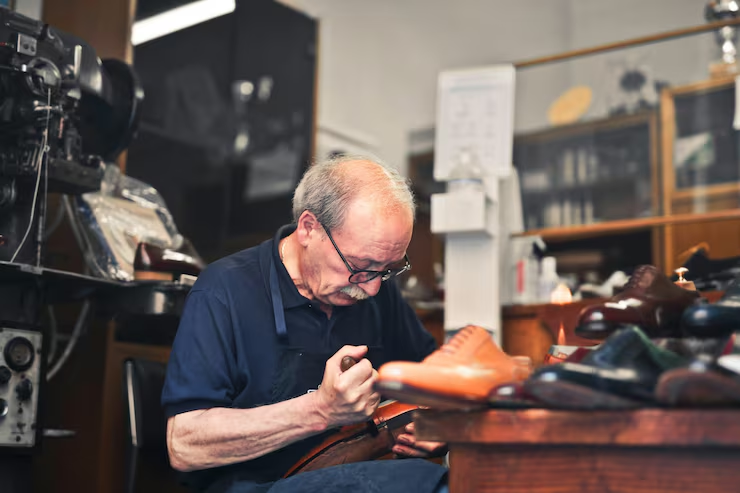
In a quiet corner beside a tiny cobblestone workshop, a man named Gideon Pierce polished leather shoes, the air around him filled with the smell of wax and tanned hides. His hands moved with practiced efficiency, decades of muscle memory guiding the cloth across worn leather, coaxing a shine from shoes that had seen better days. He was sixty-three years old, his back bent from years of labor, his fingers permanently stained with polish and dye.
His eyes caught sight of Evelyn’s tear-streaked face, and something stirred within him. Perhaps it was the memory of his own daughter, lost to illness fifteen years ago. Perhaps it was simply the impulse of a man who had known suffering and recognized it in others. He stood slowly, joints protesting, and wiped his hands on his worn apron.
“Child, why are you crying so?” he asked softly.
Evelyn looked up, startled. Through her tears, she saw a man with kind eyes, weathered hands, and a gentle expression that reminded her of her late father—her real father, who had died when she was five, before her mother had married Marcus, the man who now ruled their home with an iron fist and a quick temper.
She sniffed and attempted to steady herself. “Sir, I lost my school fees. I searched everywhere, but I cannot find them. My stepfather… he gave me the money to pay the school today, and if I don’t, he’ll punish me and maybe even kick my mother and me out.”
Her voice trembled as she spoke, and Gideon felt his heart constrict. He knew the type of man she described—he’d encountered enough of them in his sixty-three years. Men who measured love in transactions, who wielded fear like a weapon, who confused control with care.
“How much do you need?” he asked gently.
“Four thousand,” Evelyn replied, the number feeling impossibly large in her small mouth.
Gideon’s workshop barely earned him enough to survive, and most days he went without a proper meal to ensure his grandson Miles had food in his belly. The four thousand in his pocket represented an entire month of labor—thirty days of bent back and aching hands, of skipped lunches and evening hunger pangs. It was meant for rent, for the landlord who came on the first of every month with outstretched hand and zero sympathy.
Yet when he looked at Evelyn—at her tear-stained uniform, her desperate eyes, her trembling hands—a determination arose that ignored his own struggles.
Without a word, Gideon reached into his pocket and handed her the bundle of notes he had saved all month.
“Take it, child. Go and pay your fees,” he said, his smile faint but sincere.
Evelyn stared in disbelief. “Are you sure, sir? This is so much money. What about you?”
“I am sure, Evelyn,” he replied, somehow knowing her name though she hadn’t spoken it, as if the universe itself had whispered it to him. “Be diligent in school, and never follow bad company. Study hard. Make something of yourself. One day, you will rise above all this.”
Clutching the money, Evelyn wiped her tears. “I will never forget you. I promise I will make you proud. What is your name, sir?”
“Gideon Pierce,” he said simply. “And that workshop there—that’s where you’ll find me, should you ever need me again.”
Evelyn memorized his face, his name, the exact location of his tiny shop. She committed it all to memory with the fierce determination of a child who understands that some debts can never be repaid, only honored.
“Thank you, Mr. Pierce. Thank you so much.”
Gideon placed a hand on her head, muttering a quiet prayer—words his own grandmother had taught him, words about protection and guidance and the strange grace that sometimes visits the world—then returned to his humble work.
The Consequences
At school, Evelyn paid her fees, holding the receipt like a lifeline. The school secretary barely looked at her, just stamped the paper and waved her toward class. But Evelyn folded that receipt carefully, placed it in the innermost pocket of her bag, and vowed to keep it forever.
At home that evening, her mother, Clarisse, looked anxious as ever. She was a thin woman, once beautiful but now worn down by years of walking on eggshells, of managing Marcus’s moods, of making herself smaller and quieter to avoid triggering his rage.
When Evelyn confessed she had lost the money, Clarisse’s face tightened with worry. “Your stepfather… he will be furious,” she whispered, glancing nervously toward the door as if Marcus might materialize at any moment.
“But Mama, I found help,” Evelyn said quickly. “A man—a shoemaker—he gave me the money. He gave me all of it.”
Clarisse blinked, moved by the story of the poor shoemaker who had given his last money to save a child he didn’t know. Tears filled her eyes—not from fear this time, but from something else. Hope, perhaps. Or the reminder that goodness still existed in the world.
“We must find him,” she said softly. “We must thank him properly. What was his name?”
“Gideon Pierce. He has a workshop on Fletcher Street.”
“Tomorrow,” Clarisse promised. “Tomorrow we’ll go together and thank him.”
But tomorrow came too late for Gideon.
The Eviction
That very afternoon, tragedy struck. A team of city workers arrived at Gideon’s workshop, clipboards in hand and determination in their eyes. The lead inspector, a man with a bureaucrat’s cold efficiency, announced that the workshop occupied government land and must be demolished immediately.
“You can’t do this,” Gideon protested, his voice cracking. “I’ve been here for twenty years. I have permits—”
“Your permits are outdated,” the inspector said, not unkindly but not kindly either. “This land has been rezoned. New development is coming. You have thirty minutes to remove your personal belongings.”
Gideon tried to gather his tools and materials, but thirty minutes was nowhere near enough time. They tore the shed apart while he scrambled to save what he could—his grandfather’s hammer, a few pairs of unfinished shoes, the tin where he kept his meager earnings. Everything else—the workbench his father had built, the leather and supplies he’d accumulated over decades, the sign he’d painted himself—was scattered across the dirt street like garbage.
Exhausted and heartbroken, Gideon carried his small hammer and a single box of salvaged tools back to the boarding house where he and his grandson lived. But when he arrived, he found their possessions sitting in the street.
The landlord, Mrs. Chen, stood on the steps with her arms crossed. She was a stern woman with little patience and even less compassion.
“Your rent was due yesterday, Pierce. You promised me by noon. It’s four o’clock and you show up empty-handed.”
“Please, Mrs. Chen, I had the money but—”
“But nothing. Out. Both of you. I have new tenants moving in tomorrow who actually pay on time.”
“But my grandson—he’s only sixteen. Where will we—”
“Not my problem,” she said, and turned her back, closing the door with finality.
Miles, Gideon’s grandson, sat on their pile of belongings with tears streaming down his face. He was a gentle boy, studious and kind, who had lost both parents in a car accident when he was eight. Gideon had raised him alone ever since, sacrificing everything to ensure Miles could finish school.
“Grandfather, what do we do?” Miles whispered.
The night was cold, the pavement unforgiving, yet Gideon held Miles close, whispering words of hope and faith. “We survive, boy. We’ve survived worse. Remember the winter when your parents died? We survived that. We’ll survive this too.”
They spent the night under the awning of a closed shop, their possessions stacked around them like a fortress against the world. Gideon didn’t sleep. He kept watch, one hand on his hammer, protecting his grandson and their meager belongings from thieves and the cold.
The Friend
By morning, Gideon made a decision. They couldn’t stay in Ashford Glen. There was nothing left for them here. But he had an old friend, Samuel Vance, who lived in the nearby town of Eastbridge. Samuel had been Gideon’s apprentice forty years ago, before opening his own successful shoe repair business. They’d stayed in touch over the years, exchanging letters during holidays.
With what little money he had left from the previous week—money he’d hidden in his shoe, a habit from years of poverty—Gideon purchased two bus tickets to Eastbridge.
The journey took an hour, during which Miles slept against his grandfather’s shoulder while Gideon stared out the window, watching the landscape change from urban decay to rolling hills and small towns. He prayed silently, asking for guidance, for strength, for one more chance to provide for his grandson.
When they arrived at Samuel’s shop, the older man took one look at them—disheveled, exhausted, carrying everything they owned in two battered suitcases—and opened his arms without questions.
“Brother,” Samuel said simply. “Come in.”
Over tea, Gideon explained everything. The girl. The school fees. The demolished workshop. The eviction. Samuel listened without interrupting, his weathered face growing more thoughtful with each detail.
When Gideon finished, Samuel stood and walked to his safe. He returned with a bundle of cash and a set of keys.
“I have a small house,” Samuel said. “It belonged to my mother. It’s been empty since she passed last year. It’s yours. And this money—it’s enough to restart your workshop. Pay me back when you can, or don’t pay me back at all. It doesn’t matter.”
Tears streamed down Gideon’s face as he realized that in one night, their lives had shifted from despair to hope. He thought of the money he’d given to Evelyn, and how he’d worried that his generosity might have destroyed his grandson’s future. But here was proof—undeniable, tangible proof—that goodness begets goodness, that what you cast upon the waters returns multiplied.
“I don’t know what to say,” Gideon whispered.
“Say you’ll accept,” Samuel replied. “And say you’ll teach your grandson the trade, because I’m getting old and I need someone trustworthy to eventually take over this shop.”
Miles looked up with wonder. “Really? You’d teach me?”
“If your grandfather agrees, then yes. The Pierce name means quality and integrity. I’d be honored to continue working with it.”
Years Pass
The years that followed were not easy, but they were good. Gideon rebuilt his business slowly, servicing the small community of Eastbridge with the same care and attention he’d given to customers in Ashford Glen. Miles proved to be an exceptional student of the craft, his young hands learning quickly, his eye for detail surpassing even Gideon’s.
Miles attended the local secondary school, then enrolled in the regional university, studying business management while continuing to work in the shop on weekends. He graduated at twenty-two with honors, but found that the job market had no use for graduates without connections or family wealth.
So Miles returned to the workshop, donning his grandfather’s old apron, polishing shoes and helping customers. Despite the disappointment, he remained hopeful. He’d learned from Gideon that honest work was never beneath anyone, that dignity came from how you treated people, not from what title appeared on your business card.
Meanwhile, in Ashford Glen, Evelyn’s life had transformed entirely.
The day after Gideon gave her the school fees, she and her mother had gone to Fletcher Street to thank him, only to find an empty lot and scattered debris. They asked neighbors, shopkeepers, anyone who might know where Gideon Pierce had gone. But no one knew. Or if they knew, they didn’t care enough to remember.
Clarisse, moved by the shoemaker’s sacrifice, made her own difficult decision. She left Marcus, taking Evelyn with her. It wasn’t easy—they spent months in a women’s shelter, then in a tiny apartment Clarisse could barely afford on her waitress salary. But they were free. Free from fear, free from walking on eggshells, free to build something better.
Clarisse worked three jobs while Evelyn studied. The girl who had once cried over lost school fees became a scholar, driven by a promise she’d made to a kind stranger. She received a scholarship to university, then another to business school. She graduated top of her class and immediately started her own company—a logistics firm that connected small manufacturers with retail distributors, cutting out the expensive middlemen.
The business thrived. Within five years, Evelyn was wealthy. Within ten, she was very wealthy. She bought her mother a house, hired staff, ensured Clarisse would never have to work another day unless she wanted to.
But Evelyn never forgot. Every year on the anniversary of that terrible morning when she’d lost her school fees, she returned to Ashford Glen. She walked Fletcher Street, hoping to find some trace of Gideon Pierce. She hired investigators, placed advertisements in newspapers, searched public records. But Gideon seemed to have vanished completely.
Still, Evelyn kept searching. It became her mission, her obsession. The debt she owed wasn’t just financial—it was existential. That man had saved her life, had given her hope when she had none. She needed to find him. She needed to say thank you.
The Intersection
On a Saturday morning in his twenty-fourth year, as Miles adjusted the straps on a customer’s shoe outside the Eastbridge workshop, a sleek black car pulled up, and a well-dressed woman stepped out.
She was perhaps fifty, elegant and composed, with sharp eyes that seemed to assess everything instantly. Her shoes were expensive Italian leather, but the buckle on one had come loose.
“Could you help me with this buckle?” she asked, her voice calm yet authoritative.
Miles carefully examined the shoe. “It’s just worked itself loose. One moment.” He retrieved a small tool from his kit and secured the buckle properly, testing it to ensure it would hold.
“How much do I owe you?” the woman asked, reaching for her purse.
Miles smiled and shook his head. “It’s nothing, ma’am. Just a quick fix. No charge.”
The woman, Madame Vivian Hartley, observed him closely. She had been searching for a trustworthy driver, someone diligent and honest. In her world of wealth and privilege, those qualities were surprisingly rare. Most people saw her money and either tried to take advantage or became obsequious and false.
But this young man had refused payment for his work. More importantly, he’d done the work well, with care and attention, even knowing he wouldn’t be paid.
She handed him a business card. “I’m looking for a driver. Someone reliable and honest. The position includes accommodation, meals, and a salary that I suspect is better than what you’re earning here. Call me tomorrow if you’re interested.”
Miles stared at the card. Vivian Hartley, CEO, Hartley Industries. He knew the name—everyone in the region did. Hartley Industries was one of the largest manufacturing companies in the country.
“I… thank you, ma’am. I’ll discuss it with my grandfather and call you.”
That evening, Miles rushed home, sharing the news with Gideon. Their hearts swelled with cautious optimism. Gideon, older now and wiser, urged caution. “Verify everything, boy. Make sure this is legitimate. But if it is… this could be the opportunity we’ve prayed for.”
Miles called the next day. The interview was thorough—background checks, driving tests, a meeting with Madame Hartley’s security team. But within a week, Miles had the position.
He moved into a small but comfortable apartment above the Hartley family’s garage, drove Madame Hartley to meetings and appointments, and gradually became trusted not just as an employee but almost as family.
Six months into the position, he met her daughter.
Evelina Hartley was twenty-eight, brilliant and beautiful, with her mother’s sharp mind and a warmth that seemed to radiate from within. She ran the charitable foundation attached to Hartley Industries, managing millions in grants and donations to causes across the country.
Miles first saw her when he drove Madame Hartley to the foundation’s offices. Evelina came out to greet her mother, and when she smiled at Miles in thanks for opening the car door, something in his chest tightened.
Over the following weeks, their paths crossed frequently. She would join her mother for dinners, charity events, business meetings. And always, she spoke to Miles—not with the condescension of wealth speaking to service, but with genuine interest. She asked about his life, his grandfather, his studies. She laughed at his jokes. She remembered details he’d mentioned in passing.
Slowly, cautiously, Miles felt himself falling in love.
The Search Ends
What Miles didn’t know was that Evelina had noticed him too. Had been drawn to his kindness, his integrity, the way he treated everyone—from the CEO to the parking attendant—with equal respect. She’d asked her mother about him, learned his story, and found herself thinking about him more than was probably appropriate.
Vivian, no fool, watched the dynamic developing and chose not to interfere. She’d known since Evelina was a teenager that her daughter would never marry for convenience or status. Evelina would marry for love, or not at all. And if she’d found that love in a young man who fixed shoe buckles and drove cars with equal care and attention, then Vivian would support it.
Meanwhile, Evelyn’s search continued. She’d expanded her investigation nationwide, hiring the best private investigators money could buy. And finally, twelve years after that morning in Ashford Glen, they found him.
“Gideon Pierce, age seventy-five, living in Eastbridge. Runs a small shoe repair shop with his grandson Miles Pierce, age twenty-four.”
Evelyn’s hands trembled as she read the report. After all these years. After all the searching. She’d found him.
She drove to Eastbridge immediately, her heart pounding the entire three-hour journey. When she arrived at the address—a modest shop on a quiet street—she sat in her car for ten minutes, gathering courage.
What would she say? How do you thank someone for saving your life? How do you repay a debt that can never truly be repaid?
Finally, she stepped out of the car and walked into the shop.
Gideon was there, older now, his hair completely white, his hands more gnarled with arthritis. He looked up from the shoe he was working on and smiled the same gentle smile he’d given a crying girl twelve years ago.
“Can I help you, miss?”
“Mr. Pierce? Mr. Gideon Pierce?”
“Yes, that’s me.”
Evelyn felt tears streaming down her face. “Do you remember me? Twelve years ago, in Ashford Glen. I was a little girl who lost her school fees. You gave me your rent money.”
Gideon’s eyes widened. The shoe dropped from his hands. “Evelyn?” he whispered. “Little Evelyn Harper?”
“Yes,” she sobbed. “Yes, it’s me.”
He stood, moved around the counter, and without a word, pulled her into a hug. They stood there, the old shoemaker and the successful businesswoman, crying together in a tiny shop in Eastbridge.
“I looked for you,” Evelyn said when she could speak. “I’ve been looking for twelve years. I needed to say thank you. I needed to tell you that you changed my life, that everything I have is because you gave me hope when I had none.”
“Child,” Gideon said gently, “you don’t owe me anything. Seeing you here, seeing that you’re well—that’s thanks enough.”
“No,” Evelyn said firmly. “It’s not. Please, let me help you. Let me give back even a fraction of what you gave me.”
The Reunion
Over the next weeks, Evelyn learned everything about Gideon’s life since that morning in Ashford Glen. She met Miles, was charmed by his kindness and humility, and understood immediately why Vivian Hartley had hired him.
And then, at a dinner Evelyn arranged to celebrate finding Gideon, she met Evelina.
The connection was instant. They were close in age, shared similar values, had both built careers around helping others. They talked for hours that first night, discovering a friendship that felt destined.
It was Evelina who first realized the strange connection forming. “Wait,” she said slowly. “Your grandfather is Gideon Pierce?”
Miles nodded. “Yes. Why?”
“And you work for my mother. As her driver.”
“Yes…”
Evelina started laughing. “This is insane. Miles, Evelyn is like my sister now. We talk every day. And you—you’re my…” She paused, blushing. “You’re important to me.”
Miles’s heart began to race. “Important?”
“Very important,” Evelina said softly.
Evelyn, watching this exchange with growing delight, suddenly understood. “You’re in love with him.”
Evelina nodded, not looking away from Miles. “I am.”
“And you?” Evelyn asked Miles. “How do you feel?”
Miles, who’d been taught by his grandfather to be honest even when honesty was terrifying, said simply, “I’ve loved her since the first day I saw her.”
What followed was a whirlwind. Courtship that was both careful and inevitable. Dinners and conversations and long walks where they learned each other’s hearts. Vivian Hartley gave her blessing enthusiastically. Gideon, watching his grandson fall in love with a woman of character and kindness, wept with joy.
Two years later, they married. It was a small ceremony despite the Hartley family wealth—Evelina insisted on intimate and meaningful rather than grand and impressive. Gideon walked Miles down the aisle. Evelyn served as Evelina’s maid of honor. Clarisse and Vivian became fast friends.
And before the wedding, Evelyn had made good on her promise to repay Gideon.
She purchased a beautiful house for him—nothing ostentatious, but comfortable and warm, with a garden and space for a proper workshop. She set up a trust fund to ensure he’d never want for anything again. She hired staff to help with cooking and cleaning, freeing Gideon to spend his final years doing what he loved: crafting beautiful shoes and teaching young apprentices the trade.
But the greatest gift came during the wedding toast, when Evelyn stood and told the assembled guests the story. The story of a crying girl, a kind shoemaker, and four thousand in rent money that changed multiple lives.
“Gideon Pierce gave me everything when he had nothing,” Evelyn said, her voice ringing clear. “He taught me that wealth isn’t measured in money, but in the generosity of spirit. That a person’s worth isn’t determined by what they have, but by what they’re willing to give. Because of him, I’m here. Because of him, my mother is free. Because of him, I learned that one act of kindness can ripple forward for years, touching lives in ways we can never predict or fully understand.”
She raised her glass. “To Gideon Pierce. The richest man I’ve ever known.”
Legacy
Gideon lived another ten years, long enough to meet his great-grandchildren—twin girls born to Miles and Evelina, spirited and kind like their parents. He taught them to tie their shoes, to polish leather, to understand that all honest work is noble work.
He died peacefully in his sleep at eighty-five, surrounded by family, his last words a prayer of thanksgiving for a life that had been hard but ultimately beautiful.
At his funeral, hundreds came. Not just family, but people whose lives he’d touched over decades of quiet generosity. Former customers who remembered a time he’d repaired their shoes for free when they couldn’t pay. Students he’d mentored. Neighbors he’d helped.
Evelyn gave the eulogy, and she began with the truth: “Gideon Pierce was the kindest man I ever knew. He taught me everything that matters. And he did it with four thousand in crumpled bills and a smile that said, ‘You’re worth saving.'”
The foundation Evelyn established in Gideon’s name still operates today, providing school fees and emergency assistance to struggling families. The Pierce & Hartley Workshop, run by Miles and his daughters, is known throughout the region for quality craftsmanship and fair dealing.
And in the entrance of Evelyn’s corporate headquarters hangs a photograph: a young girl in a faded school uniform standing next to an elderly man in a worn apron, both smiling at the camera.
Beneath it, a plaque reads: “From small kindnesses, mighty legacies grow.”
From the tears on a sunlit street to a thriving family filled with love and success, the story of Evelyn, Gideon, and Miles became a testament to the power of generosity, hope, and unwavering faith in human goodness.
Because in the end, that’s what Gideon had given Evelyn—not just money, but faith. Faith that the world could be kind. Faith that she mattered. Faith that one person, acting with courage and compassion, could change the course of history.
And history proved him right.