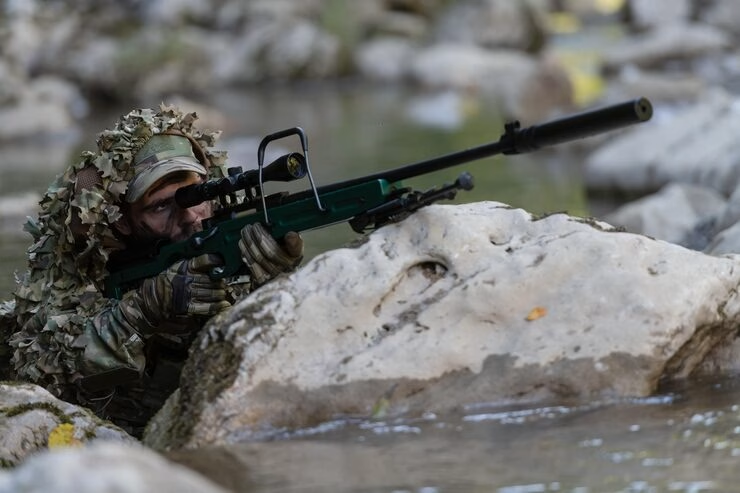
Ghost 13
The air in the strategic briefing room at MacDill Air Force Base always smelled the same: burnt coffee, industrial floor wax, and the metallic tang of aggressive air conditioning. It was a cold, sterile scent—the olfactory signature of bureaucracy and unyielded power.
I sat in the back row, seat Z-14. My spine was fused to the hard plastic of the chair, my posture rigid enough to calibrate a carpenter’s level. My uniform was pressed sharp enough to draw blood, my blonde hair pulled back into a regulation bun so tight it pulled at my temples. I made myself small. I made myself invisible. It was a survival mechanism I had perfected over three decades—not in SERE school, but at the dinner table.
Down in the front row, bathed in the harsh glow of the fluorescent lights, sat the VIPs. And right in the center, holding court like a king on a throne, was my father, General Arthur Neves.
He was sixty, but he wore his years like medals. His silver hair was cut in a high-and-tight fade that defied gravity, and his skin was tanned from weekends on the golf course with senators. He was laughing loudly at something a Lieutenant Colonel had just whispered to him. It was a booming, practiced laugh, designed to suck the oxygen out of the room and remind everyone who owned the lungs in the building.
“That’s rich, Johnson. That’s rich!” my father bellowed, slapping his knee.
The surrounding officers chuckled in unison, a chorus of sycophants. They didn’t laugh because it was funny. They laughed because he was a three-star General, and their mortgages depended on his mood.
I looked down at my hands. They were steady. They had to be. I thought of Marcus Aurelius, the stoic emperor I read every night before bed. The best revenge is to be unlike him who performed the injury.
Then, the atmosphere in the room shifted. It wasn’t a sound; it was a drop in barometric pressure.
The Entrance
The heavy double doors at the back of the auditorium didn’t creak open; they burst inward with controlled violence. The chatter died instantly. Even my father’s laughter was cut short, caught in his throat like a fishbone.
A man stalked in. He didn’t walk; he occupied space. He was wearing the Navy Working Uniform, the digital camouflage looking jarringly out of place in our sea of Air Force blue. On his collar, the silver eagle of a full Colonel. On his chest, the trident of a Navy SEAL.
Colonel Marcus Hale.
I knew him. Not socially, but operationally. We had shared an extraction helicopter in Kandahar three years ago while the world burned beneath us. He was a legend in the special operations community—a man who didn’t play politics. He played for keeps.
He ignored the two hundred heads turning toward him. He ignored protocol. He walked straight down the center aisle, his boots thudding rhythmically against the carpet, and stopped ten feet from the stage, staring directly at the panel of generals.
“General Neves,” Hale said. His voice wasn’t loud, but it carried to the back of the room with the terrifying clarity of a slide racking on a pistol. It was gravel and sandpaper.
My father blinked, clearly annoyed at having his spotlight stolen. He adjusted his tie, donning his mask of the benevolent leader. “Colonel Hale. To what do we owe this interruption? We are in the middle of a strategic assessment.”
“I don’t have time for assessments, General,” Hale said, cutting him off. “I have a situation developing in the Sierra Tango sector. I need a Tier One asset. Immediate deployment.”
My father scoffed, leaning back in his chair. “We have plenty of pilots here, Colonel. Take your pick.”
“I don’t need a pilot,” Hale said. “I need a Ghost. Specifically, a TS/SCI clearance sniper with deep reconnaissance capability.”
The room went silent. TS/SCI—Top Secret/Sensitive Compartmented Information. That wasn’t just high clearance. That was doesn’t exist clearance.
Hale scanned the room, his eyes moving like a predator seeking prey. “I was told the asset is in this room.”
My heart hammered against my ribs like a trapped bird. Do it, Lucia.
I stood up. The sound of my chair scraping against the floor echoed like a gunshot in a library.
Heads turned. Two hundred pairs of eyes shifted from the stage to the back row. I stood at attention, shoulders back, chin up, a perfect statue of military discipline. Marcus Hale turned slowly, his eyes locking onto mine. There was no recognition in his face, just professional assessment. He nodded once.
But before he could speak, a voice boomed from the front.
“Sit down!”
It was my father. He wasn’t looking at Hale anymore. He was looking at me. His face had transformed. The benevolent leader was gone. In his place was the man who used to inspect my room with a white glove when I was ten. His face was twisted in a mixture of embarrassment and rage.
“Major Neves,” he barked, his voice dripping with condescension. “Did you not hear me? I said, sit down.”
“General,” I started, my voice steady despite the trembling in my knees. “The Colonel requested—”
“I don’t care what he requested!” my father shouted, standing up to assert his dominance. He looked around the room, offering a tight, apologetic smile to the other officers, as if I were an unruly toddler who had just spilled juice on the carpet.
“Apologies, gentlemen,” my father said, his tone shifting to a dismissive chuckle. He pointed a finger at me—a finger that felt like a weapon. “My daughter… she gets confused. She works in administration. Logistics. Paper clips and fuel trucks. She has a tendency to overstate her importance.”
The room exhaled. The tension broke. A ripple of laughter spread through the crowd.
“Admin,” someone whispered nearby. “She stood up for a sniper request? That’s rich.”
“Sit down, Lucia,” my father said, his voice dropping to a dangerous low growl that only family members would recognize. “You are a zero in this equation. Don’t make me ashamed of you. Not here.”
Pride goes before destruction, and a haughty spirit before a fall. The verse from Proverbs flashed in my mind.
I stood there for three seconds. Three seconds that felt like three lifetimes. I felt the heat rising in my cheeks, not from shame, but from a cold, hard fury. He didn’t just dismiss me; he erased me. To him, the uniform I wore was a costume. The rank on my shoulder was a decoration.
I slowly lowered myself back into the chair.
My father nodded, satisfied. He had put the dog back in the kennel. He turned back to Marcus Hale, flashing a winning smile. “Now, Colonel, let’s find you a real operator, shall we?”
But I wasn’t looking at the floor anymore. I lifted my head and looked straight at my father’s back. He turned his head slightly, catching my eye for a brief second before dismissing me again. That look—it was the same look of utter, casual contempt I had seen fifteen years ago.
And just like that, the briefing room melted away.
Thanksgiving, Fifteen Years Ago
I was eighteen years old again. It was Thanksgiving Day in Northern Virginia.
Our house was a sprawling colonial-style mansion with white pillars and a manicured lawn that looked like it had been cut with nail scissors. Inside, it was a museum of my father’s ego: framed photos of him shaking hands with senators, shadow boxes filled with his medals, and an American flag folded into a perfect triangle on the mantle.
The dining room table was set with the good china. My mother had spent three days preparing the meal, but the air was so cold you could see your breath.
“Pass the gravy,” my father said, not looking up from his plate. In the background, the Dallas Cowboys game blared from the living room TV.
I took a deep breath. My hands were shaking under the table. I had news. Big news.
“Dad,” I started, my voice small. “I got the letter today.”
He kept chewing, slicing a piece of turkey with surgical precision. “What letter?”
“The Air Force,” I said, unable to keep the pride from leaking into my voice. “I got in. Not just in, Dad. I qualified for the specialized track. My ASVAB scores were in the 99th percentile.”
My mother froze, the gravy boat suspended in mid-air. She looked at him, her eyes wide, silently pleading with him to be kind. Just this once.
My father slowly placed his fork down. The clinking sound against the china echoed like a gavel. He finally looked at me. It wasn’t a look of pride. It was a look of confusion, as if I had just told him I planned to become a circus clown.
“Nursing?” he asked. “Or logistics?”
“Combat operations,” I corrected him, sitting straighter. “I want to fly. Or maybe Intel.”
He laughed. It was a short, sharp bark. He picked up his wine glass, swirling the expensive Cabernet. “Lucia, honey, let’s be realistic. The military is a hard life. It’s not for someone of your… disposition. You want to help people? Be a nurse. Find a nice officer in the Medical Corps. Don’t play soldier.”
My heart shattered. “But, Dad,” I pushed. “My scores were higher than yours were when you enlisted.”
The temperature in the room dropped ten degrees.
“Scores are paper!” he snapped. “War is blood. You don’t have the stomach for it.”
He turned away from me, dismissing my entire future with a wave of his hand. He looked at my brother, Jason, who was sitting across from me. Jason, who had just dropped out of college because the pressure was too much and had spent the last three months sleeping on the couch.
“Jason,” my father’s voice softened instantly. “How’s the job hunt coming, son? No rush. Take your time. We’re proud of you for knowing your limits.”
Jason shrugged, stuffing a roll into his mouth. “Thanks, Dad.”
I looked down at my plate. The turkey looked like ash. The injustice burned in my throat like acid. Jason quit, and he was supported. I excelled, and I was dismissed.
That night, while the rest of the house slept, I lay on the floor of my bedroom. I reached under my bed and pulled out an old Nike shoebox. This was my secret. Inside weren’t love letters or diaries. Inside were blue ribbons from the local shooting range. Certificates for “High Scorer.”
I ran my fingers over the gold foil. Every time I had tried to show him a target sheet with a tight grouping, he would sneer. “Guns are for men, Lucia. A woman holding a rifle looks ridiculous. It looks desperate.”
So, I learned to hide my talent. I learned to be ashamed of the one thing I was truly gifted at.
But lying there in the dark, touching those ribbons, I made a vow. I wasn’t going to be a nurse. I wasn’t going to be a lawyer’s wife. I was going to become the thing he feared most.
I was going to become a weapon he couldn’t control.
Forged in Fire
If you want to know what hell looks like, it isn’t fire and brimstone. It’s a drainage ditch in Georgia at 3:00 AM with forty-degree mud seeping into your pores.
I was twenty-two years old, lying prone in a ghillie suit that weighed fifty pounds when wet. I hadn’t moved in fourteen hours. My body was screaming. An ant was crawling across my eyelid, but I couldn’t blink. If I blinked, the glint might give away my position to the spotters.
This was Sniper School. The washout rate was over 60%. For women, it was nearly impossible. But I had something the men didn’t have: a lifetime of practice in being invisible.
My father had trained me well. He taught me how to sit still, how to be quiet, how to occupy space without drawing attention. He thought he was suppressing me, but he was actually forging a sniper.
Six months later, the mud of Georgia was replaced by the dust of the Korengal Valley in Afghanistan.
I was perched on a ridge, eight hundred yards out, looking through a Schmidt & Bender scope. Below me, a SEAL platoon was taking heavy fire.
“Taking fire! Three o’clock high!” the comms crackled.
I saw him. A fighter with an RPG popping up from behind a rock wall.
My world narrowed down to the crosshairs. Windage, three clicks left. Elevation adjusted. Breath in. Breath out. Pause at the bottom. Squeeze.
The recoil of the M24 kicked my shoulder. A second later, pink mist sprayed against the gray rock. The fighter dropped.
“Good effect on target,” my spotter whispered. “Clean kill.”
I didn’t feel sick. I felt a cold, professional satisfaction. I had just saved four American lives. I was good at this. I was exceptional at this.
I did two tours. I racked up a confirmed kill count that would have made any of my father’s staff officers envious. And when I finally got my top-secret clearance and joined the Special Activities Division, I chose my call sign.
Ghost 13.
The number thirteen was for bad luck. My father’s bad luck. Because he thought he had buried me under his lies. He didn’t realize that by forcing me into the shadows, he had given me the perfect cover.
The Revelation
“Major Neves.”
The voice brought me back to the present. Back to the briefing room at MacDill.
Marcus Hale hadn’t moved. He had turned his back on my father—a breach of protocol so flagrant it drew a gasp from the front row. He was looking directly at me.
“Colonel,” I replied, my voice steady.
“I asked for a specific asset,” Hale said, his voice low and dangerous. “I was told the asset was in this room. Are you claiming that identity?”
My father sputtered behind him. “Colonel, I don’t know what game you’re playing, but my daughter is a logistics officer! She orders paper clips! She is not—”
“SILENCE!” Hale roared.
The word cracked like a whip. My father froze, his mouth hanging open. No one told Arthur Neves to be silent. Not on his own base. Not in his own kingdom.
Hale didn’t even turn around. He kept his eyes on me. “I’m asking you a question, Major. Status and identifier.”
This was it. The point of no return. I took a breath. I let go of the daughter who cleaned patio furniture. I let go of the girl who hid ribbons under her bed.
“Ghost 13,” I said. The name hung in the air like smoke.
“Sector?” Hale asked.
“Sierra Tango,” I replied. “Hindu Kush. Operation Valley of Death. Overwatch for Team Six.”
Hale nodded, his expression unreadable. “And your clearance level?”
I paused for a fraction of a second. I let my eyes drift to my father, who was standing there blinking rapidly, his face a mask of confusion.
“Level Five,” I said clearly. “Yankee White. Special Access Program.”
The reaction was immediate and catastrophic. My father’s hand, holding his glass of water, began to tremble. Water sloshed over the rim, dripping onto his polished shoes.
Level Five. He knew what that meant. My father was a three-star General; he had Level Three clearance. He thought he was God. But Level Five? That was the stratosphere. That was need-to-know so high that even generals weren’t read in unless they were mission-critical. It meant I reported to shadows. It meant I knew things that would put him in prison if I whispered them in his ear.
“That’s… that’s impossible,” my father stammered, his voice losing all its boom. He looked around the room, desperate for an ally. “She’s lying. She’s delusional. She works in supply!” He looked at his Chief of Staff, Colonel Rohr. “Tell him, Rohr. Tell him she’s just a paper pusher.”
But Colonel Rohr wasn’t looking at the General. He was looking at me. And for the first time in ten years, he wasn’t looking at me with pity. He was looking at me with awe.
“Sir,” Rohr said quietly. “If she knows the Sierra Tango designator… we don’t have access to those files. That’s Black Ops.”
My father turned back to me, his eyes wide, searching for the child he thought he owned. But she wasn’t there.
“Lucia,” he whispered. “You… you never told me.”
“You never asked,” I said. “You were too busy telling everyone I was backpacking in Europe.”
A murmur erupted in the room. Two hundred officers began whispering at once. The General didn’t know. The man who claimed to know everything didn’t know his own daughter was a Tier One operator.
Marcus Hale checked his watch. He was done with the drama.
“We have a bird spinning on the tarmac,” Hale said to me. “Wheels up in ten mikes. You have your gear?”
“Always,” I said. “It’s in the trunk of my car.”
“Get it,” Hale ordered. “We have an extraction team waiting in Yemen. I need eyes on the ground by 0600.”
“Yes, sir.”
I stepped out of the row. I walked past the officers who had snickered at me minutes ago. They pulled their legs in, scrambling to get out of my way. Some of them even started to stand up—an instinctive reaction to the presence of a superior warrior.
I reached the center aisle. My father was blocking my path. He looked smaller now. His shoulders were slumped. The confidence that usually radiated from him had evaporated.
He reached out a hand. “Lucia, wait. We need to discuss this. You can’t just leave. I forbid—”
I didn’t flinch. I just stopped and looked at him. I looked at the wrinkles around his eyes. I looked at the fear behind his bluster. For years, I had wanted to scream at him. I thought this moment would feel like vengeance. But I didn’t feel angry. I felt pity.
“You don’t have the clearance to discuss this, General,” I said softly.
The words were a blade, but I delivered them with the gentleness of a nurse.
“Lucia…” his voice cracked.
“Goodbye, Dad,” I said. “Enjoy your meeting.”
I walked past him. I walked toward the heavy double doors where Colonel Hale was waiting. The bright Florida sunlight was pouring in from the outside, blinding and white. As I crossed the threshold, I heard the sound of a glass shattering against the floor.
I didn’t turn back. I walked out of the air-conditioned nightmare and onto the tarmac, where the rotors of a Blackhawk were already cutting the air.
Yemen
Three hours later, I was sitting in a Tactical Operations Center in Yemen.
I wasn’t wearing my service dress blues anymore. I was wearing multicam fatigues, dusty and smelling of sweat. In front of me sat the instrument of my trade: a CheyTac M200 Intervention. It fired a .408 round that could remain supersonic beyond two thousand yards.
“Ghost,” Marcus Hale’s voice crackled in my earpiece. “We are pinned. Sniper in the minaret. Sector Four. Do you have a solution?”
I leaned into the scope. My world narrowed to a circle of glass. I saw the heat signature of the enemy shooter.
“Distance is 2,400 meters,” I said calmly. Over a mile and a half.
My personal sat-phone, left on the corner of the table, buzzed. It lit up the dim room.
DAD: 20 MISSED CALLS.
He was blowing up my phone. Not because he was worried about my safety—he didn’t know where I was. He was calling because he had lost control of the narrative. He was terrified of what I might say.
For thirty-three years, that phone had been a leash. When it rang, I answered. When he commanded, I obeyed.
I looked at the flashing screen. Then I looked at the drone feed showing Hale’s team taking rounds.
There was no choice. There never really was.
I reached out and pressed the power button. I held it down until the screen went black.
“Goodbye, General.”
I went back to the scope. “Solution set. Windage, three mils left. Elevation, one-two-zero.”
“Send it,” Hale ordered.
I exhaled. I squeezed the trigger. The recoil was a mule kick to the shoulder.
One. Two. Three. Four.
On the drone feed, the heat signature in the minaret jerked backward and collapsed. Pink mist sprayed against the ancient stone wall.
“Target down,” I reported, my voice flat. “The window is open.”
“Good effect on target,” Hale replied. “Moving.”
I sat back. I picked up the spent brass casing from the floor. It was heavy. It was real. My father could have his medals. He could have his cocktail parties and his senators. I had this. I had the dust, the math, and the respect of men who didn’t give it away for free.
Fallout
The fallout back home was nuclear.
I learned later that my father had tried to bully Colonel Rohr into giving him my personnel file. Rohr, a man with a spine of steel, had recorded the call and threatened the General with a felony charge under the Espionage Act.
The General, the great Arthur Neves, was reduced to a pariah. Officers avoided him at the club. The rumor mill chewed him up and spit him out. He was the man who didn’t know. The emperor with no clothes.
We met three months later at a Starbucks in South Tampa. Neutral ground.
He wasn’t wearing a uniform. He was wearing a beige polo shirt and wrinkled khaki shorts. He looked like just another retiree.
“Lucia,” he said, his voice scratchy.
“Dad.” I sat down.
“You look fit,” he said, avoiding my eyes. Then, he tried to pivot. “About that day at MacDill… I didn’t know. If I had known, I would have protected you. Black Ops is a meat grinder. I just wanted you safe.”
It was the classic defense. I did it for your own good.
I placed my hands flat on the table. “Dad,” I said. My voice was low, level, and absolute. “I am not a child you need to protect. I am a field-grade officer. I have saved lives. I don’t need your protection.”
“But—”
“I’m not finished. We are going to have a new relationship, or we are going to have no relationship at all.”
I laid out the rules. No dismissing my rank. No taking credit for my achievements. No disrespect.
“I don’t need you to be proud of me,” I said, delivering the final blow to his ego. “I really don’t. I’m proud of myself. What I need is for you to respect me as an adult.”
He looked at me, stunned. The arrogance drained out of him, leaving a tired old man. He nodded slowly.
“Respect,” he repeated. “Okay, Lucia.”
It wasn’t a hug. It wasn’t a movie ending. But it was peace.
Ten Years Later
The auditorium at Langley was full. I stood at the podium, looking out at the sea of blue. My uniform had changed. The gold oak leaves were gone, replaced by the silver oak leaves of a Lieutenant Colonel.
I was their commander now.
In the front row, Arthur Neves sat in a civilian suit. He was seventy, frail, and weeping. They were quiet tears. He caught my eye and offered a small, wobbly smile. It was the smile of a man who realized too late that he had bet on the wrong horse, but was grateful he was allowed to watch the race finish.
I nodded at him.
After the ceremony, a young Second Lieutenant approached me. Her uniform was stiff, her eyes terrified.
“Ma’am,” she squeaked. “Lieutenant Sarah Jenkins. I just… my dad is a Colonel in the Marines. He wanted me to be a lawyer. He says I’m wasting my potential in Intel.”
I froze. Different words, same melody.
I stepped into her personal space, not to intimidate, but to shield.
“Lieutenant, look at me,” I said firmly.
She looked up.
“Your father may have given you your name, but he does not get to write your story,” I said. “Do not let anyone define your value. Not your enemies, and certainly not your blood. You are not here to be his legacy. You are here to build your own.”
She straightened up. A spark lit in her eyes. “Yes, ma’am. Thank you, Lieutenant Colonel.”
I watched her walk away, standing a little taller.
I walked out into the Virginia sun. I wasn’t Little Lucia. I wasn’t even Ghost 13 anymore. That was a name for the shadows.
My name is Lucia Neves. And for the first time in my life, I wasn’t running away from anything. I was flying.






An O-6 in the Navy is a Captain the equivalent of a Colonel and an O-5 is a Commander in the Navy. It also takes longer than 3 hours to get from MacDill to the described battlefield.