The White Curtain
The highway was not merely a road; it was a charcoal scar cutting through the pristine, frozen landscape of upstate New York. The first snow of the season wasn’t drifting lazily—it was driving hard, a white curtain dropping with the heavy finality of a theater drape.
I gripped the steering wheel of my ten-year-old Honda until my knuckles turned the color of old parchment. In the rearview mirror, Emma, my seven-year-old anchor to reality, was strapped into her booster seat. Her boots clicked together in a rhythmic, happy cadence that defied the howling wind outside.
“Daddy, do you think Grandma will make the apple pie? The one with the crumbly top?” Emma asked. Her breath bloomed against the cold glass, a fleeting ghost of warmth as she pressed her nose to the window.
“I wouldn’t bet against it, kiddo,” I replied, catching her eye in the mirror. “And if we’re lucky, she’s already started on those cinnamon rolls you inhale like a vacuum cleaner.”
She giggled—a sound like silver bells that warmed the cockpit of the car. It was the only warmth I had felt in a long time. It had been four years since the silence fell over our house, since her mother decided that the script of domestic life was too boring for her taste. The divorce had been surgical: quick, painful, and leaving behind a phantom limb ache that never quite went away. She had walked out, leaving me with a three-year-old who waited by the window for months for a car that never returned.
But we had built a fortress, Emma and I. We were a two-person army. Emma was resilient, a collector of shiny rocks and broken things, possessing a heart that seemed dangerously large for her small ribcage.
The holidays, however, were the siege. That was when the absence of a third chair at the table felt less like a gap and more like a canyon. My parents’ house was our sanctuary, a place where the noise of unconditional love drowned out the quiet of our daily lives.
We were battling the elements, forty minutes out, when I saw the silhouette of distress.
The Stranded Couple
It was an older sedan, a relic from a different era, maroon paint peeling like sunburned skin. It sat precariously on the shoulder, listing to the right. The front passenger tire wasn’t just flat; it was eviscerated, ribbons of black rubber flayed outward like the petals of a dead flower.
Standing beside this mechanical corpse were two figures.
The man was slight, wearing a windbreaker that might have been sufficient for an autumn breeze but was laughably inadequate for this biting squall. His hands, clad in thin, woolen gloves, trembled violently as he wrestled with a lug nut that refused to yield. The woman stood a few paces back, her arms wrapped around her torso as if trying to physically hold herself together. Her gray hair whipped across her face, blinding her, but her posture screamed of a bone-deep exhaustion.
Cars streamed past them. Red taillights flared for a second—a moment of hesitation—before accelerating back into the anonymity of the storm. No one stopped. The world was in a hurry to be warm.
I didn’t calculate the risk. I didn’t think about the schedule. I simply flipped the blinker and guided my car onto the gravel shoulder, pulling in twenty feet ahead of them.
“Stay in the car, sweetheart,” I commanded, engaging the child locks with a sharp click. “I’m going to see if I can help them. You keep the heat inside, understand?”
Her eyes grew wide, filled with that solemn gravity children get when they sense the stakes are high. “Okay, Daddy. Are they gonna freeze?”
“Not on my watch,” I murmured.
I stepped out. The wind hit me like a physical blow, a frozen hammer to the chest. It sucked the air from my lungs. I lowered my head and marched toward the couple.
As I approached, they turned. I expected relief. Instead, I saw a profound, devastating shame.
“Oh, no, please,” the woman cried out, her voice thin and brittle. “You don’t need to stop. We… we’ve called for help. We don’t want to be a burden.”
“You aren’t a burden,” I shouted over the wind, my teeth already beginning to chatter. “I’ve got a jack that actually works. Let’s get you off this roadside.”
The man straightened up, clutching his chest slightly. He extended a hand that vibrated with cold. “William,” he introduced himself. “And this is Margaret.”
“Stuart,” I replied, gripping his hand. His skin was ice, but his grip was surprisingly firm. His eyes, a piercing, intelligent blue, locked onto mine. He didn’t look like a man accustomed to helplessness; he looked like a man humiliated by his own frailty.
“Let me take over, William,” I said. “Go stand in the car with your wife. Turn the heater on.”
“The engine died ten minutes ago,” he confessed, his voice breaking. “We’re saving the battery.”
“Then get in my car,” I offered. “My daughter is in there. It’s warm.”
“No, no,” Margaret insisted, tears freezing on her cheeks. “We won’t intrude. Just… if you can help with the tire.”
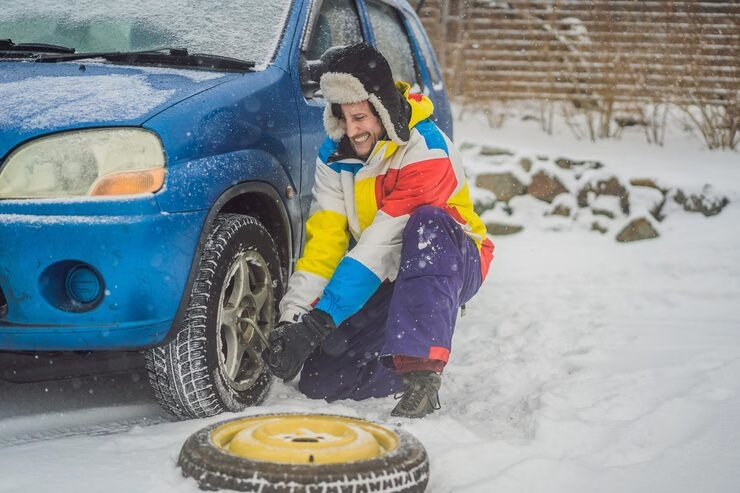
I nodded and knelt on the pavement. The cold wetness soaked through the denim of my jeans instantly, biting into my kneecaps. I worked with the desperation of a man who knew the temperature was dropping. My fingers grew clumsy, numb, fumbling with the frozen metal.
“Tell me about where you’re headed,” I grunted, wrestling with the rusted lug nut. “Distract me from the fact that I can’t feel my toes.”
Margaret stepped closer to shield me from the wind. “Grandchildren,” she said, a smile fighting its way through her shivering. “Four of them. The youngest, she’s five. She has a song to sing for us.”
“My daughter is seven,” I said, finally hearing the metallic creak of the nut loosening. “She’s currently obsessed with Christmas carols. Doesn’t matter that it’s November.”
“What is her name?” William asked. He was leaning over me, handing me the tools before I even asked for them. He anticipated my moves.
“Emma,” I said. “She’s the one watching us like a hawk from the back seat.”
They looked. Emma, seeing their attention, waved enthusiastically, her mitten pressing against the glass. Margaret let out a sob that sounded like a laugh. “An angel,” she whispered.
It took fifteen minutes of brutal, freezing labor. When the spare was finally secured, my hands were covered in black grease and road sludge. I stood up, my back seizing in protest.
“That’s it,” I panted, wiping my hands on a rag from my trunk. “It’s a donut tire, so keep it under fifty miles per hour. But it’ll get you to the dinner table.”
William reached for his wallet. His hands were shaking so hard he nearly dropped it. “Young man, please. Let me give you something. You saved us. Truly.”
I pushed his hand away gently. “Absolutely not. It’s Thanksgiving. Pass it on.”
“At least your name,” Margaret pleaded. “Your address. We need to thank you properly.”
“Just Stuart,” I said, retreating toward my car. “Go see your grandkids.”
William grabbed my arm. For a second, the frailty vanished. He looked at me with an intensity that felt heavy, significant. “You have no idea what you did today,” he said, low in his throat. “You didn’t just change a tire. You reminded me that the world isn’t broken.”
I nodded, uncomfortable with the weight of his gratitude, and scrambled back into the sanctuary of my Honda.
As I put the car in gear, Emma was frantic, digging through her backpack. “Wait! Daddy, wait!” She rolled down her window before I could stop her, letting the freezing gale rush in. She leaned out, her small arm extending a piece of crinkled paper toward the elderly couple. “This is for you!” she screamed over the wind.
Margaret took it, confused, and as I pulled away onto the asphalt, I glanced in the rearview mirror. I saw William looking at the paper, and then looking at my retreating car with an expression I couldn’t decipher—it wasn’t just gratitude. It was the look of a man who had just made a decision that would alter the course of history.
Back to Reality
The rest of the holiday passed in a blur of turkey, stuffing, and the comforting embrace of my parents’ home. I scrubbed the grease from my hands, but the memory of the cold lingered in my bones for days. By Monday, the incident on the highway had faded into the background, just another anecdote of winter driving.
I returned to the trenches of high school education, trying to convince thirty bored teenagers that The Great Gatsby was relevant to their Instagram-filtered lives. Emma went back to second grade, armed with stories of cranberry sauce and her cousin’s new puppy.
Life normalized. The bills piled up on the counter—the electric, the water, the terrifying quote for the roof leak that was slowly staining the ceiling of Emma’s bedroom. I juggled the math in my head, as I always did, calculating how many extra tutoring sessions I’d need to take on to keep us afloat.
Then came Tuesday.
I was in the kitchen, performing the morning ritual of sandwich assembly. Emma was halfway through a bowl of cereal, her hair a chaotic halo of static.
My phone buzzed. It was my mother.
“Hey, Mom, I’m running a bit la—”
“Stuart!” Her voice was a shriek, distorted by the speakerphone. “Turn on the TV! Channel Seven! Now!”
“Mom, is Dad okay? What’s—”
“Just turn it on!”
I grabbed the remote, panic spiking my heart rate. I clicked the power button on the small kitchen TV. The local morning news flickered to life.
I dropped the knife into the jar of mayonnaise.
There, sitting on the beige sofa of the news studio, were William and Margaret.
But this wasn’t the shivering, fragile couple from the roadside. This was a transformation. William wore a charcoal suit that fit him like armor. His silver hair was swept back, his posture regal. Margaret was radiant in emerald green, pearls resting at her throat.
The chyron at the bottom of the screen read: FORMER SENATOR WILLIAM HARRINGTON & WIFE BREAK SILENCE.
“Senator?” I whispered, the word feeling foreign on my tongue.
“Daddy,” Emma said, pointing with her spoon. “That’s them! That’s the tire people!”
The news anchor, a woman named Janet who usually covered cat rescues and bake sales, looked starstruck. “Senator Harrington, you haven’t given an interview since your retirement ten years ago. What brings you out today?”
William leaned forward. The camera zoomed in. He possessed a gravitas that radiated through the screen. “Janet, we live in a cynical time. We believe that everyone is out for themselves. That kindness is a transaction.”
He paused, and for a moment, the studio was dead silent.
“Last week, on Thanksgiving eve, my wife and I were stranded. It was dangerous. We were invisible to hundreds of drivers. But one man stopped.”
Margaret took his hand. “He had his little girl in the car,” she said, her voice soft but clear. “He worked in the freezing sleet for twenty minutes. He ruined his clothes. He risked his safety. And when we tried to pay him, he refused. He wouldn’t even give us his full name.”
My heart hammered against my ribs like a trapped bird.
“But,” William continued, “his daughter gave us something.”
He reached into his jacket pocket and pulled out the paper. The camera focused on it. It was Emma’s drawing—stick figures with giant smiles, a car with X’s for eyes, and the jagged, colorful scrawl: EMMA & DADDY.
“We are looking for them,” William said, staring directly into the lens. “Because that young man restored my faith in this country more than twenty years in the Senate ever did.”
“We are offering a reward,” Margaret added. “Twenty-five thousand dollars to the Good Samaritan who helped us. And we want to establish a foundation in his name.”
I gripped the counter. Twenty-five thousand dollars. The roof. The college fund. The debt. It was a lifeline thrown across a chasm I had been trying to bridge for years.
“Sir,” William said, his blue eyes boring into me through the screen. “If you are watching, please come forward. Not for the money. But because I need to shake your hand one more time.”
“Daddy!” Emma squealed, jumping off her chair. “We’re famous! We have to call them!”
I stood there, paralyzed. This wasn’t just a thank you. This was a spotlight. And for a single father who valued his privacy, a spotlight was a dangerous thing.
My phone began to ring. Then the landline. Then my cell again. It was a deluge. But before I could answer, a heavy knock echoed from the front door. I looked through the peephole and saw not a reporter, but two men in dark suits with earpieces, standing next to a black SUV that idled in my driveway like a hearse.
They already knew. They had found us before I had even made the choice to be found.
The Invitation
I opened the door, placing a protective hand on Emma’s shoulder.
“Mr. Stuart Whitman?” the taller agent asked. He didn’t smile, but he didn’t scowl either. He looked like a machine designed to be polite.
“Yes,” I said, my voice tighter than I wanted it to be.
“I’m Agent Carson, security detail for Senator Harrington. The Senator requested we locate you immediately. He was concerned the media might arrive before we did.”
“Locate me?” I asked. “How?”
“Traffic cameras,” Carson said simply, as if that explained everything. “The Senator and Mrs. Harrington are at the Fairmont Hotel downtown. They are requesting your presence. They want to thank you personally, away from the cameras.”
I looked down at Emma. She was vibrating with excitement, clutching her half-eaten toast.
“Can we go, Daddy? Can we?”
I looked at the agent. “I have to get her to school. I have to get to work.”
“We’ve already contacted your principal and the school board,” Carson said. “You’ve been given the day off. Excused absence for civic duty.”
The power these people wielded was terrifying. But as I looked at the black SUV, I realized I had two choices: run from the wave, or surf it.
“Let me get my coat,” I said.
The Penthouse
The ride to the hotel was silent luxury. We bypassed the lobby, taking a private elevator to the penthouse suite. The doors opened to a room that cost more per night than I made in three months.
And there they were.
Margaret rushed forward the moment we stepped inside, bypassing me entirely to envelope Emma in a hug. “Oh, you wonderful little girl!”
William stood by the window, overlooking the city. He turned, and the politician’s mask fell away. He was just the old man from the highway again, eyes wet with emotion.
“Stuart,” he said, walking over with his hand extended. “Forgive the theatrics. If I had just called, you might have hung up thinking it was a prank.”
“You’re Senator Harrington,” I said, shaking his hand. “I voted for you. Twice.”
He laughed, a dry, rasping sound. “Then I owe you even more. Please, sit.”
We sat. Coffee was poured from a silver pot. Emma was given a hot chocolate with a mountain of whipped cream that made her eyes bulge.
“The money,” William started, getting straight to the point. “It’s yours. It’s in a trust. No strings.”
“I didn’t do it for money,” I said, my pride flaring up reflexively.
“I know,” Margaret said gently, placing a hand on my arm. “That’s why you deserve it. But Stuart, it’s not just about the money.”
William leaned forward, his elbows on his knees. “I was done, Stuart. I was done with people. I’ve spent my life in rooms full of sharks who smile while they bite you. I had convinced myself that goodness was a myth we tell children.”
He pointed to the refrigerator in the kitchenette of the suite. Emma’s drawing was taped there, the only personal item in the sterile luxury.
“That drawing,” he said, his voice cracking. “And your hands, bleeding in the cold to help two strangers who couldn’t offer you a thing… it woke me up. I want to launch the Harrington Initiative. An annual award for unseen acts of kindness. And I want you and Emma to be the face of it.”
I hesitated. “We’re just normal people, Senator. I teach English. I struggle to fix my roof. I’m not a symbol.”
“That is exactly why you are perfect,” he countered. “We don’t need more celebrities. We need more fathers. We need more neighbors.”
He looked at Emma, who was now wearing a milk mustache.
“We want you to fly to D.C. next month,” William said. “To the National Christmas Tree lighting. The President will be there. I want Emma to flip the switch.”
Emma dropped her spoon. “The President?”
“Yes, dear,” Margaret beamed.
I looked at my daughter. I saw the wonder in her eyes. I thought about the cynical world she was growing up in, a world I tried so hard to shield her from.
“Okay,” I said, letting out a breath I didn’t know I was holding. “We’ll do it.”
William smiled, but then his face turned serious. He leaned in close, his voice dropping to a whisper so Emma wouldn’t hear. “There is one more thing, Stuart. Something I didn’t say on television. When you were changing that tire… I wasn’t just going to dinner. I was going to announce my final withdrawal from public life. I was going to disappear. You stopped me from quitting. But the people who wanted me gone… they aren’t going to be happy that I’m back in the spotlight. And by standing next to me, you’re stepping into the line of fire.”
I met his eyes. I saw the weight of decades of public service, the scars of political battles, the weariness of a man who had seen too much.
“I’ll take that risk,” I said quietly. “If it means Emma gets to see that kindness matters.”
William nodded slowly. “Then we do this together.”
The Aftermath
The next month was a whirlwind. The story exploded. Major networks picked it up. Good Morning America wanted us. 60 Minutes called. But William, with the skill of a career politician, controlled the narrative. He granted exactly three interviews, each one carefully orchestrated to highlight not me, but the principle.
“This isn’t about Stuart Whitman,” he told Anderson Cooper. “This is about the thousands of Stuarts who stop every day. Who help. Who care. We need to celebrate them.”
The money arrived in the trust as promised. I fixed the roof. I started Emma’s college fund. I paid off the credit cards that had been strangling me for years. But more than that, I felt something shift inside me—a weight lifting, a fear dissolving.
The hate mail came too. Anonymous letters calling me a opportunist, a fraud, accusing me of staging the whole thing for money. My principal called me into her office to discuss “security concerns.” Some parents didn’t want their children taught by “someone seeking fame.”
But for every hateful message, there were ten beautiful ones. Letters from single parents who saw themselves in my story. Cards from elderly couples thanking me for helping people like them. Drawings from children who wanted to be like Emma.
And through it all, William became more than a former Senator I’d helped. He became a friend. We talked on the phone weekly. He sent Emma books. Margaret mailed her birthday cards.
“You gave me a reason to believe again,” William told me one evening over the phone. “That’s worth more than you’ll ever know.”
The Night of Lights
The air in Washington D.C. was crisp, smelling of pine and anticipation.
I stood on the stage, the White House looming in the background like a lit-up wedding cake. To my left stood the President of the United States. To my right, William and Margaret.
But my eyes were on Emma.
She was wearing a blue dress she had picked out herself—sparkly, slightly too puffy, and absolutely perfect. She stood on a small crate so she could reach the oversized switch.
The crowd was a sea of thousands, a hum of humanity stretching into the darkness.
“Ladies and gentlemen,” William’s voice boomed over the speakers, strong and defiant. “Tonight, we light this tree not just as a tradition, but as a beacon. We light it for the people who stop on the side of the road. For the people who give without asking. For the Stuarts and the Emmas of the world.”
He looked at me and nodded.
I nodded back. I wasn’t afraid of the “line of fire” William had warned me about. Let the critics come. Let the cynics sneer. I had fixed the roof. I had secured my daughter’s education. But more importantly, I had taught her that her actions mattered.
“Emma,” the President said, smiling down at her. “Are you ready?”
“Yes, Mr. President,” she chirped.
“Then light it up.”
Emma threw the switch.
A surge of electricity hummed through the air. Suddenly, the massive evergreen exploded into brilliance—thousands of lights fracturing the darkness, turning the night into day. The crowd roared.
Emma looked back at me, her face illuminated by the golden glow, her smile outshining every bulb on that tree.
“I love you, Daddy!” she shouted over the applause.
“I love you too, kiddo,” I whispered.
Years Later
Years later, people would still talk about the “Highway Heroes Fund.” They would talk about the single dad who became a national symbol of decency.
But I would always remember it differently.
I would remember the cold wind. The smell of burning rubber. The shaking hands of an old man who needed help.
I would remember that I almost didn’t stop. I almost kept driving, wrapped in my own problems, safe in my own warmth.
But I hit the brakes.
And in that split second, on a gray ribbon of road in upstate New York, I didn’t just save a tire. I saved myself.
As the band began to play Joy to the World, I squeezed William’s shoulder. He covered my hand with his own. We stood there, a teacher and a Senator, bound by a moment of grace in a frozen world, watching the lights burn against the dark.
The Harrington Initiative grew beyond anything we imagined. It funded scholarships for children of single parents. It created emergency assistance programs for stranded travelers. It became a movement.
And every year, on the anniversary of that snowy Thanksgiving eve, William and I returned to that stretch of highway. We placed a small plaque on the shoulder where his car had died—not to commemorate us, but to remind travelers that stopping matters.
Emma grew up knowing that a simple act of kindness changed our lives. She carried that lesson forward, becoming a social worker who dedicated her life to helping families in crisis.
William lived to be ninety-two. At his funeral, the President spoke. Senators spoke. But the moment that mattered most was when Emma, now a woman in her thirties, stood at the podium and held up that crumpled drawing—the one with the stick figures and the broken car.
“This,” she said, her voice steady, “is where everything changed. Not because my dad was a hero. But because he was human. And he chose to act.”
I sat in the front row, tears streaming down my face, watching my daughter honor the man who had honored us.
We were home.
Not because of the lights or the fame or the money.
But because we had learned that the greatest wealth isn’t measured in dollars—it’s measured in the moments when you choose to stop, to help, to care.
And in that choice, in that single act of compassion on a frozen highway, we discovered something profound: that the world isn’t broken.
It’s just waiting for people brave enough to stop and help fix it.