The Bruise That Changed Everything
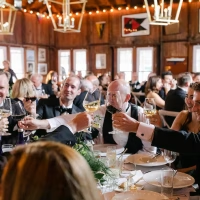
The bruise appeared like a dark secret beneath my son’s eye on the night of his twelfth birthday, casting a shadow over what should have been nothing but cake, candles, and celebration. The moment Theo walked into our lakefront dining room, surrounded by family and the warm glow of string lights reflecting off the water beyond our windows, I felt my stomach drop. Someone had hurt my child, and judging by the way he kept his gaze carefully averted from my sister Mara across the table, I had a terrible suspicion about who was responsible.
My name is Jillian Harper, and at forty years old, I’d devoted everything to two things: raising Theo as a single mother and building Harper’s Lakeside, the restaurant I’d grown from a rundown boathouse into one of Madison’s most beloved dining spots. That night should have been perfect—Theo’s favorite chocolate cake with raspberry filling, his friends scattered around the table, the lake breeze drifting through open windows carrying the scent of late summer. Instead, it became the night everything I thought I knew about my family shattered like dropped crystal.
Tucker, my fifteen-year-old nephew, lounged in his chair with the kind of casual arrogance only teenagers can truly perfect. He was tall for his age, athletic, the kind of kid who’d always gotten away with too much because he had a charming smile and my parents thought the sun rose and set by his existence. When someone at the table commented on Theo’s bruise with concern, Tucker leaned back with a smirk that made my blood run cold.
“I just taught him a lesson,” he said, his voice carrying that particular teenage swagger that thinks cruelty is comedy. “My parents say I’m never wrong anyway.”
Uneasy laughter rippled around the table like a stone dropped in still water. My parents, Stanley and Irene Harper, who had spent Theo’s entire life making it clear that their firstborn daughter’s firstborn son would always be their favorite grandchild, actually chuckled as if Tucker’s words were nothing more than boyish humor. Mara, my older sister who’d always been the golden child with her perfect hair and perfect husband and perfect ability to charm everyone into believing she could do no wrong, fidgeted with her wine glass but said nothing. She wouldn’t meet my eyes.
I felt something dark and cold settle in my chest as I turned to my son. “Theo, who did this to you?”
The room went quiet. Theo’s small fingers twisted the edge of his napkin, his eyes flickering toward Mara with an expression that was part fear, part desperate hope, part something that looked heartbreakingly like betrayal. When he finally spoke, his voice was barely above a whisper, but every word landed like a hammer blow.
“Why did you let him?”
The Shattering
The wine glass slipped from Mara’s hand. The sound of it shattering against the hardwood floor seemed to echo endlessly, crystalline shards scattering across the room like fragments of whatever trust had existed between us. Her face drained of all color, lips parting as if to speak, but no words came. The air grew impossibly heavy, every guest frozen in their seats, eyes darting between my sister and my son and me, trying to understand what had just been revealed without being explicitly stated.
My sister knew something. My sister had done something. And Theo’s question—not an accusation, not an explanation, just those six devastating words—had exposed it to everyone in the room.
A week earlier, I’d been standing in the shadows near our boat shed, clearing my head after a long day at the restaurant, when I overheard Mara’s voice cutting through the quiet evening. She was on the phone, pacing near the dock, unaware of my presence. Her words had made my blood run cold then, and they burned in my memory now as I stared at her pale, guilty face across the dining table.
“Dad’s giving Theo everything,” she’d snapped into the phone, her voice sharp with resentment. “Maybe it’s time he learns what responsibility really feels like.” There had been a pause, then her voice had turned even colder. “If he’s the favorite, someone needs to show him it’s not that easy. We need to control this before it’s too late.”
I had frozen in the darkness, my heart pounding as I processed what I was hearing. Mara was talking about Theo—my quiet, bookish twelve-year-old who loved reading more than sports and spent his weekends helping me at the restaurant, learning to fold napkins and greet customers with genuine warmth. What did she mean by “control”? Control what?
The answer, I’d feared even then, was the restaurant. My parents had always favored Mara, their eldest, the one who’d graduated first, married first, given them their first grandchild. They’d installed her as manager of our second location and praised her “business sense” while dismissing my late nights balancing books and perfecting recipes as mere dedication rather than skill. But the original Harper’s Lakeside was mine, built with my money and my vision and my hands. I’d always planned to leave it to Theo when he was old enough, when he’d learned the business from the ground up the way I had.
“Eric just makes sure he knows his place,” Mara had said that night by the dock, and I’d heard my brother-in-law’s name with a sinking feeling.
Now, standing in the aftermath of Theo’s question and Mara’s shattered wine glass, I understood what “knowing his place” had meant. Tucker had been the weapon. Mara had provided the target.
The Aftermath
The birthday party dissolved quickly after that, guests making awkward excuses and hurried exits, their cheerful facades crumbling under the weight of obvious family tension. My parents lingered, trying to smooth things over with their usual favoritism disguised as peacekeeping.
“Jillian, you’re making a fuss over nothing,” my mother said, her tone sharp with disapproval. “Boys get scrapes. Let’s not ruin the celebration over childhood roughhousing.”
My father nodded, his eyes warm only when they landed on Mara. “You’re too sensitive about these things. Tucker’s just spirited. You know how boys are.”
Their words stung the way they always had, but now they ignited something fiercer than hurt. “This isn’t roughhousing,” I said, my voice steady despite the fury building in my chest. “Look at Theo’s face and tell me that’s nothing.”
But they wouldn’t. They never did. After forty years, I knew exactly where I stood in their hierarchy of affection, and it wasn’t at the top.
After everyone left, I found my friend Connie in the kitchen, stacking dishes with the careful deliberation of someone trying to give a family space to implode privately. Connie had been my closest friend since we’d met at a restaurant industry conference five years ago, and she’d stayed to help with the party despite having no obligation to witness our family drama.
“Jillian,” she said quietly, her hands pausing mid-rinse. “I need to tell you something. Last week, I was here helping with the landscaping, and I heard Theo crying near the dock. I thought I heard Tucker’s voice too, but when I went to check, they were gone. I should have said something then, but I didn’t want to assume—”
Her words confirmed what I’d already known in my gut. “What did you hear exactly?”
“It didn’t sound like playing,” Connie admitted, guilt evident in her expression. “It sounded like he was hurt or scared. I’m sorry I didn’t tell you sooner.”
The Footage
I pulled up the security camera footage that night after Theo had gone to bed. My hands trembled as I navigated to the date Connie had mentioned, scrolling through grainy nighttime footage until I found it. There, captured in black and white beneath the pale glow of our dock lights, was the truth I’d been dreading.
Tucker stood over Theo, his posture aggressive and dominating. As I watched, he shoved my son hard enough to send him sprawling onto the grass. Theo curled up instinctively, trying to protect himself, and I watched Tucker kick dirt toward his face. My stomach turned, tears blurring my vision, but I couldn’t look away.
And there, standing just a few feet away with her arms crossed and her expression cold, was Mara. She didn’t intervene. She didn’t call out. She just watched as her son hurt mine, her face showing something that looked disturbingly close to satisfaction.
I called Theo into my study, my heart breaking as he shuffled in wearing his pajamas, his eyes wary and guarded in a way no twelve-year-old’s should be. I knelt to meet his gaze, taking his small hands in mine.
“Theo, sweetheart, I saw the camera footage from last week. I need you to tell me the truth about what happened that night. You’re not in trouble, and you’re not going to get in trouble. I just need to know.”
He was quiet for a long moment, his fingers twisting in the fabric of his shirt. When he finally spoke, his voice was so small I almost couldn’t hear it. “Mara told Tucker I deserved it.”
The words hit me like a physical blow. My sister—my own sister—had encouraged her son to hurt mine. She’d stood there and watched it happen and told Tucker that my gentle, kind, book-loving child deserved to be shoved to the ground and humiliated.
“Why didn’t you tell me right away?” I asked, pulling him into a hug as his small body began to tremble.
“I was scared,” he whispered against my shoulder. “She said no one would believe me. She said you’d think I was just being dramatic because I’m too soft.”
The Confrontation
Fury replaced my shock, burning away any remaining doubt about what I needed to do. I marched into the living room where Mara sat with my parents, all three of them nursing coffee as if this were any ordinary family evening. I held up my phone with the paused security footage clearly visible.
“Care to explain this?” I demanded.
Mara’s cup froze halfway to her lips. The color drained from her face as she recognized what she was seeing—herself standing by while Tucker brutalized Theo. “It’s not what it looks like,” she stammered. “I thought they were just playing rough. Boys do that, Jillian. You’re overreacting.”
“Overreacting?” The word came out sharp enough to cut. “You stood there and watched your son hurt mine. Theo told me you said he deserved it.”
My parents gasped, but their next words revealed exactly where their loyalties lay. “Jillian, calm down,” my mother said, her voice shaking not with anger at Mara but with panic at potential scandal. “We can’t have this getting out. Think of the family, the restaurant, our reputation in Madison.”
My father nodded grimly. “This stays between us. No need to air our dirty laundry publicly.”
Their concern wasn’t for Theo. It was for their image, their precious standing in our small lakeside community, their ability to maintain the fiction that the Harper family was successful and happy and free of ugly complications.
Mara stood, her hands raised defensively. “I didn’t mean for it to go that far,” she said, her voice thin and unconvincing. “I was frustrated, okay? Theo’s always been Dad’s favorite, getting everything handed to him. I just told Tucker to teach him a lesson about how the real world works. I didn’t think he’d actually hurt him.”
Her excuse was pathetic, her eyes finally meeting mine with a mixture of defiance and guilt. She’d made a deliberate choice, stood by while her son carried out her resentment, and now she wanted me to believe it was somehow an accident.
“You crossed a line,” I said, my voice cold and steady despite the storm of emotions churning inside me. “I trusted you with my business, with my family, with my son’s safety. And you used all of that to hurt him because you were jealous of a twelve-year-old child.”
“Don’t be dramatic,” she snapped back, her defensiveness sharp now. “Tucker’s just a teenager. Kids fight. This is normal sibling rivalry between cousins.”
“This isn’t rivalry,” I said. “This is abuse. And you’re the adult who enabled it.”
The word hung in the air—abuse—making it real and undeniable.
Taking Action
By morning, I’d made my decision. I called a lawyer first, then Child Protective Services, reporting exactly what I’d witnessed on the security footage and what Theo had told me. The CPS caseworker who arrived two days later was named Dana, a woman in her mid-forties with kind eyes and a no-nonsense demeanor that made Theo feel safe enough to tell his story without minimizing what had happened.
Then I called Mara and told her she was no longer manager of the second location and that she was being removed from any ownership or management role in Harper’s Lakeside. The restaurant was mine, built with my money and my vision, and I wasn’t going to let her use it as leverage to justify hurting my son.
“You can’t do that,” she’d hissed over the phone, her voice shaking with rage. “I’ve poured years into that business. I’ll sue you for wrongful termination.”
“I’m not firing you,” I said calmly. “I’m removing you from a family business because you proved you can’t be trusted with family. There’s a difference. And if you want to sue me, go ahead. I have security footage, CPS reports, and a bruise on my son’s face. I’ll happily let a judge decide who was in the wrong here.”
Eric, her husband, threatened legal action. My parents begged me to reconsider, warning that I was tearing the family apart over a childhood spat. But their words no longer had power over me. I’d spent forty years seeking their approval, trying to earn the same automatic affection they showered on Mara, hoping that if I just worked hard enough and stayed quiet enough and didn’t make waves, they’d finally see me as worthy.
Now I understood that their approval had always come with conditions, and one of those conditions was allowing Theo to be hurt if protecting him meant holding Mara accountable.
The New Sign
Three months after Theo’s twelfth birthday, I stood outside Harper’s Lakeside watching workers install a new sign. Theo’s Lakeside Kitchen, it read in bold, elegant letters, my son’s name claiming ownership of his future and erasing Mara’s presence from the place I’d built.
Connie stood beside me, her hand on my shoulder. “It’s perfect,” she said softly. “He’s going to love it.”
I’d asked Connie to help me run the restaurant, to teach Theo the business when he was ready, to be the family member who showed up with honesty and support rather than manipulation and favoritism. She’d agreed without hesitation, moving from occasional helper to co-manager and becoming the aunt Theo deserved.
When I brought Theo to see the new sign, his face lit up with wonder. “That’s my name,” he said, tracing the letters with his eyes. “It really says my name.”
“It’s yours,” I told him, kneeling to meet his gaze. “One day, when you’re ready, you’ll make this place your own. But right now, it’s here to remind you that you’re valued and loved and that your name means something important.”
He threw his arms around my neck, holding on tight, and I felt the weight of the past months begin to lift.
The Investigation
The CPS investigation concluded with a finding of “reasonable cause for concern” and mandated counseling for Tucker, parenting classes for Mara, and supervised contact only with Theo. There were no dramatic courtroom scenes or criminal charges, but there was an official acknowledgment that what had happened wasn’t acceptable, that Theo’s pain mattered, and that adults had failed to protect him.
Mara sent letters occasionally, apologies that arrived in expensive stationery with looping handwriting that always seemed to focus more on her own hurt feelings than on what she’d done to Theo. I read the first one, where she claimed she’d “made a mistake” and “never meant for things to go so far” and “hoped we could move past this as a family.” The second letter I left unopened on my desk for three days before throwing it away. By the fourth letter, I didn’t even open the envelope—I simply burned it in the metal trash can by the dock where Tucker had pushed Theo, watching the flames consume her words unread.
Theo found me there once, smoke curling up from the trash can, and asked quietly, “Was that from her?”
“Yes,” I said.
“Did you read it?” he asked.
“No,” I said. “Some doors don’t need to be opened.”
He nodded, satisfied, and we walked back to the restaurant together without discussing it further.
The Grocery Store
Six months after the initial incident, I ran into Tucker at the grocery store. He was in the cereal aisle with a woman I recognized as a county caseworker, his swagger completely gone, replaced by hunched shoulders and a wary expression. When he saw me, he froze.
“Hi,” he said finally, his voice lower and less certain than I remembered.
“Hi,” I replied, waiting.
“Is Theo with you?” he asked, glancing around nervously.
“No,” I said. “He’s at the restaurant.”
Tucker swallowed hard, his hands fidgeting with the cereal box he was holding. “They make me talk to this counselor,” he said, nodding slightly toward the caseworker. “About anger and stuff. About what happened.” He paused, then added in a rush, “They keep asking why I did it, why I pushed him, why I listened to Mom. And I don’t… I don’t even know what to tell them.”
His honesty surprised me. “It’s not stupid to name those feelings,” I said quietly. “It’s ugly. But it’s honest.”
He looked at me with something like desperate hope. “Does he hate me? Theo, I mean?”
I could have lied. I could have made it easier. But Theo deserved honesty from the adults in his life, which meant I owed Tucker honesty too.
“He’s scared of you,” I said. “And he’s angry about what you did. That doesn’t go away just because you’re sorry now.”
Tucker flinched but nodded. “Yeah,” he said hoarsely. “I figured.” He glanced at the caseworker, who was giving us space but watching carefully. “They say I’m supposed to apologize someday. Face-to-face. But only if you and Theo want that.”
“Not today,” I said. “Maybe not ever. That’s Theo’s choice, not mine and definitely not yours.”
“Okay,” he said. “I just wanted you to know I’m not… I’m not proud of what I did.”
“Feeling bad is a start,” I said. “What you do with that feeling is up to you.”
One Year Later
On Theo’s thirteenth birthday, exactly one year after the night that had changed everything, we celebrated at Theo’s Lakeside Kitchen with a party that bore no resemblance to the previous year’s disaster. The dining room was full of people who genuinely loved my son—school friends, restaurant staff who’d taught him to fold perfect napkins and flip pancakes, Connie’s family, neighbors who’d become more like family than my own blood relatives had ever been.
When it came time to cut the cake, a server approached with a cream-colored envelope. I recognized Mara’s handwriting immediately, and my stomach clenched. I handed it to Theo without comment, watching his face as he opened it and scanned the contents.
His expression hardened. Without a word, he tore the letter in half, letting the pieces fall to the floor.
“Some things are better left unread,” he said firmly, his voice carrying a confidence that made my heart swell with pride.
I glimpsed phrases as the torn pieces fluttered down—”I was wrong” and “please forgive me” and “we’re still family”—but Theo’s choice was clear. He wasn’t interested in words on paper. He wanted actions, consistency, safety. He wanted adults who’d proven they deserved his trust, not ones who asked for it back after destroying it.
My parents never set foot in Theo’s Lakeside Kitchen. I’d see their car sometimes, driving slowly past the parking lot, my mother’s face visible through the passenger window as she stared at the sign with my son’s name on it. They never stopped, never called, never acknowledged that they’d chosen Mara’s comfort over Theo’s safety and lost access to their grandson as a result.
Their absence used to hurt. Now it was just a fact, like the color of the lake or the temperature of winter air—unchangeable and no longer surprising.
Moving Forward
Business thrived. We expanded the menu, started hosting community events, became known not just for good food but for being the kind of place where people felt genuinely welcomed. Theo grew into his role gradually, helping with small tasks at first, then learning inventory management and customer service, watching Connie and me handle problems with honesty and fairness.
He designed a kids’ menu with hand-drawn illustrations—smiling pizza slices, little rowing boats, a cartoon version of himself in a chef’s hat. When a customer complimented his artistic talent, he smiled and said simply, “I’ve got my own talents.” Not his mother’s, not inherited from some family legacy. His own.
Some people in town whispered about our family drama. I’d overhear fragments sometimes: “She called CPS on her own nephew” or “Imagine airing family business like that.” But just as often, I’d hear other voices responding: “Maybe if more people were willing to air business, there’d be fewer kids walking around with bruises nobody talks about.”
The regulars kept coming. They left bigger tips. They taught Theo to refill coffee cups and master the perfect pizza dough spin. They proved that family isn’t always about shared blood—sometimes it’s about shared values and who shows up when it matters most.
The Dock
Two years after that devastating birthday party, I stood at the dock where Tucker had pushed Theo, where I’d once overheard Mara’s resentful phone call, where I’d burned her unopened letters. The dock had been a stage for our worst moments, but it had also become something else—proof that we could stand in the place where we’d been hurt and choose not to be defined by that pain.
Theo appeared beside me, taller now, his voice deepening, his confidence steady rather than forced. “You know what I realized?” he said, looking out over the water. “That night at my twelfth birthday, when I asked Aunt Mara why she let him hurt me, I wasn’t actually asking her. I was asking you.”
I turned to look at him, surprised. “What do you mean?”
“I needed to know if you’d let it happen too,” he said. “If you’d choose keeping peace over keeping me safe. I needed to know which kind of mom you were going to be.”
Tears stung my eyes. “And now you know?”
He smiled, putting his arm around my shoulders with the casual affection of a teenager who felt secure enough to be openly loving. “Yeah,” he said. “Now I know. You’re the kind who picks me. Every single time.”
We stood there together as the sun set over the lake, painting the water gold and orange and deep purple. Behind us, Theo’s Lakeside Kitchen glowed with warm light, its sign reflected in the still water like a promise kept.
There had been no perfect ending, no tearful family reunion where everyone apologized and learned their lessons. Life wasn’t a story with neat resolutions. Tucker was still working through anger issues in counseling. Mara still sent occasional letters that I no longer opened. My parents still drove past without stopping.
But Theo was safe. Theo was confident. Theo knew with absolute certainty that when someone hurt him, the adults in his life would believe him and protect him and refuse to sacrifice his wellbeing for someone else’s comfort.
“Family isn’t blood,” I said aloud. “It’s trust.”
Theo squeezed my shoulder. “We’ve got that now,” he said simply.
And we did. Not in the family I’d been born into, but in the family we’d chosen and built and protected with absolute conviction.
The lake rippled in the evening breeze, carrying away the last light of day. Tomorrow, Theo would help open the restaurant, greeting customers with genuine warmth. I’d work beside him, teaching him the business he’d inherit when he was ready, building something beautiful on the foundation of honesty rather than the quicksand of obligation without respect.
Pain had happened at this dock. Betrayal had happened in our dining room. Glass had shattered and wine had stained the floor and a twelve-year-old boy had asked a question that exposed everything rotten beneath our family’s polished surface.
But courage had happened here too. Truth-telling had happened. The kind of fierce, protective love that refuses to bend or compromise or look away had happened.
And in the end, that was the story worth remembering—not the bruise or the broken glass or the sister who’d chosen cruelty over kindness, but the mother who’d chosen her son and the son who’d grown strong in the shelter of that absolute, unwavering choice.
As stars began to appear in the darkening sky, Theo’s laughter carried across the water, mixing with the gentle lap of waves against the dock and the warm sound of voices from the restaurant behind us. It sounded like healing. It sounded like home. It sounded like the future we’d fought for and finally, finally claimed as our own.