The Ghost Flight
Chapter 1: The Apex Predator
The crystal champagne flute on the mahogany table wasn’t just shaking; it was vibrating with a deep, chest-rattling bass that triggers a primal, reptilian fear in the gut. It was the sound of the air itself being torn apart.
My uncle Marcus, a man who prided himself on controlling the temperature, lighting, and conversation of every room he entered, was gripping his hand-stitched leather armrest so hard his knuckles had turned the color of bone. He looked like a king whose throne had suddenly turned into an electric chair.
Outside the oval window, the pristine blue sky had dissolved into a nightmare. A silhouette—distinct, lethal, and impossibly close—banked hard against the clouds, its afterburners glowing like the angry eyes of a dragon. It was an F-22 Raptor, the apex predator of the skies, a machine designed to erase existence before the enemy even checks their radar. And it wasn’t just passing by. It was hunting us.
“What in God’s name is happening?” Marcus screamed into the intercom, his voice cracking, shedding its usual baritone veneer of authority. “Pilot! Why are we being targeted? Did you stray into restricted airspace? Is this a coup?”
He was convinced the world was breaking because he hadn’t given it permission to turn. He thought a coup had started without his authorization.
The cockpit door burst open, but the pilot didn’t look at Marcus. He didn’t look at the man who signed his checks or the heavy-set investors cowering in the plush cream seats. The pilot was pale, sweat beading on his forehead, clutching an iPad that was flashing a terrifying, rhythmic shade of crimson.
He bypassed the billionaire paying his salary and looked directly at me.
“Sir… Ma’am…” He stammered, his voice trembling over the deafening roar of the twin engines screaming outside. He turned the screen toward us. The red security banner reflected in his terrified eyes, casting a demonic glow over his face. “You didn’t tell me we had a Valkyrie Class asset on board.”
He swallowed hard, looking at me with a mixture of awe and absolute terror. “ATC just grounded us. They have a lock. That escort isn’t for protection, Mr. Vance. It’s for her.”
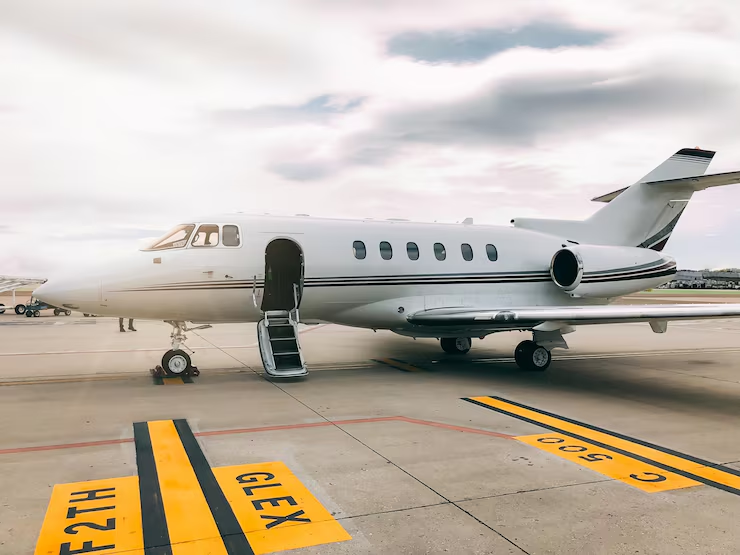
Uncle Marcus spent millions on this Gulfstream G650 to feel powerful, to separate himself from the common people he viewed as ants to be crushed under his Italian loafers. But as the F-22s screamed overhead, executing a tactical pincer maneuver that rattled the fillings in our teeth, a profound shift occurred in the cabin.
Marcus realized, with dawning horror, that his money meant absolutely nothing compared to my clearance.
To understand how a man who thought he owned the world ended up detained on his own tarmac, stripped of his dignity and his ego, we have to go back to the dinner invite where he made the biggest, and final, mistake of his life.
Chapter 2: The Poor Relation
It happened a week earlier at a family gathering that felt more like a hostile corporate merger than a meal. My uncle Marcus, a pompous defense contractor lobbyist who truly believed he ran the Western Hemisphere from his country club membership, had summoned us to The Gilded Lily, a restaurant where the water cost more than my hourly wage—or at least, the wage he thought I earned.
The dinner was ostensibly to discuss his daughter Jessica’s destination wedding in Aruba. I was sitting at the far end of the table, nursing a glass of tap water, trying to remain invisible. It was a skill I had perfected over years of being the “disappointing niece.”
Marcus held court at the head of the table, dissecting the waiter’s performance with loud, performative sighs. He looked down the length of the table at me, a smirk playing on his lips, and decided it was time to be benevolent.
“You can hitch a ride, Elena,” he announced loudly, silencing the rest of the table so they could witness his generosity. “Since you can’t afford the commercial flight to Aruba, I’ll let you take a jump seat on the jet.”
He paused for effect, swirling his scotch. “But there are rules. Don’t bring that beat-up duffel bag you always drag around. It looks like something a homeless person would carry. And try not to embarrass us in front of my investors. Just sit in the back, keep your mouth shut, and don’t touch the single malt.”
The table chuckled—a polite, obedient sound. My cousin Jessica, the bride-to-be whose entire personality was curated for Instagram, offered me a pitying smile.
“Dad’s right, Elena,” she chimed in, smoothing her designer silk dress. “We can lend you something from last season for the reception. I have a dress that might fit… if you suck in a little. We don’t want you looking like a charity case in the photos.”
To them, I was just a low-level logistics clerk for the State Department. A paper pusher. A gray mouse who lived in a modest apartment, drove a ten-year-old sedan, and couldn’t afford a plane ticket. They looked at my scuffed boots and my lack of jewelry and saw failure.
They had no idea that my “beat-up duffel bag” contained encrypted hard drives capable of toppling three different governments. They didn’t know that my “modest apartment” was a safe house with bulletproof glass and a direct line to the Joint Chiefs of Staff.
I tried to decline. I tried to warn him without breaking my cover.
“Uncle, I appreciate it, but I have travel protocols,” I started, keeping my voice low. “My movement requires specific security clearances. I should fly commercial.”
He cut me off with a wave of his hand, dismissing me like a waiter who had brought the wrong wine.
“Stop pretending your little government job has ‘protocols,’ Elena,” he snapped, his voice dripping with condescension. “You sort mail. You file receipts. You’re flying with me, or you’re not going at all.”
He leaned in, his eyes hard. “Don’t be ungrateful. It’s ugly.”
I smiled and took a sip of my water, swallowing the sharp retort that rested on my tongue like a loaded round. They didn’t know that my poverty was a carefully constructed operational cover. In the trade, it’s called being a Gray Man. If you look important, you become a target. If you look like a logistics clerk who struggles to pay rent, nobody looks twice.
In reality, I am a Chief Strategic Analyst for the Defense Intelligence Agency, specializing in High-Value Target Extraction. I don’t book flights or file travel vouchers. I authorize Tier One extraction teams to pull assets out of hostile nations before the borders close. When I disappear into a windowless basement for work, I’m not sorting mail. I’m entering a sanitized SCIF—Sensitive Compartmented Information Facility—where biometric scanners read my retinas to grant access to terminals where a single keystroke can reroute a drone strike or burn a spy network.
I looked at my uncle, who was bragging about dodging a parking ticket, and I thought about the decision I made last Tuesday to extract a compromised family from a safe house in Damascus while under mortar fire.
The silence I kept at that dinner table wasn’t submissiveness. It was the disciplined silence of a woman who carries state secrets in her head that are worth more than Uncle Marcus’s entire investment portfolio.
But the worlds were about to collide, and the friction started with a phone call.
Chapter 3: The Walking Vault
I stepped away from the table, excusing myself to the restroom, but instead ducked into a quiet alcove near the kitchen. I pulled out my secure phone—not the burner I let my family see—and answered the vibrating line.
“Report,” a voice growled. It sounded like grinding gravel.
It was Colonel Viper Ricks, my commanding officer. He was a man who viewed civilian life as a chaotic liability and sleep as a weakness.
“I’m visiting family, Colonel,” I whispered, turning my back to the dining room. “I’m off rotation.”
“You are currently holding the decryption keys for Operation Black Sands in your head,” he countered, his tone dropping an octave. “You are a walking vault, Elena. If you go off-grid for more than sixty minutes, the Pentagon assumes you’ve been taken. Do not get on any transport that hasn’t been vetted. I don’t care if it’s your mother’s minivan. If we lose your signal, we escalate.”
“I know the risks,” I said. “But if I don’t get on this plane, my cover is blown within the family. They’re already suspicious of why I’m so private. I’ll log the flight.”
“Elena,” Ricks warned, the static of the encryption crackling. “If that plane deviates one degree off course… I will scour the sky.”
“Understood.”
I hung up. He was right. I was a walking national security risk. Hopping on a private jet with a man who treated flight laws as mere suggestions was a tactical nightmare. But I was tired of fighting. I wanted, just for once, to be the niece who didn’t cause a scene. I wanted to sit in the back, endure the insults, and let them have their day.
So, I decided to compromise.
I opened the secure portal on my phone and logged a movement request. I typed in the tail number of Marcus’s jet and marked the trip as Civilian Transport / Low Visibility. It was a digital fail-safe—a breadcrumb trail telling the Air Force, “I am here. I am safe. Do not panic.”
I assumed, quite naturally, that Marcus’s pilot would file a standard flight plan. If both our records matched in the system, the military tracking software would see a green light.
I underestimated Marcus’s greed.
I didn’t know that my uncle, in his infinite arrogance, planned to fly “off the books” to save a few thousand dollars in landing fees and taxes. He was going to run a Ghost Flight. No manifest. No transponder squawk. No record.
He was about to take a jet carrying a Tier One intelligence asset and make it disappear from the grid completely. He thought he was being clever.
The United States Air Force would think he was kidnapping me.
Chapter 4: The Setup
When I walked onto the polished concrete of the private hangar, the sharp smell of jet fuel mixed with the familiar, suffocating scent of my family’s disapproval. Uncle Marcus stood by the stairs, eyeing my carry-on—a reinforced tactical bag containing a secure satellite phone and encrypted drives—like it was a bag of dirty laundry.
“Jesus, Elena,” he sneered, loud enough for the flight crew to hear. “I told you to travel light. Stash that garbage in the galley. You can sit in the jump seat next to the coffee maker. Don’t speak to the investors unless spoken to.”
I climbed the stairs, keeping my head down, moving past the plush cream leather recliners reserved for his business partners. It was the same dynamic as every holiday since I was twelve. Allowed in the room, but only on the periphery.
As we taxied, I heard Marcus holding court in the main cabin, his voice booming with unearned confidence.
“I don’t file standard manifests,” he bragged to a heavy-set investor, clinking his glass of scotch. “Keeps the government out of my business and saves me ten grand in fees. I told the pilot to file a Ghost Plan. We’re invisible up there, boys. Rules are for the little people.”
My blood turned to ice.
A Ghost Plan.
That meant flying dark. No official record. No correct squawk code. To him, it was clever tax evasion. To the Defense Department algorithms tracking my location, it looked exactly like a hostile extraction.
I stared at the back of his head, calculating the sheer magnitude of his stupidity. If this plane took off with me inside, and the transponder didn’t match the log I’d just filed, the automated defense grid wouldn’t see a niece going to a wedding. It would see a Tier One asset being moved off-grid at five hundred miles an hour toward international waters.
The system doesn’t ask questions. It neutralizes anomalies.
I could have stood up and screamed. I could have explained that he was about to trigger a national security incident. But I knew Marcus. He would just laugh, call me paranoid, and tell me to go back to my corner.
So, I didn’t scream. Instead, I slid my phone out of my pocket, shielding the screen from the flight attendant. I pulled up my encrypted chat with Colonel Ricks and typed a message that would change everything.
Civilian transport vectoring non-standard. Squawk code likely invalid. Do not shoot us down. Just intercept.
I hit send, watching the encryption lock confirm delivery.
Then I reached into my pocket and found my keys. There was a small, unassuming black fob next to my apartment key. It looked like a garage door opener, but it was a Panic Beacon linked directly to the nearest military command post.
I ran my thumb over the plastic. I remembered every time Marcus had interrupted me. Every time he’d told me I didn’t understand how the “real world” worked. Every time he made me feel small.
He told me to sit down and shut up because the adults were talking business. He didn’t know that with one press of a button, I had just invited the entire 1st Fighter Wing to our location.
I pressed the button until I felt the silent, tactical click.
Chapter 5: The Sky Shatters
The engines of the Gulfstream were whining to a crescendo, pushing us back into our seats as the jet began its taxi toward the main runway. Uncle Marcus was already halfway through a celebratory scotch, his laughter booming through the cabin as he recounted a time he bullied a senator into submission.
I sat in the jump seat, my hands folded calmly in my lap, counting down the seconds in my head.
Three… Two… One…
The aircraft didn’t just stop. It lurched violently as the pilot slammed on the brakes, sending Marcus’s crystal tumbler flying off the table. Amber liquid soaked the expensive carpet.
The cabin went deadly silent for a heartbeat, broken only by the frantic, terrified voice of the pilot crackling over the intercom, stripped of all its usual customer service polish.
“We have… we have a situation,” he stammered. “Tower just locked us down. They’re screaming at us to cut engines immediately.”
Before Marcus could even unleash his indignation, the air around us seemed to shatter.
A roar—louder than anything a civilian jet could produce—tore through the fuselage, rattling my teeth in my skull. It was a physical force, a wall of sound that vibrated the very rivets of the plane.
I looked out the porthole just in time to see the twin vertical stabilizers of an F-22 Raptor screaming past us at low altitude. It was a show of force so violent, so undeniably lethal, that the investors in the plush seats actually ducked, covering their heads.
Then, the second one appeared. It banked hard, its nose pointed aggressively toward our cockpit, hovering like a bird of prey waiting to strike.
Outside, a fleet of black SUVs swarmed onto the tarmac like angry beetles, cutting off every escape route. Blue and red lights reflected off the sleek white paint of Marcus’s jet.
“What is this?” Marcus screamed, his face turning a dangerous shade of purple. He scrambled to the window. “I’m a platinum donor! Get my lawyer on the phone! They can’t do this to me! It’s just a clerical error!”
He didn’t understand. He thought this was a misunderstanding about taxes or flight logs. He thought this was a game he could win with a checkbook.
The cabin door didn’t open. It was breached.
Armed Air Force Security Forces—Defenders wearing full tactical gear and carrying rifles that weren’t for show—stormed up the stairs. They didn’t knock, and they certainly didn’t care about the thread count of Marcus’s carpet.
“Hands! Let me see your hands!” The lead Defender bellowed, his weapon scanning the room.
Marcus jumped up, his instinct to dominate taking over. “Now listen here! You can’t just barge onto a private—”
A Defender shoved him back into his seat with one hand. A motion so casual it was insulting. “Sit down, sir! Hands where I can see them! Do not move!”
Then the chaos parted.
A man walked onto the plane, moving with a different kind of energy. It was Major Vance, a field officer I had briefed on three separate operations. He was wearing his flight suit, helmet tucked under his arm. He scanned the cabin, his eyes sweeping over the cowering investors and the sputtering uncle.
Until they locked onto me.
He didn’t see a niece in a jump seat. He didn’t see a logistics clerk. He saw a superior officer.
He snapped to attention, his salute razor-sharp in the cramped space.
“Ma’am,” he said, his voice cutting through the panic. “Command received your beacon. We have a Valkyrie Alert active on this vector. We cannot allow an asset with your knowledge base to depart on an insecure, unvetted civilian craft. The Ghost Flight protocol initiated by this pilot flagged as a Tier One abduction attempt.”
The silence that followed was heavy enough to crush a lung.
Marcus stared at the Major, then at me. His brain was trying to reconcile the logistics clerk he bullied with the woman being saluted by a field-grade officer.
“Her?” Marcus sputtered, his laugh nervous and high-pitched. “She’s… she’s just a clerk. She sorts mail! Arrest her for… for wasting government time!”
Major Vance turned to my uncle slowly. He looked at Marcus with the kind of cold, professional detachment you reserve for a hostile combatant.
“Sir,” Vance said, his voice dropping to a terrifying calm. “Step back or you will be neutralized. This individual is a protected national security asset. You are currently interfering with a federal operation.”
Neutralized. The word hung in the air, foreign and violent in Marcus’s world of boardrooms and golf courses.
The pilot, who had been cowering in the cockpit doorway, finally stepped forward. He held up the iPad, the red screen glowing.
“Sir,” the pilot whispered to Marcus, shaking his head. “Look at the authorization code. It’s Yankee White. She… She outranks you. She outranks everyone on this plane. She outranks the tower.”
In his world, money was the ultimate trump card. But on that tarmac, Marcus learned that clearance is the only currency that matters.
Chapter 6: The Exit
Major Vance gestured toward the open cabin door with a deference that made the hair on the back of my neck stand up.
“Your transport is waiting, Ma’am,” Vance said. “We have a C-37A spooled up and ready to take you to the secure site. Colonel Ricks sends his regards.”
I unbuckled my seat belt. The click sounded like a gunshot in the silent cabin.
I stood up. I didn’t look at the investors who were currently trying to blend into the upholstery. I didn’t look at the pilot who was staring at his instrument panel as if praying for a rewind button.
I walked past Uncle Marcus. He was still sputtering, his face a mask of confusion and impotent rage. He looked small. For the first time in my life, I didn’t feel the need to shrink away from him or apologize for my existence. I simply walked past him like he was a piece of furniture, an obstruction that had been cleared.
“Elena?” he whispered, his voice trembling. “What did you do?”
I paused at the door and looked back. “I followed protocol, Uncle. You should have filed a manifest.”
I stepped out onto the metal stairs, and the cool air of the tarmac hit me, carrying the scent of burnt kerosene and ozone.
Waiting for me at the bottom wasn’t a shuttle bus or a rental car. It was a Gulfstream C-37A, painted in the stark, authoritative gray of the United States Air Force, with the Star and Bars emblazoned on the tail. It was a bird designed for one thing: moving people who matter to places where history is being written.
A security detail of four Defenders formed a perimeter around me. Their movement was synchronized and lethal, creating a corridor of steel that separated me from the civilian chaos I was leaving behind.
I climbed the stairs to the military transport without looking back, leaving the “poor relation” narrative on the tarmac along with my uncle’s impounded ego.
Chapter 7: The Aftermath
The aftermath was catastrophic for Marcus, unfolding with the slow, crushing inevitability of a glacier.
Because he had attempted to fly an unlisted ghost flight with a classified Tier One asset on board, the federal government didn’t view it as a tax dodge. They viewed it as potential espionage and trafficking.
The logic of the investigation was cold and binary: Why would a defense lobbyist hide the transport of an intelligence analyst unless he intended to sell her or her knowledge?
He was detained on the tarmac for forty-eight hours. He was interrogated in a windowless room by agents who didn’t care about his country club membership or his net worth. His precious jet was impounded for a forensic counter-intelligence sweep—a process that involves tearing the interior apart to look for listening devices. His custom Italian leather seats were likely sitting in a heap in an evidence locker, slashed open by federal agents.
He missed the wedding, of course. While his daughter was walking down the aisle in Aruba, wondering where her father was, Marcus was trying to explain to the Department of Justice why he thought federal aviation laws were optional.
The irony wasn’t lost on me. He had spent years excluding me from family events, making me feel like an outsider who wasn’t quite good enough to make the cut. Now, the system he claimed to master had physically removed him from the most important day of his daughter’s life. All because he couldn’t show a basic level of respect to the person he sat next to.
Six months later, I was sitting at my desk inside the SCIF, deep within the bowels of the Pentagon. The air was recycled and cool, humming with the sound of server banks and the quiet murmur of analysts directing global operations.
The mail clerk dropped a physical letter on my desk—a rare occurrence in a world that runs on encrypted digital bursts.
It was from a high-end law firm in D.C., printed on paper that felt thicker than the bedsheets in my first apartment. It was from Marcus’s lawyer.
The letter wasn’t a lawsuit. It was a plea.
The investigation had spooked the Department of Defense, and Marcus’s security clearance—the lifeblood of his lobbying career—was under review for revocation. He needed character references. Specifically, he needed a reference from a current government official with equivalent or higher standing to vouch for his patriotism and lack of malicious intent.
He was asking me to save his career.
I held the letter, reading the desperate, polite legal jargon. I thought about the kids’ table at Thanksgiving. I thought about the time he made me park my rusting sedan three blocks away so it wouldn’t be seen in his driveway during a party. I remembered the way he looked at my shoes, my bag, my life, with that sneering pity that cut deeper than any insult.
He had spent thirty years treating me like a liability, a smudge on his pristine reputation that needed to be hidden away. Now, he needed the “logistics clerk” to sign her name—a name that carried more weight in this building than he could ever purchase—to give him back his livelihood.
I didn’t feel angry. I didn’t feel sad. I felt a profound, clinical detachment.
I walked over to the heavy-duty shredder in the corner of the office, the one rated to destroy classified documents. I fed the letter into the teeth of the machine.
I didn’t watch it disappear. I just listened to the satisfying, rhythmic grinding sound as the plea for help turned into confetti.
I had established a hard boundary, one enforced not by emotion, but by the reality of our respective stations. I wasn’t his niece anymore—not in any way that mattered. I was the entity he feared. The quiet professional who held the keys to the castle he was locked out of.
I grabbed my jacket and walked out into the main corridor of the Pentagon, the heels of my boots clicking against the polished floor. Two Generals passed me, deep in conversation. They glanced at my badge, saw the clearance level, and nodded with genuine respect as we crossed paths.
I nodded back.
This was my family now. These were the people who judged you on your competence, your reliability, and your honor, not your bank account.
My uncle wanted to teach me a lesson about my place in the world. I’m just glad the United States Air Force was there to help him find his.
Real power doesn’t need to scream to be heard. It just needs to be sanctioned.