The Mathematics of Betrayal
Chapter 1: The Timeline
“The baby is fine, but… what I’m seeing on the screen…”
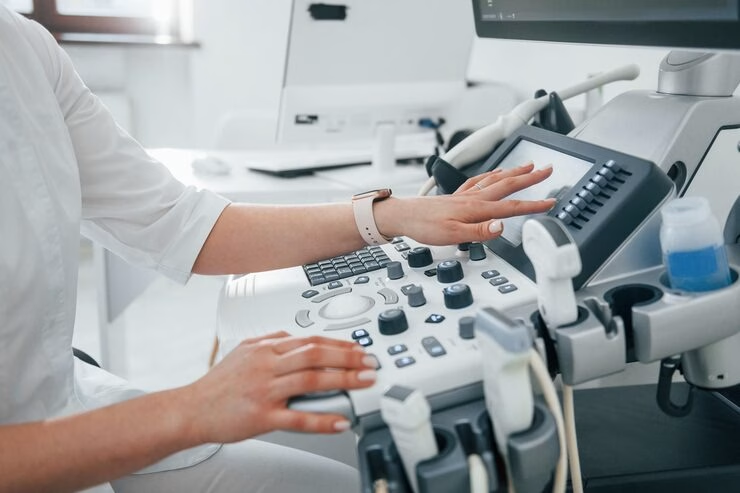
My name is Joe. I’m thirty-seven years old, a Marine. I just got back from Kandahar two weeks ago after an eight-month deployment. I was sitting in that sterile room in Phoenix, watching my wife, Melissa, get her ultrasound, when Dr. Bradley Richardson’s hand started shaking like he’d seen a ghost.
“Sir, you need to leave immediately and call a lawyer.”
The words hit me like shrapnel. Melissa was lying there on the examination table, the ultrasound gel still wet and glistening on her belly, looking between the doctor and me with confusion painted across her face. It was the same expression she’d been wearing a lot lately, like she was always trying to calculate the windage on a moving target.
“Is something wrong with the baby?” I asked. My voice stayed level. Military training does that to you—it teaches you to keep your pulse steady when the world is detonating around you.
Dr. Richardson wiped sweat from his forehead with the back of his hand. He’d been practicing medicine for twenty years, according to the framed certificates on his wall. This wasn’t his first ultrasound. But his face had gone pale, and he kept glancing at the screen like it was displaying classified intelligence that could get us all killed.
“The baby is fine,” he repeated, then leaned closer to me, lowering his voice. “But what I’m seeing on this screen shows thirty-two-week development.”
The room went silent, save for the rhythmic hum of the equipment. Melissa was still smiling, a fixed, plastic expression, acting like everything was normal. She’d been doing that a lot since I got home. Acting.
“Thirty-two weeks,” I repeated.
“Yes, sir.”
I did the math in my head.
Thirty-two weeks ago, I was loading gear onto a C-130 transport plane bound for Afghanistan. Thirty-two weeks ago, I was saying a tearful goodbye to my wife at Sky Harbor Airport. Thirty-two weeks ago, I was sleeping in a barracks tent on the other side of the world, surrounded by sand and silence.
Dr. Richardson looked at me like he was waiting for the explosion. Maybe he expected me to start yelling, or flipping tables. But I just sat there, processing the information like intel from a mission brief.
Objective: Confirm hostility. Status: Confirmed.
“Joe?” Melissa’s voice sounded small. “What’s wrong? Why does everyone look so serious?”
I looked at my wife. Really looked at her. I saw the way she’d been checking her phone constantly since I got back, shielding the screen. The way she’d been talking about the pregnancy like it was some kind of miracle surprise gift. The way she’d insisted on scheduling this appointment for when I could come with her. She wanted me here for this moment.
The realization settled in my chest like a cold, lead weight. She wanted me to bond. She wanted me to see the heartbeat. She wanted to lock me in.
I met Melissa six years ago at a barbecue in Tempe. She was working as a dental hygienist, had this laugh that could fill up a room. I was stationed at Luke Air Force Base then. She said she’d always wanted to marry a military man. Said she respected the sacrifice, the service. We got married three years later.
When this deployment to Kandahar came up eight months ago, she cried at the airport. Real tears. Not the fake ones I’d learned to recognize over the years. She hugged me tight and promised to be waiting.
“I’ll keep myself busy,” she said. “Maybe take some classes. Fix up the garden.”
I remember thinking how lucky I was.
When I came home two weeks ago, she told me she was pregnant. “I found out a few days after you left,” she said, crying happy tears. “I wanted to surprise you when you got home. I’m about ten weeks along.”
Ten weeks.
Now, I was sitting in this doctor’s office learning that the math didn’t work. The timeline was all wrong. Everything was wrong.
“Thirty-two weeks,” I said again, more to myself than anyone else.
Dr. Richardson nodded. “Sir, I have to ask. Were you present for conception?”
Melissa’s face went white. Not confused white. Caught white.
“Joe, I don’t understand what’s happening,” she said. But her voice had changed. Less confusion, more panic. “What does thirty-two weeks mean?”
I stood up from the chair slowly, utilizing every inch of my military bearing. Back straight. Shoulders square.
“It means I was in Afghanistan when this baby was conceived.”
The silence in that room was absolute. Even the hum of the machine seemed to die.
“That’s not possible,” Melissa whispered. But she wasn’t looking at me anymore. She was staring at the acoustic ceiling tiles, and her hands were shaking. “I told you I’m ten weeks pregnant. The baby… I got pregnant right before you left.”
Dr. Richardson cleared his throat. “Ma’am, the fetal measurements are very clear. This is a thirty-two-week pregnancy. The conception date would have been approximately eight months ago.”
I watched my wife’s face as the reality hit her. The careful story she’d built was falling apart in real-time. She’d made a mistake. She’d lost track of the timeline, or maybe she’d just been so focused on selling the lie that she’d forgotten to check the math.
“There has to be an error,” she said, sitting up. The paper crinkled underneath her. “The ultrasound machine or… or something…”
But I was already thinking about other things. The neighbor, Trevor Williams. He’d been helping with yard work while I was gone. Melissa had mentioned him in a few phone calls. Good neighbor, she’d called him.
The cold weight in my chest was spreading. It wasn’t anger yet. Just clarity. The kind of clarity you get when you look through a rifle scope and everything suddenly comes into focus.
“Dr. Richardson,” I said. “I need copies of everything. The measurements. The images. The report.”
“Joe, what are you doing?” Melissa’s voice was rising. “You’re scaring me.”
I looked at her. Six years of marriage. Three years of believing I knew who she was. Eight months of sleeping alone in a combat zone while she was sleeping with someone else.
“I’m getting the facts,” I said. “Just like any good mission requires.”
I could see in her eyes that she knew it was over.
Chapter 2: The Drive Home
The drive home was quiet. Melissa kept talking, filling the silence with explanations that made less sense with every word.
“Maybe they mixed up my file with someone else’s,” she said, her hands twisting in her lap. “Medical mistakes happen all the time. Remember when they sent you that other guy’s blood test results?”
I kept my eyes on the road. Phoenix traffic was heavy for a Tuesday afternoon. Normal people living normal lives, going about their business while my world was collapsing in the passenger seat of a Ford F-150.
“Or maybe the machine was calibrated wrong,” she continued, desperate. “Computers make errors.”
We pulled into our driveway. The house looked the same as when we’d left an hour ago. Same desert landscaping. Same red tile roof. Same basketball hoop I’d installed three summers back. But it wasn’t home anymore. It was a crime scene.
I parked the truck and sat there for a moment, the engine ticking as it cooled down.
“Joe, please say something,” Melissa said. “You’re making me nervous.”
I looked at her. Really looked at her. The weight gain made sense now. The loose clothes. The way she’d been avoiding certain positions when we’d been intimate since I got home.
“When are you due?” I asked.
“What?”
“If you’re thirty-two weeks pregnant, when is the baby due?”
Her mouth opened and closed. She was calculating, trying to figure out what answer would minimize the damage.
“I… The doctor didn’t say exactly,” she finally managed.
“Eight weeks,” I said. “Thirty-two plus eight is forty. You’re due in eight weeks.”
We got out of the truck. I opened the front door, and the house smelled like the vanilla candles Melissa always lit. Smelled like home.
In the kitchen, I poured myself a glass of water and looked out the back window. Trevor Williams was in his yard next door, working on his motorcycle. Mid-forties, divorced, worked construction. He had “helped” Melissa move the patio furniture while I was deployed.
“You want me to make some lunch?” Melissa asked. She was trying to act normal, but her voice was pitched too high.
“How long have you been sleeping with Trevor?” I asked.
The glass she’d been reaching for slipped from her hand and shattered on the kitchen tiles.
“What did you just say?”
I turned around to face her. “You heard me.”
“Joe. That’s insane. Trevor is our neighbor. He helped me with some things around the house while you were gone, but that’s it. I can’t believe you’d accuse me of something like that.”
But she was backing away from me as she spoke. Not the body language of an innocent woman. The body language of someone who’d been caught.
“The baby is yours,” she said, her voice getting stronger, more defensive. “I don’t know what that doctor thinks he saw, but the baby is yours. We’ll get a second opinion.”
I knelt down and started picking up the broken glass. The pieces were sharp, clear. Like the truth.
“Melissa,” I said, not looking up from the floor. “I’ve been trained to gather intelligence. To read situations. To recognize deception.”
“This isn’t Afghanistan!” she snapped. “This is our marriage! This is our life!”
I stood up and dumped the glass pieces in the trash. “You’re right. In Afghanistan, when someone lies to you, they’re usually trying to kill you. Here, they’re just trying to destroy your life.”
She was crying now. Not the pretty tears from the airport. Ugly tears. Desperate tears.
“I love you,” she said. “Whatever you think happened, I love you.”
I walked past her toward our bedroom. “I’m going to pack some things.”
“Where are you going?”
“To get a lawyer.”
“Joe, please! We can work through this! The baby needs a father!”
I stopped in the doorway.
“The baby has a father,” I said. “It’s just not me.”
Chapter 3: The Paper Trail
I spent the night at a motel near Luke Air Force Base. Cheap place, but clean. The kind of room I’d stayed in a hundred times during training exercises. Familiar territory.
At 0700, I called my lawyer, Steven Parker. We’d used him for the house purchase and our wills. Good man. Former Army. He understood military life.
“Joe, what can I do for you?”
I explained the situation. The ultrasound. The timeline. The mathematics that didn’t lie.
“Jesus,” he said when I finished. “I’m sorry, brother. That’s rough.”
“I need to know what my options are.”
“First thing, we get you a DNA test. Establish non-paternity. Second, we start documenting everything. The ultrasound report, any communications you have with your wife about the pregnancy. Third, we prepare for divorce proceedings.”
“What about the house?”
“Arizona is a community property state, but infidelity can affect asset division, especially if she was using marital resources to conduct the affair. We’ll need proof.”
After the call, I drove back to the house. Melissa’s car wasn’t in the driveway. At work, probably, pretending everything was normal.
I had my key. It was still my house.
Inside, I went to our home office. Melissa kept papers in the desk drawer—bills, bank statements. I’d never had reason to look through them before. I trusted her.
What I found made the cold weight in my chest freeze solid.
Credit card statements showing charges at restaurants I’d never been to. Hotel charges in Scottsdale. Shopping receipts for men’s clothing—size Large. I wore a Medium. Phone bills with hundreds of calls to Trevor Williams’ number, starting about a month after I deployed.
But the worst was a receipt from a women’s clinic in Tempe, dated seven months ago. Prenatal vitamins. And a pregnancy test.
She’d known. She’d known she was pregnant almost from the beginning. She’d had seven months to figure out how to handle the situation, and her plan had been to convince me the baby was mine. To let me raise another man’s child.
I photographed everything with my phone. Evidence. Intelligence.
I was putting the papers back when I heard a car in the driveway. Melissa was home early.
I was in the kitchen when she came through the front door. She looked surprised to see me.
“I thought you were staying somewhere else,” she said.
“I came back for some things.”
She set her purse on the counter and looked at me carefully. “Have you been going through my stuff?”
“Should I have been?”
Her face told me everything I needed to know. “Joe, whatever you think you found, there’s an explanation.”
I pulled out my phone and showed her one of the photos. The restaurant receipt from five months ago. Dinner for two, paid for with our joint credit card.
“Explain this.”
She looked at the screen, and her face went pale again. “I took my sister out for her birthday.”
“Your sister lives in Tucson. She hasn’t visited in a year.”
I swiped to the next photo. The hotel receipt from Scottsdale. “Explain this one.”
Silence.
I swiped again. The men’s clothing receipt. “And this.”
She sat down hard on one of the kitchen chairs. The fight had gone out of her.
“How long?” I asked.
“Joe…”
“How long have you been sleeping with Trevor?”
She put her face in her hands. “It’s not what you think.”
“How long?”
“Since about a month after you left.” Her voice was barely a whisper. “It wasn’t planned. It just happened.”
Seven months. Almost my entire deployment.
“The baby?”
“I don’t know. It could be yours. The timing…”
“Melissa.” I kept my voice level. “You know it’s not mine.”
She looked up at me, mascara running down her cheeks. “What are you going to do?”
I was already walking toward the door.
Chapter 4: The Settlement
Steven Parker’s office was in Scottsdale. Modern building, glass and steel.
“I have the evidence,” I said, sliding the printed photos across his desk.
He went through them methodically. Former military men understand documentation.
“This is comprehensive,” he said. “Credit cards, phone records, medical receipts. How are you holding up?”
“I’m functional.”
He nodded. He understood what that meant. Functional was sometimes the best you could hope for.
“Here’s what we’re going to do,” he said. “First, we file for divorce on grounds of adultery. Arizona allows fault-based divorce, and you have clear evidence. Second, we get a court-ordered DNA test. Third, we petition for return of any marital funds used to support the affair.”
“What about the house?”
“With this level of evidence, we can argue for a disproportionate share. She used marital assets to conduct an affair. That matters to judges.”
I left his office with a folder full of paperwork and a court date three weeks away. The divorce petition would be served to Melissa at her work the next day. Professional. Clean. No drama.
That evening, I went back to the house one last time to get the rest of my gear. Melissa was in the kitchen cooking dinner.
She looked up when I walked in, hope in her eyes. “I made your favorite,” she said. “Chicken and rice.”
“I filed for divorce today.”
The wooden spoon she was holding clattered to the floor.
“Joe, please. Can’t we talk about this?”
“There’s nothing to talk about. The baby isn’t mine. We’ll have a DNA test to confirm it, but we both know the truth.”
She turned off the stove and faced me. “What do you want? You want me to beg? Fine, I’ll beg. I made a mistake. I was lonely and scared and Trevor was there and I made a terrible mistake.”
“Seven months isn’t a mistake. Seven months is a choice.”
“I love you.”
“No, you don’t. If you loved me, you wouldn’t have spent seven months sleeping with our neighbor while I was getting shot at in Afghanistan.”
She was crying again, but I felt nothing. The emotional part of the situation had burned out somewhere between the ultrasound and the credit card statements.
“I was going to tell you,” she said.
“When? After the baby was born?”
“I was going to tell you everything.”
“You were going to let me raise another man’s child for eighteen years and tell me afterward?”
She didn’t answer. Which was an answer.
“I’m staying at a motel until this is settled,” I said. “The papers will be served tomorrow. You’ll want to get your own lawyer.”
“Joe, wait.”
I stopped at the kitchen doorway.
“What about us? What about our marriage?”
I looked back at her. Six years of marriage. Three years of thinking I knew who she was.
“There is no us,” I said. “There hasn’t been an ‘us’ since you decided to sleep with Trevor Williams.”
I left her standing in the kitchen with dinner getting cold on the stove. Outside, Trevor was in his driveway again, working on that motorcycle. He looked up when he heard my truck start. Our eyes met for a second through the windshield. He looked away first.
Chapter 5: The Courtroom
The courtroom was small, sterile. Judge Patricia Hernandez presiding. Melissa sat across the aisle with her lawyer, a young guy in an expensive suit who looked like he’d rather be anywhere else.
Steven Parker had done his homework. The evidence was organized, documented, undeniable. Phone records. Credit card statements. Hotel receipts. The ultrasound report showing a timeline that made paternity impossible.
And the DNA test results. Zero probability that I was the father.
“Your Honor,” Steven said, standing tall. “The evidence clearly shows that the defendant conducted an extramarital affair throughout the plaintiff’s military deployment, used marital assets to support this affair, and attempted to deceive the plaintiff into believing he was the father of another man’s child.”
Melissa’s lawyer tried to argue that the affair was irrelevant to asset division. But Judge Hernandez had been doing this for twenty years. She’d seen it all.
“The court finds that the defendant’s actions constitute a significant breach of the marital relationship and misuse of marital property,” she said, looking over her glasses at Melissa. “The plaintiff is awarded sixty-five percent of all marital assets, including the family home. The defendant is ordered to reimburse the plaintiff for all marital funds used in furtherance of the extramarital relationship.”
Melissa stared at the table in front of her. No tears this time. Just defeat.
“Furthermore,” the judge continued, “the court orders that the defendant is solely responsible for all costs related to the pregnancy and birth, as the child is not the plaintiff’s biological offspring.”
The gavel came down. Final.
Outside the courthouse, Melissa caught up with me.
“Joe, wait.”
I stopped walking but didn’t turn around.
“I’m sorry,” she said. “I know that doesn’t fix anything. But I’m sorry.”
I looked back at her. She was showing now, belly round under a loose dress. In two months, she’d have a baby with no husband and no father willing to claim responsibility.
“Sorry doesn’t bring back eight months,” I said.
She nodded and walked away.
Chapter 6: The Aftermath
Three months later, I signed the final papers at Steven’s office.
The house was mine. The bank accounts were divided as ordered. Melissa had moved out of state, back to her parents in Ohio.
Trevor Williams had lost his job when word spread around the construction community. Sleeping with a deployed Marine’s wife doesn’t make you popular in Arizona’s defense-heavy economy. His ex-wife had also learned about the affair during our divorce proceedings, which cost him additional money in their settlement modification. I heard through neighbors that he’d moved to Tucson, trying to start over.
I kept the house for six months, then sold it. Too many memories. Too much history in those rooms. I bought a smaller place near the base. Clean lines. No history.
I had my truck, my savings account, and a lesson learned about trusting people completely. The deployment to Kandahar had taught me about survival in a hostile environment. Coming home had taught me about survival in a different kind of hostile environment.
My commanding officer had offered me another overseas assignment. I turned it down. I wanted to stay stateside for a while. Figure out what came next.
Some evenings, I’d sit on my back porch and think about the alternative timeline. The one where I’d believed the lie. Raised another man’s child. Never learned the truth. That version of Joe would have been living a completely different life, built on deception.
I preferred the truth. Even when it was ugly.
The military had taught me that clear intelligence leads to better decisions. In war, and in life. Melissa’s deception had failed because she’d underestimated the power of simple mathematics and a Marine’s commitment to facts over fiction.
Sometimes the strongest response to betrayal is simply refusing to participate in someone else’s lies.