The Truck They Tried to Take
The process server found me in a metal box in the middle of Wyoming, where the wind never stops howling and the dust finds every crack in existence. It was six-thirty on a Tuesday evening in November, the kind of night where the sun drops behind the horizon at four-thirty and takes all the warmth with it, leaving nothing but darkness and cold that seeps into your bones no matter how many layers you’re wearing.
I was still in my flame-resistant coveralls when he knocked—two sharp raps that made the whole trailer wall rattle. The diesel heater in the corner coughed and droned, fighting a losing battle against the Wyoming cold. I’d been on the rig for twelve hours straight, pulling spools of pipe with hands so raw the skin had cracked along my knuckles, and I smelled like 7018 welding rod, stale Red Bull, and the particular combination of sweat and steel that defined my life.
“Ethan Hayes?” the man called through the thin metal door.
I opened it expecting a vendor, maybe a safety inspector, possibly even a coworker who’d locked himself out of his own trailer. What I got instead was a stranger in a Carhartt jacket holding a manila envelope like it contained something radioactive.
“Got some paperwork for you,” he said, breath visible in the freezing air. “You’ve been served.”
I took the envelope, signed where he pointed with fingers that could barely hold the pen, and shut the door with my boot. The fluorescent light overhead flickered like it was dying in slow motion, casting shadows that made the cramped space feel even smaller. I sat down at the little Formica table that served as my desk, dining room, and life planning center, tore open the envelope with a calloused thumb, and pulled out a stack of stapled legal papers.
The caption at the top made me blink twice, certain I was reading it wrong:
DISTRICT COURT, ARAPAHOE COUNTY, COLORADO ROBERT AND DIANE HAYES, PLAINTIFFS, v. ETHAN HAYES, DEFENDANT.
I had to read it three times before my brain accepted what my eyes were seeing. My own parents—Robert and Diane Hayes—had filed a lawsuit against me. Not for some family dispute over property or inheritance, not because I’d damaged something or failed to repay a loan. They were suing me for ownership of my truck.
The truck I’d bought myself. The truck I’d saved eight years to afford. The truck that represented every eighty-hour week I’d worked in subzero temperatures, every Christmas I’d spent alone in a man camp, every sacrifice I’d made to build something of my own.
“Defendant must surrender title to the 2021 Ford F-150 Lariat, VIN [redacted], to Jordan Hayes, age 26, as previously agreed within the Hayes family.”
The Laugh
I laughed. It started as a small chuckle and built into something bigger, uglier, the kind of laugh that comes from your gut and makes your ribs hurt. I laughed so hard the cheap folding chair creaked under me, laughed until tears stung my eyes. Because it was so absurd, so perfectly insane, that it had to be some kind of joke.
But my father’s signature stared back at me from the bottom of the complaint, bold and unmistakable. My mother’s neat cursive on the verification page, swearing under penalty of perjury that everything in the document was true.
The laughter twisted in my chest and came out wrong the next time, less amusement and more something that burned on the way up. When it finally died, I sat there in that rattling trailer listening to the wind try to rip the whole structure off its foundation, and I thought: Of course. Of course they did.
My name is Ethan Hayes. I’m thirty years old, a pipefitter welder with UA Local 208. I’ve spent eight straight years working in the Bakken oil fields of North Dakota and the Permian Basin of Texas, putting in eighty-hour weeks while my family pretended I’d moved to another planet and that oilfield money didn’t spend the same as any other kind.
And until that moment, some foolish part of me had still believed that if you never asked for anything, never complained, never made waves, your family would at least leave you your scraps. I’d spent my entire life being the low-maintenance child, the one who didn’t need new trucks or bailouts or constant attention, believing that someday that would mean something.
Turns out scraps are still too much when the golden child is hungry.
Growing Up Hayes
We grew up in a 1970s split-level house in Aurora, Colorado, the kind of generic suburban home that appeared on every third street. Orange shag carpet that never stopped smelling faintly of cigarette smoke from the previous owners, wood paneling that absorbed every argument and gave nothing back. Dad—Robert Hayes, retired Air Force Master Sergeant—ran the household like it was still basic training, except nobody ever graduated. Chores had white-glove inspections. Grades were mission-critical objectives. Failure was met with lectures you could hear three houses down.
Mom—Diane—worked part-time at a dentist’s office and full-time as Dad’s translator, softening his edges, turning “You’re a disappointment” into “Your father just wants the best for you” with a sad little smile that made you wonder if maybe you really were the problem.
Jordan arrived when I was four years old, all red face and shrieking lungs, and from that moment forward, the gravity in our house shifted permanently. Everything that mattered got pulled toward him like he was the sun and the rest of us were just cold planets circling at a distance.
I was the practice kid, the trial run. Jordan was the real one, the one they’d been waiting for.
At eight years old, I was pushing my dad’s ancient Craftsman mower across three neighbors’ lawns every Saturday morning, getting paid in wrinkled five-dollar bills so I could buy jeans that didn’t have holes from last year. Jordan at eight got a PlayStation “because he’s sensitive” and Dad wanted him to “have something to take his mind off things.” Off what, exactly, nobody ever bothered to explain.
At fourteen, I came home from school and went straight to work at a burger joint, flipping patties and working the fryer until close at midnight. My shoes smelled like grease no matter how many times I scrubbed them. Jordan at fourteen got a used Mustang with a dented quarter panel and a straight-pipe exhaust because “he needs to build confidence with girls” and “high school is tough enough.”
At eighteen, I graduated high school, threw my cap in the air with everyone else, and walked out of that orange-carpeted house with a duffel bag, a beat-up Honda Civic I’d kept alive with junkyard parts and prayer, and four hundred dollars in my checking account. Dad shook my hand at the door—no hug, no “I’m proud of you,” just a firm handshake like I was being discharged from his command.
“Don’t come crying to me when that piece of shit Civic dies on you,” he said. “You wanted to go be a big shot. Go be one.”
Jordan at eighteen got handed the keys to a brand-new 2017 Ram 1500, candy-apple red, chrome gleaming, plastic still on the seats. “College is stressful,” Mom said, tears in her eyes, glowing with maternal pride. “He needs reliable transportation.”
The Ram lasted six months before Jordan wrapped it around a telephone pole doing ninety-five in a forty-five after some party. The airbags saved his life. The police report diplomatically noted that “alcohol may have been a factor.” Dad called me at three in the morning from the emergency room, not to tell me Jordan was okay, not to share the fear and relief, but to inform me of a problem that needed solving.
“Your brother’s gonna need another truck,” he said, like he was mentioning we were out of milk.
“Are you serious right now?” I asked, sitting up in a bunk bed in a North Dakota man camp that smelled like feet, diesel fumes, and broken dreams.
“You’re doing good up there, right?” Dad continued. “Making decent money? You can help out. Family helps family.”
I sent twelve thousand dollars. Every single overtime hour I’d worked that brutal winter, every shift I’d picked up when other guys called in sick, every penny I’d saved by eating ramen and skipping the bar. Dad never said thank you. Just sent a text two days later: “Jordan appreciates it.”
Jordan sent me a thumbs-up emoji.
The Oilfield Years
The oilfield will take everything you let it take: your time, your body, your sleep, your relationships, your sanity. I’ve watched guys burn out at twenty-five, get divorced at twenty-six, die at thirty from exhaustion or accidents or despair. The work is brutal—long hours in extreme weather, dangerous equipment, isolation that can break your mind if you’re not careful.
I made a deal with myself early on. No bars, no drugs, no buying new boots until the old ones were literally falling apart. Coffee and energy drinks were my only vices. Every per diem check went straight into a high-yield savings account. Every tax return went directly at debt until there wasn’t any debt left, then into savings.
Winters in North Dakota, the wind cuts through your Carhartt jacket like it isn’t even there. I’ve watched thermometers sit at forty below zero for days at a time, watched exposed skin go from pink to white to black if you’re stupid enough to leave it uncovered. I’ve thawed my hands over forty-gallon drum fires more times than I can count, feeling that hot ache spreading back into my bones and thinking: Someday. Someday this will be worth it.
By March 2024, I had ninety-two thousand dollars in that savings account and an 810 credit score that nobody in my family believed was real when I mentioned it. I took two weeks off—my first real vacation in three years—and drove home to Colorado, my old Civic rattling down I-25 like every mile was a negotiation between the engine and physics.
I parked under a billboard for Frontier Ford in Denver and stared at it until my throat got tight. I’d spent eight years telling myself “someday.” Someday I’d have something nice. Someday I’d reward myself for all the sacrifice. Someday I’d stop living like I didn’t deserve good things.
Screw someday. It was time.
The Purchase
The Ford dealership smelled like new rubber and the cologne that finance guys apparently buy in bulk. Bright fluorescent lights, polished floors, salesmen with teeth so white they probably glowed in the dark. I walked in wearing work jeans, a faded hoodie, and steel-toed boots still stained with rig mud from my last shift. One of the salesmen glanced up, took in the oilfield beard and the scar on my cheek from a grinder incident, and looked past me like I’d wandered in to use the bathroom.
Another guy, younger, came over anyway. “Can I help you out, bud?”
“I’m here for a 2021 F-150 Lariat,” I said. “Magnetic gray, 3.5 EcoBoost engine. I know you have at least one that’s not spoken for. Premium package, FX4 if you’ve got it.”
He blinked, clearly recalibrating his assessment. “Uh, you looking to trade something in?”
“No trade,” I said. “Just need to know the out-the-door price.”
That got his attention real fast.
The truck I wanted had a sticker price of seventy-eight thousand four hundred dollars. Every option that actually mattered and none of the fake add-ons dealers try to push. Heated and cooled leather seats. Remote start. A touchscreen in the dash that looked like someone had installed a tablet from the future. It was beautiful, powerful, and completely unnecessary for any practical purpose—which made it perfect.
We went back and forth on the price exactly once, just enough for him to feel like he’d done his job. Then I slid fifty thousand dollars in cashier’s checks across his desk and told him to finance the remaining twenty-eight thousand four hundred at whatever the best rate was.
He came back with 3.9 percent. I accepted immediately.
“Title in my name only,” I said. “No co-signers. Nobody else on the paperwork. Just me.”
He looked almost disappointed, like I’d robbed him of some procedural joy. “You sure you don’t want to add a co-signer? Sometimes it can help with the rate—”
“I’m sure,” I interrupted. “Nobody’s name on that title except Ethan Hayes.”
When they handed me the keys an hour later, I sat in the driver’s seat for a full minute before starting the engine. The protective plastic was still on the door sills. The leather smelled rich and new, untouched by human sweat or spilled coffee. This was mine. I’d earned every penny, every payment, every inch of this truck through work that had carved lines into my face and scars into my hands.
Eight years of eighty-hour weeks in brutal conditions. Eight years of frostbite scares, blown knuckles, missed holidays, and loneliness that sometimes felt like a physical weight. Eight years of watching other people live normal lives while I chose isolation and overtime.
It was all humming under my right foot when I pulled off the lot, and I felt something I hadn’t felt in a long time: pride. Pure, uncomplicated pride in something I’d accomplished entirely on my own.
The Mistake
I should have driven straight back to North Dakota right then. Should have taken the truck to a storage unit somewhere and kept it hidden, a secret between me and the bank that financed it. Instead, I made the mistake of pointing it toward Aurora, toward the house I’d grown up in, because some stupid part of me wanted them to see. Wanted them to know that the kid they’d written off as the expendable one had made something of himself.
It was a Sunday afternoon when I pulled up, the kind of perfect Colorado day where the sky is impossibly blue and the mountains stand sharp on the western horizon. The house looked smaller than I remembered, more tired. Same peeling trim around the windows. Same crooked basketball hoop over the garage that hadn’t had a net in a decade.
Jordan was sitting on the front porch steps, hoodie pulled up over his head, a curl of marijuana smoke drifting around him like incense. He wore the same faded Colorado Rockies sweatshirt he’d had for three winters straight.
He lifted his head when he heard the turbocharged engine, and his eyes locked onto the Ford like a predator spotting prey. He walked down the steps slowly as I parked at the curb, moving with the careful deliberation of someone trying not to spook something valuable.
“Holy shit, bro,” he said, hands already reaching out before he’d even made it to the truck. “That’s mine.”
I laughed, still in a good mood, feeling generous. “Negative, little brother. This one’s all me.”
He circled the truck like a shark, fingers trailing over the paint. Then he opened the driver’s door without asking permission and climbed into my seat, putting his hands on the steering wheel like it was a religious experience.
He adjusted the mirrors to his height. Tilted the seat back. Flipped down the visor and immediately took a selfie, angling the phone just right so the Ford emblem on the steering wheel and the stitched leather seats were perfectly framed.
He posted it before I’d even turned off my Civic’s engine. I saw the notification pop up on his phone screen: “Big bro finally came through. Appreciate you ♥️ blessed new whip.”
“Delete that,” I said, suddenly uneasy.
He looked at me with a smirk, thumb already moving. “Relax, man. Just playing around.”
He tapped the screen and the post disappeared. Or so I thought.
The Real Post
Monday morning, Jordan proved me catastrophically wrong.
I found out about the real post—the one he’d never actually deleted—because my foreman texted me a screenshot. I was sitting in a work truck outside a gas station in twelve-below-zero weather, waiting for equipment, when my phone buzzed with a message that made my blood pressure spike instantly.
It was a photo of Jordan in the driver’s seat of my truck, my vanity plates visible: ETHAN1.
The caption read: “When your brother takes the self-made man route, uses the $50,000 grandpa secretly promised me for my first real truck and buys himself the exact one I showed him on my vision board. Real classy, Ethan. Some of us are still struggling with student loans and mental health, but go off I guess.”
He’d tagged me. He’d tagged my employer. He’d tagged my union local. He’d even tagged my ex-girlfriend from high school for some godforsaken reason.
In the first twenty-four hours, the post got 2,847 likes. The comments stacked up like a wall of sewage: “Wow, what a selfish prick.” “Typical oldest child syndrome.” “Prayers for Jordan, stay strong king.”
I called him. He didn’t pick up. On the third attempt, he answered.
“What’s up, bro?” he said, sounding bored.
“What the hell is that post?” I demanded, my voice shaking with fury. “Take it down. Right now.”
“You mad?” he asked. I could hear the smile in his voice.
“You lied, Jordan. Grandpa never promised you fifty thousand dollars for a truck. That’s complete bullshit and you know it.”
“It’s not a lie if that’s how I feel,” he said smoothly. “You knew that money was always meant for me. Everyone in the family knew it. You just decided to be selfish.”
“There wasn’t any money,” I said, trying to keep my voice level. “Grandpa set up UTMA accounts for both of us—ten thousand each. I left mine alone and used it for trade school. You blew yours on concert tickets and vape pods.”
He made a fake sympathetic noise. “Maybe next time don’t flex on Instagram with your big boy toy when your family’s struggling.”
“I never posted it on Instagram,” I said. “That was you. Without my permission.”
He snorted. “Semantics, dude. Look, I gotta go. Having a mental health day.”
He hung up.
The Call from Dad
Two minutes later, my father called.
“Son,” he said. His voice was flat, controlled, dangerous in its calmness. “Your mother and I are very disappointed in you.”
“That truck was understood to be for Jordan when he gets back on his feet,” Dad continued in that lecture tone I’d heard my entire childhood. “You knew that. Everyone knew that.”
“There was never any such understanding,” I said, forcing the words out through clenched teeth. “I paid for that truck. Every single cent.”
“We’ve retained legal counsel,” he said, like he was informing me about a change in the weather. “You can sign the title over quietly and we’ll call it resolved, or we’ll see you in court and make this official. Your choice, son.”
He hung up without waiting for a response.
I sat in that gas station parking lot with snow swirling and my coffee going cold, and I realized my family had just declared war over something I’d earned.
Finding Sarah
I found a lawyer the next day. Her name was Sarah Delgado, and she practiced out of a fifth-floor office in downtown Denver that smelled like old paper, strong coffee, and justified confidence. Hispanic, mid-forties, with sharp eyes and a sharper mind. The diplomas on her wall showed fifteen years of civil litigation experience.
I slid the complaint across her desk. She read it once, her eyebrows climbing steadily higher. Then she leaned back in her chair and let out a low whistle.
“This is the most batshit insane thing I’ve seen in fifteen years of practice,” she said. “And I once represented a woman who sued her neighbor over a stolen ferret.”
I almost laughed. “Can they actually do this?”
“Anybody can sue anybody for anything,” she said. “Winning is another matter entirely.” She tapped the complaint. “This is garbage. There’s no written agreement. No documentation of any kind. They’re claiming an ‘oral contract’ based on ‘family expectations,’ which isn’t even close to meeting basic contract requirements.”
“I’m not rolling over,” I said.
“Good,” Sarah replied, a predatory smile crossing her face. “Because we’re going to absolutely destroy them in court.”
Discovery
Discovery in a civil case is a polite legal term for a strip search of your entire financial life. Their attorney—some country club type named Whitaker who apparently golfed with my dad every Thursday—sent subpoenas to every bank I’d ever used, every credit union, every financial institution that might reveal some secret windfall.
He found nothing. Because there was nothing to find.
The depositions were brutal and cathartic in equal measure. Jordan showed up wearing a four-hundred-dollar Canada Goose jacket I’d bought him for Christmas two years earlier, white sneakers too clean to have walked any real ground. He carried a stainless steel water bottle covered in stickers proclaiming MENTAL HEALTH MATTERS and GOOD VIBES ONLY.
Under oath, he claimed Grandpa had “always told him” the first real truck would come from him. He cried on cue when discussing how “traumatizing” it was that I’d “betrayed the family trust.”
Then Sarah played the Ring doorbell footage from my apartment complex.
At 2:14 in the morning, there was Jordan, hoodie up, trying my truck’s door handle. When it didn’t open, he popped the hood and fumbled around. After a minute of failing to hotwire it, he stepped back and deliberately dragged his keys down the driver’s side door in one long, vicious scratch.
Four thousand two hundred dollars in damage.
“Was that a prank?” Sarah asked mildly.
Jordan swallowed hard. “Yeah. Just messing around. Brothers do that.”
He never mentioned it to me. Never apologized.
Mom’s deposition was somehow worse. She came prepared with tissues already in hand, pearls around her neck, cardigan buttoned to her throat. She dabbed at dry eyes every time she said Jordan’s name.
She painted him as a fragile angel struggling with depression and anxiety. She explained that he “needed the truck to get to therapy appointments.”
“If transportation is the issue, why not buy him a fifteen-thousand-dollar used truck?” Sarah asked.
Mom looked at her like she’d suggested feeding Jordan from a dog bowl. “That wouldn’t be fair to Ethan,” she said earnestly. “Ethan worked so hard for his education. It wouldn’t be right for Jordan to get something cheaper.”
“Something cheaper than a seventy-eight-thousand-dollar luxury vehicle?” Sarah clarified.
Mom nodded. “Besides,” she added, “Ethan can always earn more. Jordan cannot.”
There it was, laid bare on an official court record. The family hierarchy I’d lived under my entire life, finally articulated with brutal honesty.
Uncle Tim
Two nights before trial, my Uncle Tim flew in from Phoenix—Dad’s older brother, a retired airline pilot with shoulders like a refrigerator and zero tolerance for his younger brother’s favoritism. He arrived at Sarah’s office with a battered briefcase full of documentation that would prove decisive.
He had Grandpa’s original 2009 will, yellowing but clear, spelling out the UTMA accounts: ten thousand dollars each, equal distribution, no secret clauses or asterisks. He had bank statements. He had birthday cards Grandpa had written to both of us over the years.
No mention of trucks. No promises of fifty thousand dollars. Just equal treatment and equal opportunity.
“Your father’s been hearing what he wants to hear since 1999,” Uncle Tim said grimly. “It’s time someone made him listen to reality.”
The Trial
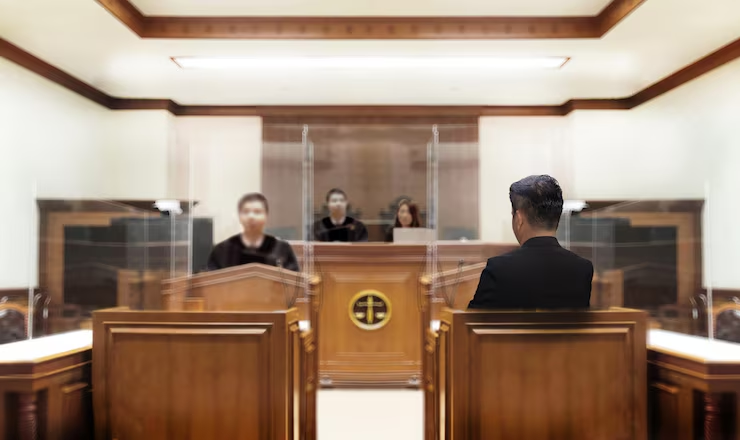
The trial took place in the Arapahoe County Courthouse, a modern building trying hard to look impressive. Judge Harlland presided—a former JAG lawyer with a crew cut so precise you could bounce a quarter off it and the demeanor of someone who’d eaten ten versions of my father for breakfast during his Army career.
When both sides had presented their cases, Judge Harlland took a brief recess. Eighteen minutes later, we were called back for his ruling.
“This court has reviewed the testimony and exhibits in Hayes versus Hayes,” he began, “and I’m going to give you my decision from the bench.”
He proceeded to eviscerate my parents’ case with surgical precision. There was no enforceable agreement. No constructive trust. No unjust enrichment. Just a thirty-year-old man who’d saved his paychecks and bought himself a truck, and a twenty-six-year-old man who thought he was entitled to it.
“The plaintiffs’ complaint is dismissed with prejudice,” Judge Harlland declared. “The 2021 Ford F-150 Lariat is unequivocally the property of Ethan Hayes. Furthermore, the plaintiffs are ordered to pay the defendant’s attorney fees in the amount of eighteen thousand, seven hundred forty-two dollars and court costs.”
Then he did something I’ll never forget. He looked directly at Jordan and said, “Young man, you are twenty-six years old. You live rent-free. You drive other people’s cars. You came into my courtroom asking me to take your brother’s truck and give it to you because you ‘need it more.’ Get a job.”
The gavel came down. Case closed.
The Hallway
In the hallway afterward, my parents intercepted me before I could reach the elevators. Dad’s face was purple with rage. Mom clung to his arm, mascara running.
“You think you won?” Dad hissed. “You just destroyed your mother.”
“No, Dad,” I said, surprised at how steady my voice came out. “You did that when you sued your own son over something he earned. When you taught Jordan that the world owed him my paycheck.”
“How are you going to live with yourself?” Mom wailed.
“Better than I lived with you,” I said.
I walked away from them. Uncle Tim and Aunt Karen walked with me. Sarah walked with me. And I didn’t look back.
Six Months Later
Six months later, my phone rang at 2:17 in the morning. Dad’s number on the screen. I stared at it, remembering every previous emergency call, every crisis that had required my money or my time or my sacrifice.
I let it go to voicemail.
The next morning, curiosity got the better of me. I listened to the message.
“Your brother totaled your mother’s Suburban,” Dad’s voice said, tight with barely controlled frustration. “DUI. She’s beside herself. We need to get him into another vehicle so he can keep his job prospects open. The bank says he needs a co-signer. Call me back.”
I didn’t call back.
Three days later, Mom texted: “Your brother is really struggling. He needs his big brother. Please think about what family means.”
I left her on read. No reply. No apology. Just silence.
Today
The truck keeps rolling. It’s crossed the hundred-thousand-mile mark now, pushing toward one hundred fifteen thousand. The windshield has a crack from a rock on I-80 near Rawlins. The tailgate has a dent from where I backed into a compressor skid in the dark. Coffee stains mark the carpet no detailer can fully remove.
It smells like burnt coffee, sweat, welding rods, and cheap energy drinks. It smells like my life—real, earned, imperfect, and completely mine.
Some nights, parked out in the Permian Basin with the nose pointed toward a flare stack burning a hundred feet into the air, I lie on the ground and look up at the truck and think about what it cost me. Not in dollars, but in relationships and family and the fantasy of belonging somewhere.
I’m Ethan Hayes. Thirty years old. Debt-free. Owner of a 2021 Ford F-150 Lariat with a cracked windshield, a dented tailgate, and more miles than anyone expected it to survive. I paid for it with skin and sleepless nights and loneliness that nobody will ever refund. I paid for it by learning that you don’t owe your family your bones just because they’re your family.
That truck isn’t just leather and steel and horsepower. It’s a line in the sand, a declaration of independence, proof that I don’t need their approval or their understanding to build a life worth living.
When people ask if I worry about my father trying something again, I look at my keys, at the title with my name on it, at the scars on my hands.
“If my family ever tries to take these keys again,” I say, “they’re going to find out I know how to fight back now.”
Then I get in my truck, start the engine, feel that familiar rumble under my feet, and drive. Not away from anything. Toward the life I built, one paycheck at a time, one boundary at a time, one hard choice at a time.
And that’s exactly where I intend to stay.