The Golden Truth
The Golden Wedding Anniversary of Edward and Martha Langston was the kind of celebration you read about in magazines or see in movies. Held at the elegant Rosewood Inn, with its blooming gardens and chandeliers dripping crystals, the event was a dream brought to life.
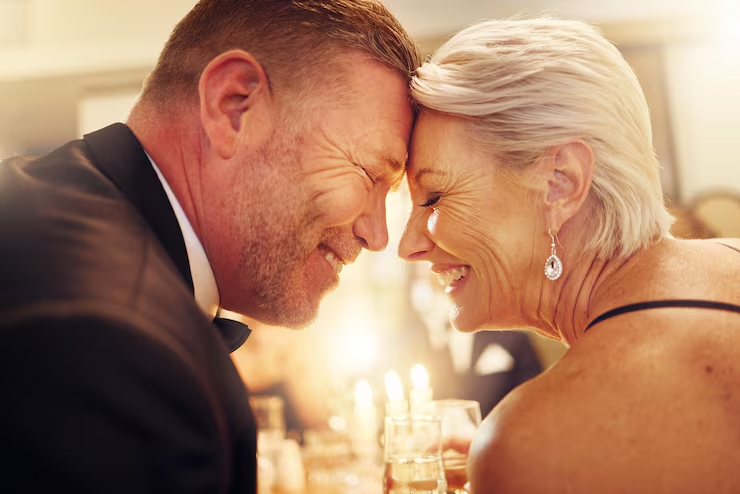
Every guest wore their finest attire. Tables were adorned with gold-trimmed linens, white roses, and candlelight. Their children had spared no expense. Edward, a tall, silver-haired man with eyes like winter skies, wore a sharp navy-blue suit. Martha, radiant in a champagne-colored gown, looked decades younger, her eyes still sparkling with quiet mischief.
Friends and family from all over the country had flown in. Everyone was eager to hear stories, relive memories, and toast to a love that had lasted half a century. People whispered, “What’s their secret?” and “They’ve been through everything together.”
The event had been months in the planning. Their three children—Charles, the eldest, a corporate lawyer in Chicago; Diana, the middle child, a pediatrician in Portland; and Michael, the youngest, a high school teacher in their hometown of Asheville—had coordinated every detail with military precision. Nothing was left to chance. This was more than a party. It was a tribute to a marriage that had survived everything life could throw at it.
As guests arrived, they were greeted with champagne and canapés on the terrace overlooking the inn’s rose garden. The afternoon sun cast everything in golden light, as if the universe itself was celebrating this milestone. Old friends embraced, cousins reconnected, and grandchildren ran through the gardens in their formal wear, laughing and playing tag between the hedges.
Edward stood near the entrance, shaking hands and accepting congratulations with his characteristic stoicism. He had always been a reserved man, measured in his words, thoughtful in his expressions. People respected him for his integrity, his work ethic, and his quiet strength. For thirty-five years, he had worked as an engineer for a manufacturing company, retiring only five years ago. He was the kind of man who fixed things—machines, problems, broken situations. But he rarely talked about his feelings.
Martha, by contrast, was warm and effusive. She greeted each guest like they were the most important person in the world, remembering names, asking about grandchildren, complimenting dresses and ties. She had been a schoolteacher for forty years, beloved by generations of students who still sent her cards and visited her home. Where Edward built walls, Martha built bridges. Where he was silent, she was eloquent. They were opposites in many ways, but somehow, they had made it work.
The Celebration Begins
As dinner plates were cleared and the sun began to set, casting the ballroom in warm amber light, the couple’s eldest son, Charles, tapped his wine glass with a spoon. The room hushed, conversations trailing off mid-sentence as all eyes turned to the head table.
“Ladies and gentlemen,” Charles began, grinning, his voice carrying the confidence of someone accustomed to commanding a courtroom, “we are gathered here today to celebrate something rarer than gold—fifty years of marriage between our incredible parents.”
Applause echoed through the hall, genuine and enthusiastic. People stood, raising their glasses toward Edward and Martha, who sat side by side, holding hands on top of the white linen tablecloth.
“Fifty years,” Charles continued, shaking his head in wonder. “Think about that. Fifty years of waking up next to the same person. Fifty years of shared meals, shared dreams, shared challenges. In a world where marriages fall apart over text messages and disagreements about whose turn it is to do the dishes, these two have built something extraordinary.”
More applause. A few people shouted, “Hear, hear!”
“Growing up,” Charles said, his voice softening with emotion, “I watched them navigate everything. Financial struggles when Dad’s company laid off half the workforce. Mom’s battle with breast cancer fifteen years ago. The loss of both sets of grandparents. My sister’s difficult divorce. My brother’s accident that left him in the hospital for three months.”
The room had gone quiet now, listening intently.
“Through all of it,” Charles said, “they never wavered. They were our rock, our foundation, our proof that love doesn’t just exist in fairy tales. It exists in the real world, in the trenches, in the moments when everything falls apart and you have to choose whether to run or stay.”
He turned to face his parents directly.
“Mom, Dad—you taught us what commitment looks like. You taught us that marriage isn’t about finding the perfect person, but about choosing to love an imperfect person perfectly. You showed us that forever is possible if you’re willing to fight for it.”
Charles’s voice broke slightly, and he paused to compose himself. His wife reached over and squeezed his hand.
“And now,” Charles said, clearing his throat, “Dad wants to say a few words.”
The room erupted in applause again as Edward stood slowly, adjusting his cufflinks with the meticulous precision that characterized everything he did. He walked to the center of the room where a microphone stood on a small podium. The microphone gave a slight squeal of feedback before settling. He looked at Martha, who was smiling patiently, hands folded in her lap, her eyes bright with unshed tears of joy.
Edward cleared his throat. He looked out at the sea of faces—people who had been part of their lives for decades, people who thought they knew everything about Edward and Martha Langston’s marriage.
His voice, when he spoke, was clear and steady.
The Speech That Changed Everything
“I’ve waited a long time to say this,” he began. “Fifty years, in fact.”
Laughter rippled through the crowd, warm and affectionate. People settled in, expecting the usual speech about gratitude, love, and partnership.
“But,” he paused, taking a breath that seemed to last forever, “I haven’t loved you all these fifty years.”
The room froze.
Smiles vanished like lights being switched off. A few people coughed awkwardly, uncertain if they’d heard correctly. Even the pianist at the corner table stopped playing mid-note, his hands hovering over the keys. Charles, still standing near the head table, went pale. Diana gasped audibly. Michael half-rose from his seat, as if preparing to intervene.
Martha’s smile faltered. She blinked, confusion flashing across her face before she carefully schooled her expression back to neutrality. But her hands, which had been folded peacefully in her lap, now gripped each other tightly, knuckles white.
Edward continued, his voice low and serious, seemingly oblivious to the shock radiating through the room.
“No, I haven’t loved you every single day of these fifty years. There were days—many, in fact—when I was angry. Days when I felt misunderstood, or tired, or lost in my own thoughts. Days when I didn’t feel like giving anything at all. On those days, love seemed so far away, like something I’d read about in a book but couldn’t quite grasp.”
He looked around the room, meeting eyes that stared back in confusion, concern, and growing horror. Some people were looking at Martha, waiting for her reaction. Others looked at the exits, as if considering whether they should leave.
“I know some of you are shocked,” Edward said, his tone matter-of-fact, almost clinical. “But let’s be honest. Real love isn’t built on fairy tales. It’s built on mornings when no one wants to get out of bed but still makes coffee for the other person. It’s built on hospital visits, bills, forgotten anniversaries, late-night arguments, and choosing forgiveness when resentment feels easier.”
Martha was watching him now with glistening eyes, though whether they held tears of sadness or something else, no one could tell.
“There were days I was selfish,” Edward admitted, his voice dropping lower, forcing people to lean forward to hear him. “Days I took you for granted. Days I questioned everything. Days I looked at you across the breakfast table and wondered who you were, this stranger I’d promised forever to when we were both so young and naive.”
Charles moved toward the microphone, clearly intending to stop this train wreck of a speech, but Diana grabbed his arm and shook her head. “Wait,” she whispered. “Just wait.”
“I remember the third year of our marriage,” Edward continued, his eyes distant now, looking at something only he could see. “We were living in that cramped apartment on Maple Street. You were pregnant with Charles, and I was working double shifts at the plant. I was exhausted all the time, sleeping maybe four hours a night. You were sick constantly, throwing up every morning, barely able to keep food down. And I resented you for it.”
A collective intake of breath swept through the room.
“I resented you for being pregnant, for needing me, for making my life harder. I never said it out loud, but I felt it. Every time you called me at work because you needed me to pick up ginger ale on the way home, every time you were too tired to make dinner, every time you cried because your body was changing and you felt ugly—I resented it all.”
Martha’s hand was at her throat now, her face unreadable.
“I remember the tenth year,” Edward went on, relentless now, as if a dam had broken and fifty years of unsaid words were flooding out. “Charles was seven, Diana was four, Michael was two. You were teaching full-time and raising three kids, and I was climbing the ladder at work, traveling constantly. We barely saw each other. And when we did, we fought. About money, about the kids, about whose career mattered more, about who was more tired, who sacrificed more.”
He paused, swallowing hard.
“I remember thinking, ‘This isn’t what I signed up for. This isn’t the life I wanted.’ I looked at my single colleagues who could stay out late, who had money to spend on themselves, who could pick up and travel on a whim. And I wondered what my life would have been like if I hadn’t gotten married at twenty-three.”
The room was utterly silent now. Even the children had stopped fidgeting, sensing something significant was happening even if they didn’t understand what.
“I remember year fifteen,” Edward continued. “Your mother died. You were devastated, barely functional for months. I tried to be supportive, I really did. But inside, I was frustrated. I needed you to be strong, to be the partner I’d always relied on. Instead, you were broken, grieving, unavailable. And I was angry at you for that. Angry at you for being human, for needing time to heal.”
He looked directly at Martha now, his winter-sky eyes locked on hers.
“Year twenty. Michael’s accident. He was seventeen, and that drunk driver nearly killed him. You practically lived at the hospital for three months. I was there too, but I kept working, kept the house running, kept everything going. And I was furious. Furious at the world, furious at that driver, and yes, furious at you for falling apart when I needed you to be strong. I needed someone to lean on, and you were too broken yourself to hold me up.”
Tears were streaming down Martha’s face now, but she made no move to wipe them away.
“Year thirty-five. Your cancer diagnosis. The fear in your eyes when the doctor said ‘malignant.’ The chemotherapy that made you so sick. The mastectomy that left you feeling like less of a woman. I held your hand through all of it, drove you to every appointment, helped you to the bathroom when you were too weak to walk. But inside, I was terrified and angry and resentful. Why us? Why you? Why did I have to be strong enough for both of us?”
He turned back to face the room, his voice growing stronger.
“I didn’t love you on those days. I didn’t love you when you were sick, when you were grieving, when you were too tired or too sad or too overwhelmed to be the woman I’d married. I didn’t love you when we fought about money, or the kids, or whose family to spend Christmas with. I didn’t love you when you gained weight after the babies, or when you cut your hair short in a style I hated, or when you stopped wearing makeup because you were too busy teaching and mothering to care what you looked like.”
The horror on people’s faces was palpable. Several women were crying. Men were shifting uncomfortably, unsure whether to intervene or stay silent.
“But here’s what I want you—and everyone here—to know.”
Edward walked away from the podium, directly toward Martha. He stood in front of her chair, and slowly, deliberately, he knelt down on one knee, taking her hands in his.
The Truth Revealed
“On those days, even when I didn’t feel love, I chose you.”
A collective gasp swept the room, but this time it carried a different quality—not horror, but dawning understanding.
“I chose to stay,” Edward said, his voice thick with emotion now. “I chose to work through it. I chose to show up. I chose to fight for us. I chose to hold your hand even when I didn’t know what to say. Because love isn’t a feeling—it’s a decision, over and over again.”
His voice broke.
“And Martha, my decision has always been you. Even when I didn’t like you very much, I chose you. Even when I was angry or resentful or confused, I chose you. Even when staying felt harder than leaving, I chose you. Every single day for fifty years, I woke up and chose you again.”
Now the room was silent but for sniffles. Even the waiters, who had tried to remain professionally stoic, were dabbing at their eyes with their pristine white napkins.
“Because here’s what I’ve learned,” Edward said, looking up at his wife’s tear-stained face. “Love isn’t the feeling you get when everything is perfect. That’s not love—that’s euphoria, that’s infatuation, that’s the high of something new and exciting. Real love is the choice you make when everything is falling apart. It’s showing up when you don’t feel like it. It’s staying when leaving would be easier. It’s giving when you feel empty. It’s choosing kindness when you want to be cruel. It’s choosing patience when you feel exasperated. It’s choosing forgiveness when you want to hold a grudge.”
He reached into his jacket pocket and pulled out a folded piece of yellowed paper, the edges soft with age.
“This is a letter I wrote to myself ten years into our marriage. I never showed it to you. I wasn’t sure I ever would.”
He unfolded the letter carefully, his hands trembling now. Martha leaned forward, seeing the paper for the first time.
Edward cleared his throat and began to read, his voice barely above a whisper.
“Dear Edward, you’re ten years in and you’re wondering if you married the right woman. She’s tired, you’re frustrated, and the spark feels dim. The woman you wake up next to doesn’t look like the girl you married. She’s got stretch marks and circles under her eyes and she’s forgotten how to laugh. You fight about stupid things—whose turn it is to change the diaper, whether you can afford a new car, why she signed Charles up for soccer without asking you first. You’re wondering if this is all there is, if this is what the rest of your life looks like. But I need you to know something.”
He paused, his voice catching.
“You married a woman who will grow into your soulmate—not because she changes, but because you’ll finally see her for who she’s always been. You’ll watch her hold your second child for the first time, and it’ll hit you like lightning that she’s creating life, that she’s the strongest person you’ve ever known. You’ll see her weep at your mother’s funeral and know she’s your anchor, the one person who understands your pain without you having to explain it. You’ll see her standing in front of her classroom at fifty-five, still lighting up when she talks about literature, and you’ll remember why you fell in love with her passion.”
Edward’s voice was shaking badly now, tears running freely down his weathered face.
“You’ll see her hold your first grandchild and watch her eyes fill with a joy so pure it takes your breath away. You’ll see her dancing barefoot in the kitchen at sixty-two to some old song from your college days, and you’ll remember the girl you fell in love with at twenty-two. You’ll see her fighting cancer with a courage that humbles you, never complaining, always thinking of others first. You’ll see her age—the wrinkles, the gray hair, the body that doesn’t move as easily as it once did—and you’ll think she’s the most beautiful thing you’ve ever seen.”
He folded the letter and placed it back in his pocket, then looked up at Martha.
“I didn’t love you every moment of these fifty years, Martha. The feeling wasn’t always there. But I’ve chosen you every day. And that, to me, is greater than fleeting romance. It’s real. It’s permanent. It’s earned. Every argument we survived, every crisis we weathered, every moment I chose to stay when I could have left—those moments built something stronger than the butterflies I felt when I first kissed you fifty-three years ago.”
He squeezed her hands.
“The feeling of love comes and goes. It’s affected by stress, by exhaustion, by disappointment, by the mundane realities of life. But the choice to love—that’s the bedrock. That’s what survives when everything else fails. That’s what I want our children, our grandchildren, and everyone in this room to understand. Marriage isn’t about feeling love every moment. It’s about choosing love every moment, especially in the moments when you don’t feel it at all.”
Martha’s Response
A tear escaped Martha’s eye, followed by another, and another. She stood slowly, and Edward rose with her. The room held its breath, waiting to see how she would respond to this brutally honest revelation.
Martha took the microphone from the podium with trembling hands and said softly, “May I?”
Edward nodded, stepping aside but staying close, his hand on the small of her back.
Martha looked at the crowd, then at Edward, then back at the crowd. She took a shaky breath.
“I wasn’t expecting that speech,” she said with a soft, watery laugh. “But I suppose after fifty years, nothing truly surprises me anymore.”
Laughter broke the tension, warm and grateful, as if the room had been holding its breath and could finally exhale.
“Edward just confessed something that most people would take to their graves,” Martha said, her voice growing stronger. “He admitted that he didn’t love me every day. That there were times he resented me, questioned our marriage, wondered what his life could have been without me.”
She paused, looking directly at her husband.
“And I want everyone here to know something. I already knew that.”
A ripple of surprise moved through the crowd.
“Did you think I didn’t notice?” Martha asked, a sad smile on her face. “Did you think I couldn’t feel the distance when you pulled away? The coldness when you were angry? The resentment radiating off you like heat?”
She turned to face the room fully.
“You said you didn’t love me every single day. That there were hard moments when you questioned everything. I want everyone to know—I did too.”
Edward’s expression shifted from relief to something more complex—surprise mixed with recognition.
“There were days when I looked at you and thought, ‘Who is this stubborn man, and where did the boy I married go?'” Martha continued, her voice gaining strength. “There were nights I cried into my pillow, mornings I stared out the window wondering if we’d lost our way. Times when your silence felt like a wall I couldn’t climb. Times when I needed you to talk to me, to open up, and you retreated into yourself like a turtle pulling into its shell.”
She looked at him directly now.
“Year seven. You forgot our anniversary completely. Not just forgot to get me a gift—forgot the day entirely. You came home late from work and were genuinely confused when I was crying. I spent that evening wondering if I’d married a man who would ever truly see me, or if I’d always be secondary to your job, your stress, your world.”
Edward closed his eyes, clearly remembering.
“Year twelve. Your father’s death. You shut down completely. Wouldn’t talk about it, wouldn’t cry, wouldn’t acknowledge that you were in pain. You just went to work every day like nothing had happened, and came home silent and distant. I tried everything to reach you, but you locked me out. For six months, I lived with a ghost. I couldn’t help you because you wouldn’t let me in. And I was so angry at you for that. Angry that you’d shut me out when I was trying so hard to love you.”
Her voice caught, but she pushed on.
“Year eighteen. Michael’s accident. You accused me of falling apart, of not being strong enough. But you know what? I was terrified. Our son almost died, Edward. He was in a coma for two weeks. I sat by that hospital bed praying every moment that he’d wake up. And yes, I fell apart. But I needed you to fall apart with me, not to be some stoic pillar that I had to maintain my composure around. I needed you to cry with me, to rage against the universe with me, to be human with me.”
Tears were streaming down her face now.
“Year twenty-five. Your promotion that required us to move away from everyone and everything I knew. You were so excited about the opportunity, about the salary increase. But I had to leave my school, my students, my friends, my mother who was already getting frail. You didn’t ask if I wanted to move—you told me we were moving. And I went, because that’s what wives did. But I resented you for it. For two years, I resented you every time I felt lonely in that new city.”
She wiped her eyes with the back of her hand.
“Year thirty-two. My cancer diagnosis. You were there for every appointment, every treatment. You held my hand, drove me everywhere, took care of me. But you were so focused on being strong that you never once admitted you were scared. I needed you to be scared with me, Edward. I needed you to tell me you were terrified of losing me. Instead, you were efficient, practical, focused on solutions. It made me feel like a problem to be solved rather than your wife who was fighting for her life.”
The room was absolutely still. Even the waitstaff had stopped moving, frozen in place by the raw honesty unfolding before them.
“So no,” Martha said, her voice cracking, “you’re not alone in having doubts, or bad days, or moments of resentment. I had them too. We both did. Because that’s what marriage is—it’s two imperfect people trying to build something lasting out of very flawed materials.”
She moved closer to Edward, close enough to touch him.
“But you know what else I want everyone to know? On all of those days, I didn’t need your perfection. I only ever needed your promise. And you gave me that—even when it was hard, even when you didn’t feel love, even when staying felt impossible.”
She reached for his hands.
“I once read a quote that said, ‘Marriage is not fifty-fifty. It’s one hundred-one hundred. You give everything you have, even when the other person can’t.’ You’ve done that for me. And I’ve tried to do it for you. That’s why we’re here today—not because we were perfect, but because we kept giving, even when we were empty.”
Her voice dropped to almost a whisper, but in the silent room, every word carried.
“You say you chose me every day. But what I want you to know, Edward Langston, is that even on the days when you couldn’t love me, I loved you enough for the both of us. And that was never a burden. It was a joy. It was a privilege. It was the honor of my life.”
She looked out at their children, who were openly weeping now.
“Our kids grew up watching us fight and make up. They saw us struggling with money, with loss, with disappointment. They saw us at our worst. And I used to feel guilty about that—that we didn’t give them the fairy tale version of marriage. But now I realize we gave them something better. We gave them the truth. We showed them that love isn’t about perfect moments—it’s about imperfect people refusing to give up on each other.”
She turned back to Edward.
“So no, I don’t need you to have loved me every moment of the past fifty years. I just need you to know—I noticed. I noticed every time you stayed when leaving would have been easier. I noticed every time you fixed something around the house without being asked. I noticed every time you held our grandchildren like they were made of glass. I noticed every time you remembered to bring me honey-lemon tea when I was sick, even though I know you hate the way it smells. I noticed every time you called me from work just to hear my voice. I noticed every time you chose me.”
Her voice broke completely now.
“Thank you for not loving me perfectly. Thank you for loving me honestly. Thank you for fifty years of choosing me, even when I was hard to choose. Thank you for showing me that love isn’t a feeling—it’s a decision you make every single day, over and over, for the rest of your life.”
The Kiss
Then, in front of everyone, she kissed him. Not a polite peck for the cameras, not a showy dip for dramatic effect, but a tender, lingering kiss that seemed to rewind time and remind every soul present what love truly looked like. It was the kiss of two people who had seen each other at their absolute worst and had chosen to stay anyway. It was the kiss of survivors, of warriors who had fought side by side through fifty years of battles. It was the kiss of two people who knew every fault, every weakness, every failure the other possessed—and loved them not despite those things, but because of the courage it took to keep going anyway.
The room erupted. Not just applause, but a standing ovation that seemed to shake the chandeliers. People were openly sobbing, clutching their partners, wiping their eyes with napkins and sleeves and whatever was handy. The head waiter, a stern-faced man in his sixties who had worked a thousand weddings and never shed a tear, was standing in the corner with his hand over his mouth, shoulders shaking with emotion.
Charles, Diana, and Michael had moved to stand together, arms around each other, all three crying. They had just witnessed their parents—these people they thought they knew so well—reveal depths of struggle and commitment they’d never fully understood.
“That’s the most beautiful thing I’ve ever seen,” someone whispered.
“Fifty years,” someone else breathed. “They made it fifty years.”
“Not made it,” an older woman corrected, squeezing her own husband’s hand. “They chose it. For fifty years, they chose it.”
The Aftermath
As the applause finally died down and people began to return to their seats, wiping their eyes and clearing their throats, the pianist—who had been frozen in place for the entire exchange—tentatively began playing again. He chose “The Way You Look Tonight,” and the tender melody filled the room like a benediction.
Edward and Martha stood together at the front of the room, still holding hands, looking out at the sea of tear-stained faces. They looked tired, vulnerable, stripped of all pretense. But they also looked free—free of the burden of pretending their marriage had been easy, free of the pressure to be the perfect couple everyone thought they were.
“Should we dance?” Edward whispered to Martha.
She laughed, the sound breaking through the emotion like sunshine through clouds. “I think we’ve given them enough of a show for one night.”
“One dance,” he insisted. “For fifty years.”
So they danced. In the center of the room, with everyone watching, they swayed to the music like teenagers at their first prom—awkward, tender, completely absorbed in each other. Edward held Martha like she was made of porcelain, and Martha rested her head on his shoulder like she was finally home after a long journey.
Around them, other couples began to join in. Charles pulled his wife onto the dance floor. Diana danced with her father’s brother. Michael swayed with his teenage daughter, who looked embarrassed but pleased. Soon the entire room was dancing, couples holding each other a little tighter, looking at each other with new understanding.
At the edge of the dance floor, a young couple—married just two years—stood watching.
“Do you think we’ll make it fifty years?” the wife asked her husband.
He looked down at her, at this woman he’d married in a haze of romantic love and optimism, and thought about Edward’s speech. He thought about the fights they’d already had—about whose career should take priority, about how to spend money, about whose family to visit for the holidays. He thought about the moments when love had felt distant, when staying had felt harder than leaving.
“I don’t know if I’ll love you every single day,” he said honestly, echoing Edward’s words. “But I promise to choose you every day. That’s all I can promise.”
She looked up at him with tears in her eyes. “That’s all I need.”
They joined the other couples on the dance floor.
Ripples in the Water
The next morning, as sunlight streamed through the windows of their suite at the Rosewood Inn, Martha woke to find Edward already awake, sitting in the armchair by the window, watching her.
“That was quite a speech you gave last night,” she said, her voice still rough with sleep.
“I’ve been carrying those words for fifty years,” he replied. “It was time to let them go.”
She sat up, pulling the blankets around her. “Were you scared? That I’d be angry? That I’d feel betrayed?”
“Terrified,” he admitted. “But I realized something while I was writing that speech. I was more afraid of reaching our fiftieth anniversary having never told you the truth. More afraid of you thinking our marriage was easy than of you knowing it was hard.”
Martha was quiet for a long moment, processing this.
“I’m glad you said it,” she finally said. “Because you gave me permission to say it too. To admit that I struggled. To stop pretending I was the perfect wife who never doubted, never questioned, never felt the weight of this commitment.”
Edward moved from the chair to sit on the edge of the bed, taking her hand.
“Did we mess up?” he asked. “Did we ruin the anniversary? The kids looked so upset.”
Martha laughed softly. “We didn’t ruin it. We made it real. We gave everyone in that room permission to be honest about their own marriages. To stop performing perfection and start embracing the messy, difficult, beautiful truth.”
She squeezed his hand.
“Charles texted me this morning. He and Jennifer stayed up half the night talking. Really talking, for the first time in months. He said your speech saved their marriage.”
Edward’s eyes widened. “I didn’t know they were struggling.”
“Neither did I. That’s the point. Everyone pretends. Everyone puts on the perfect face and hides the cracks. You and I—we showed our cracks last night. And it gave other people permission to acknowledge theirs.”
Messages and Meaning
Over the following days, the messages poured in. Diana called to say she’d finally opened up to her mother about her loneliness since her divorce, admitting that watching her parents’ honesty had made her realize she’d been lying to everyone—including herself—about being fine. Michael wrote a long email about how the speech had changed his perspective on his own ten-year marriage, how he’d been taking his wife for granted and assuming love was supposed to feel easy all the time.
But it wasn’t just family. Friends who had attended sent heartfelt letters. Martha’s former students wrote to say the story of her marriage had given them hope for their own relationships. Even strangers—because of course someone had filmed the speeches on their phone and posted them online—reached out to share how the words had affected them.
One message in particular stuck with Martha. It was from a woman in her thirties, married for five years, who wrote:
“I was planning to file for divorce next week. My husband and I have been fighting constantly, and I was convinced we’d married the wrong people. But your husband’s speech made me realize something: I’ve been waiting to feel love again, waiting for him to be the man I fell in love with, waiting for our marriage to be easy. I didn’t understand that love is a choice, not a feeling. Tomorrow, instead of going to a lawyer, I’m going to choose my husband. I’m going to tell him I choose him, even on the days when it’s hard. Thank you for saving my marriage.”
Martha read the message to Edward through tears.
“We did something good,” she said. “Something important.”
“We told the truth,” Edward replied simply. “That’s all we did. We told the truth that everyone thinks but nobody says.”
The Real Secret
One evening, about a week after the anniversary party, Edward and Martha sat on their back porch watching the sunset. They were wrapped in blankets, sipping coffee, comfortable in the silence that comes after fifty years of learning to be quiet together.
“You know what the real secret is?” Martha said suddenly.
Edward looked at her. “What?”
“The secret to fifty years isn’t that we loved each other every day. It’s that we forgave each other every day.”
Edward considered this, then nodded slowly. “You’re right. Every day, we forgave each other for not being perfect. For being human. For failing to meet each other’s expectations.”
“For being selfish sometimes,” Martha added. “For being scared. For not always knowing what to say or do.”
“For not being mind readers,” Edward said with a slight smile. “For making mistakes. For hurting each other even when we didn’t mean to.”
“And every day,” Martha continued, “we chose to start over. To give each other another chance. To believe that tomorrow could be better than today.”
She reached over and took his hand, these two hands that had held each other through fifty years of joy and sorrow, triumph and failure, love and the lack of it.
“That’s what I wish someone had told us on our wedding day,” Martha said. “That marriage isn’t about loving perfectly. It’s about forgiving endlessly. It’s about waking up every morning and choosing to start fresh, to let go of yesterday’s hurts and yesterday’s disappointments and yesterday’s failures.”
“Would we have believed them if they’d told us?” Edward asked.
Martha laughed. “Probably not. We thought we knew everything. We thought love was enough.”
“It wasn’t enough,” Edward said quietly. “But choosing was. Staying was. Forgiving was.”
They sat in comfortable silence as the sun dipped below the horizon, painting the sky in shades of orange and pink and purple. Fifty years of shared sunsets stretched out behind them. Who knew how many more stretched out ahead? But it didn’t matter. Because they had learned the secret that so many marriages never discover:
Love is not a feeling that carries you through. Love is a choice you make when the feeling fails.
The Legacy
Months later, at Charles and Jennifer’s twenty-fifth anniversary—a much quieter affair—Edward and Martha watched their son give a speech to his wife. In it, he echoed his father’s words, adding his own truth:
“I haven’t loved you perfectly for twenty-five years. But I’ve chosen you imperfectly, and that’s made all the difference.”
Jennifer cried and kissed him, and Edward and Martha held hands under the table, knowing that what they’d started at their fiftieth anniversary had planted seeds in the next generation.
This was their real legacy. Not the money they’d leave behind, not the house or the possessions. But the truth they’d spoken into existence: that real love is messy and difficult and requires choice more than feeling. That marriage is not about finding the perfect person but about choosing to love an imperfect person, over and over and over again.
And under the stars, with fifty-one years behind them now and however many more ahead, two imperfect people held on to one perfect truth:
Real love isn’t always pretty. It’s not always easy. It’s not always a feeling.
But when you choose it anyway—especially when you don’t feel it—that’s when it becomes something stronger than romance, more lasting than passion, more powerful than the butterflies that brought you together in the first place.
That’s when it becomes forever.