The Sunday Reckoning
The Sunday family dinner at the Miller estate was usually a rigid, soul-crushing display of social hierarchy, an elaborate performance for an audience of none. Today, the atmosphere in the cavernous, mahogany-paneled dining room was thicker than ever, heavy with the scent of overcooked roast beef and a simmering, palpable resentment that had been brewing for a decade. A large, stern portrait of David’s father hung over the fireplace, his painted eyes seeming to judge my every move. My husband, David, had just been promoted to CEO of a small but rapidly growing tech company called Innovate Dynamics, and his arrogance, always a significant and challenging part of his personality, had swollen to an intolerable, monstrous size.
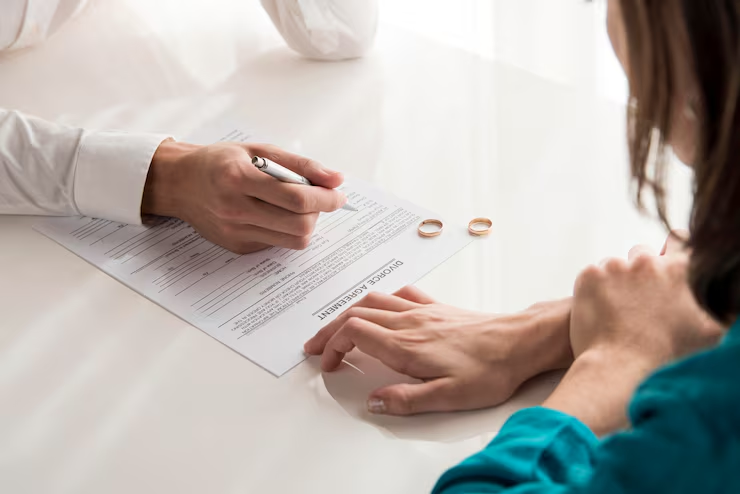
He waited until the dessert plates were cleared, a calculated, theatrical move designed for maximum emotional impact and public humiliation. With a dramatic flourish that was meant to signify his new, untouchable status, David slammed a thick stack of professionally bound papers onto the polished, antique table, right in front of my untouched plate of crème brûlée. The sharp, percussive sound echoed in the oppressive silence, a gavel falling on the sentence of our marriage.
They were divorce papers.
He looked at me, his eyes, once filled with a love I had cherished, now as cold and empty as a winter sky. “Sign it,” he commanded, his voice devoid of all warmth, all history, all humanity. “I’m sick of your provincial face, your small-town ambitions, your utter lack of sophistication. I’m a CEO now. I have a certain image to maintain, a certain caliber of partner is expected at the functions I now attend. You are, to be blunt, no longer part of that image.”
My mother-in-law, Brenda, sat beside him, a vulture in pearls, savoring a glass of expensive red wine and wearing a triumphant, reptilian smirk. She had been waiting for this moment for years, actively working towards it. “My son is a titan of industry now; he deserves someone better. Someone with… pedigree. Someone who can navigate a boardroom, not just a PTA meeting. Get out with nothing, dear. It’s what you deserve for holding him back, for being a weight around his neck, for all these years. We’re being generous by not demanding you pay us back for your upkeep.”
I, Anna, felt the humiliation like a raw, physical burn, a heat that rose from my chest to my face. My eyes were fixed on the papers, the stark, black ink of my name a testament to the end of a life I had built, a life for which I had sacrificed everything. I had given up my own promising career in finance, a position at a top-tier investment firm that I had earned on my own merit, to support his. I did it willingly, believing in the partnership we were building, in the dream he sold me of a shared future. I had been his cheerleader, his unpaid strategist, his 24/7 sounding board, and his tireless domestic support system. I had managed our home, our finances, and our social lives with the precision of a COO so that he could focus solely on his ascent. And this was my severance package. To be discarded like an outdated piece of technology, deemed incompatible with his new operating system.
The Mask Comes Off
They waited for the tears. They waited for the screams, for the begging, for the predictable, satisfying drama of a woman broken. Brenda leaned forward slightly, her eyes glittering with a predatory anticipation, thirsty for my pain.
But I did not cry. I did not argue. The world around me seemed to go silent, the roaring in my ears fading away to a crystalline, preternatural clarity. I slowly picked up the divorce papers. My hands trembled, not with fear, but with the residual pain of a decade-long betrayal, a physical manifestation of a shattered heart. My mind, however, had become cold, sharp, and ruthlessly efficient. The part of me I had suppressed for ten years, the sharp, analytical mind of a financier, the mind of Arthur Miller’s daughter, was reawakening with a vengeance.
I looked at David’s smug, self-satisfied glee. I looked at Brenda’s undisguised, venomous cruelty. I saw them clink their wine glasses together in a silent, celebratory toast to my demise. And in that moment, the pain solidified into an absolute, unshakeable resolve. I had been so busy playing the role of the supportive, unassuming housewife that I had forgotten who I truly was. But they had made a fatal, catastrophic mistake: they had forgotten who I was, and more importantly, they had forgotten who my father was. They had forgotten who held the real power.
I carefully placed the papers back on the table. I wiped my hands on the linen napkin, a deliberate, final act of cleansing myself of their filth. I pulled out my phone. This was not a plea. This was not a desperate call for help. This was the execution of a long-planned, deeply buried contingency order.
I dialed a single, pre-programmed number, and my voice rang out, clear and emotionless, loud enough for the entire dining table to hear, cutting through the smug silence like a surgeon’s scalpel.
“Hello, Ms. Vance,” I said into the phone, addressing my longtime personal secretary and asset manager, a woman of formidable competence and absolute discretion who had worked for my father for thirty years. “Yes, I’ve just been presented with the paperwork. Please proceed with the Sterling acquisition portfolio. Execute Protocol Alpha, effective immediately. All assets are to be consolidated under the primary trust. No exceptions.”
David and Brenda exchanged a confused, mocking glance. “Calling your little friends for a pity party, Anna?” David sneered. “How pathetic. No one can help you now.”
They had no idea.
The Truth Revealed
After my father, the famously discreet and brilliant investment mogul Arthur Miller, had passed away, I didn’t just inherit his money. I inherited his empire. I inherited the controlling stake in a labyrinthine, global technology investment fund called Miller Capital Holdings. Six months ago, foreseeing this very betrayal, this inevitable act of narcissistic cruelty—a pattern my father had warned me about—this fund had secretly, through a series of shell corporations and blind trusts, bought the majority of the shares in my husband’s company. It had then, with surgical precision, orchestrated the ouster of the previous CEO and, as a final, ironic flourish, installed David as his replacement. He thought he had earned it through his own genius. He thought he was a titan of industry. In reality, he was a puppet, a placeholder, a test I had set for him, which he had just failed spectacularly.
They thought I was a simple housewife. In reality, I was the company’s true owner, the unseen, silent Chairwoman of the Board.
I hung up the phone. I looked directly into David’s eyes, which were still narrowed in a condescending smirk. He believed I had just made a hysterical, nonsensical call to a friend. He thought he had won. He thought he was holding all the cards.
“Are you quite finished with your theatrics?” he sneered. “Just sign the papers, Anna. Don’t make this any more embarrassing for yourself than it already is. I have a reputation to protect.”
I smiled, a cold, powerful, and utterly unfamiliar smile that he had never seen before. It was a predator’s smile. It was my father’s smile. “I was just thinking, David. Are you sure… you want to file for divorce when your new, prestigious CEO position… was my appointment?” I asked, my voice dangerously soft, the words dropping into the silence like stones into a still pond.
David paused, a flicker of confusion crossing his face. “What? What kind of nonsense are you talking about now? Are you delusional? The stress has finally broken your mind.”
My smile widened. “The company that you are so proud to be the ‘CEO’ of… ‘Innovate Dynamics,’ I believe it’s called… is a recent acquisition. Did the board not inform you of the details of the takeover? Did you not read the fine print in your own employment contract, the one that names the parent corporation?”
Brenda gasped, a small, choked sound, her wine glass freezing halfway to her lips. She understood finance far better than her son. She understood what the word ‘takeover’ meant. She was beginning to understand that they had not just made a mistake; they had committed financial suicide.
I pointed a single, steady finger directly at David. “Innovate Dynamics is now a wholly-owned subsidiary of a private equity corporation called M.C. Holdings. The corporation my father founded, and of which I inherited sixty percent of the controlling shares last week upon the final settlement of his estate. Your boss, David, is not the board. Your boss… is me. And you are terminated. Effective immediately.”
The House of Cards Collapses
David and his mother were utterly speechless, their faces a comical, grotesque mask of shock and disbelief. “You… you can’t do that!” David finally stammered, his voice a pathetic squeak, the blustering CEO replaced by a terrified little boy. “I’m the CEO! I have a contract!”
“You were the CEO,” I stated, my voice as hard as diamond. “And your contract has a termination clause for gross misconduct, which, I believe, attempting to defraud a majority shareholder in a divorce settlement certainly qualifies as. I just spoke to Ms. Vance, who has already conferred with Mr. Peterson, the Chairman of the Board whom I appointed last month. He agrees with my decision. Your termination papers will be messengered to you in the morning.”
I took the divorce papers and placed them neatly on the table. Then, from my handbag, I produced another, thicker folder and placed it beside them. “Sign this,” I said, pushing the divorce papers towards him. “And then, you and your mother can pack your bags and move out of the house you think you own.”
“This is my family home!” Brenda shrieked, finding her voice, her face a mottled, furious red. “You can’t throw us out! This has been in the Miller family for generations!”
“Actually, I can,” I said, tapping the new folder. “This house is not your personal property. It is a corporate asset, held by Miller Capital Holdings as part of the acquisition. Your family sold it to my father’s company years ago to cover your gambling debts, Brenda. You’ve been living here as tenants, on my family’s sufferance, for the past fifteen years. Consider this your thirty-day eviction notice. I will be exercising my shareholder authority to sell it at the next board meeting. I believe the market is quite strong right now.”
The color drained from Brenda’s face. She looked at David, then back at me, her mouth opening and closing like a fish pulled from water. “You… you can’t… this is insane…”
“It’s quite sane, actually,” I replied calmly. “It’s called consequences. You wanted to discard me like trash. You wanted to humiliate me in front of the family. You thought I had nothing. You thought wrong.”
David’s hands were shaking as he reached for the divorce papers. “Anna, wait. Let’s talk about this. We can work something out. You’re upset, I understand, but—”
“I’m not upset,” I interrupted, my voice ice-cold. “I’m done. You made your choice when you threw those papers on the table. You made your choice when you called me provincial. You made your choice when you forgot that the woman you married had a brain, had ambition, had power of her own. You just couldn’t see it because you were too busy admiring yourself in the mirror.”
Walking Away
I stood up, the chair scraping softly against the polished floor. I walked toward the dining room exit, leaving David and Brenda sitting amidst the chaos, surrounded by cold, congealing food and the smoldering ruins of his pathetic, short-lived career.
“Anna!” David called after me, desperation creeping into his voice. “Anna, please! We need to discuss this! You can’t just—”
I paused at the doorway and turned back one final time. “Oh, but I can, David. That’s what you never understood. I can do anything I want. I always could. I just chose not to, for you. I chose to be small so you could feel big. I chose to be quiet so you could be heard. I chose to fade into the background so you could shine. But you didn’t appreciate the gift I gave you. You threw it back in my face. So now, I’m taking back what’s mine.”
I looked at Brenda, whose face had gone from red to ashen. “And Brenda, darling, enjoy your wine. It’s from my father’s private reserve. Consider it a parting gift. You’ll be drinking boxed wine in your new apartment soon enough.”
I walked into the grand entryway, under the gaze of the patriarchal portrait. I looked down at the divorce papers in my hand, then folded them carefully and placed them in my handbag. “They said they were sick of my provincial face,” I whispered to myself. “They didn’t know I had purchased a mask, a costume, to hide myself for their comfort, to make them feel powerful and important. And tonight, they gave me the perfect reason to rip it off.”
Behind me, I heard the sound of breaking glass. Brenda had dropped her wine. I heard David’s voice, pleading, desperate. “Mom, what do we do? What the hell do we do?”
I smiled as I opened the front door. The cool evening air rushed in, fresh and cleansing. I stepped out onto the marble steps, pulling out my phone once more.
“Ms. Vance?” I said when she answered. “Yes, it went exactly as predicted. Please have the legal team prepare the final dissolution documents. And Ms. Vance? Thank you for everything. My father chose well when he hired you.”
“Your father was a brilliant man, Mrs. Miller,” Ms. Vance replied, her voice warm with approval. “But you, if I may say so, have exceeded even his expectations. He would be very proud.”
“I hope so,” I said softly. “Because I’m just getting started.”
Reclaiming My Name
I was no longer the scorned, provincial housewife. I was the Chairwoman. I had reclaimed my dignity, my identity, and my power with the simple, brutal, and undeniable truth. I walked toward my car—my own car, purchased with my own money, registered under my own name—the sound of my heels clicking on the stone walkway the only sound in the suddenly silent, cavernous estate.
The fight was over before it had truly begun. David had brought a knife to a gunfight, unaware that I controlled the entire arsenal.
As I drove away from the Miller estate for the last time, I glanced in the rearview mirror. The house grew smaller, the lights in the windows flickering like dying embers. Inside, David and Brenda were probably still sitting at that table, trying to comprehend the magnitude of their mistake.
They had wanted a divorce. They had wanted to cast me aside. And I had given them exactly what they asked for—but on my terms, not theirs.
I thought about the past ten years. I thought about the sacrifices I had made, the dreams I had deferred, the person I had pretended to be. I had done it all for love, or what I thought was love. But love is supposed to be a partnership, not a hierarchy. Love is supposed to lift you up, not push you down. David had never loved me; he had loved the idea of me as an accessory, a supporting character in the story of his greatness.
Well, the story had just taken an unexpected turn. The supporting character had revealed herself to be the author all along.
The Morning After
The next morning, I woke up in my downtown penthouse—another asset David had never known about, purchased years ago as a safety net. The sunrise over the city was spectacular, painting the sky in shades of gold and pink. I made myself coffee, real coffee from the expensive machine I had always wanted but never bought because David thought it was “wasteful.”
I opened my laptop and checked my emails. There were already three messages from Ms. Vance. The termination papers had been delivered to David at six a.m. The board had unanimously approved my recommendation for an interim CEO. The eviction notice had been served to Brenda personally by a process server.
There was also an email from my attorney, confirming that David had signed the divorce papers at two in the morning. The settlement was exactly as I had dictated: he got nothing. No alimony, no assets, no claims to my fortune. He got exactly what he had tried to give me—nothing but his name, which I was more than happy to return.
My phone buzzed. It was a text from an unknown number.
Anna, please. We need to talk. I made a mistake. A terrible mistake. Can we meet?
I stared at the message for a long moment. Part of me—the part that had loved him for twelve years, the part that had believed in us—felt a twinge of sadness. But it was a distant sadness, like mourning a stranger.
I deleted the message without responding.
Another text came through, this time from David’s personal number.
I never knew. Why didn’t you tell me who you were? Why did you hide it?
I almost laughed. Even now, even after everything, he didn’t understand. I typed out a response, then deleted it. Then I typed another.
I didn’t hide who I was, David. I hid who I could be, because I thought you needed the spotlight more than I did. I thought supporting you was the same as loving you. I was wrong. You didn’t need a partner. You needed an audience. I hope you find one.
I hit send, then blocked his number.
Six Months Later
Six months later, I stood in front of the board of Miller Capital Holdings for the first time as its public-facing CEO. I had spent the past half-year restructuring the company, divesting from underperforming assets, and acquiring promising startups. The fund had grown by thirty-two percent under my leadership.
Innovate Dynamics had been sold to a larger tech conglomerate. The sale had netted the fund a substantial profit. David’s replacement had done an adequate job stabilizing the company before the acquisition, but adequate was the best that could be said.
I had heard through the grapevine that David was working as a middle manager at a consulting firm. His mother had moved to a small apartment in New Jersey. Neither of them had attempted to contact me again after that final text message.
As I looked out at the board members, all of them accomplished, powerful people in their own right, I felt a sense of completeness I hadn’t experienced in years. This was who I was meant to be. Not hidden behind a man’s shadow, not diminished to make someone else comfortable, but standing in my own light, owning my own power.
“Ladies and gentlemen,” I began, my voice clear and confident, “let me share with you the vision for the next quarter…”
After the meeting, as I gathered my materials, one of the older board members approached me. He had been a close friend of my father’s.
“Arthur would be so proud of you,” he said, his eyes misty. “He always knew you had this in you. He used to say, ‘My Anna is playing small now, but one day, the world will see what I see. One day, she’ll remember who she is.'”
I felt tears prick at my eyes, but I blinked them away. “I wish he were here to see it.”
“Oh, he sees it,” the man said with a gentle smile. “I have no doubt about that.”
The Final Word
That evening, I returned to my penthouse and poured myself a glass of wine—not from David’s family’s depleted reserve, but from a bottle I had chosen myself. I stood on the balcony, looking out at the glittering city below, and I raised my glass to the sky.
“This one’s for you, Dad,” I whispered. “Thank you for teaching me that power isn’t something you take from others. It’s something you claim for yourself.”
The divorce had cost me a marriage. But it had given me back something far more valuable: myself.
I had learned that you can’t build a life on making yourself smaller for someone else’s comfort. You can’t find happiness in the shadows of someone else’s ego. And you can’t love someone who doesn’t respect you.
David had thrown divorce papers at me, thinking he was discarding trash. What he had actually done was set me free.
And as I stood there, the city lights twinkling like stars, I realized something profound: I didn’t need his validation anymore. I didn’t need anyone’s validation. I was Anna Miller, daughter of Arthur Miller, CEO of Miller Capital Holdings, and the architect of my own destiny.
The mask I had worn for a decade was gone. The woman underneath was stronger, fiercer, and more brilliant than anyone—including myself—had realized.
I had reclaimed my throne. Not through anger or revenge, though those had played their part. But through the simple, powerful act of remembering who I was.
And I would never forget again.