The General They Underestimated
The sun was sinking behind the city skyline, painting the clouds in shades of amber and purple, when the black government SUV rolled into the small roadside rest area. General Regina Mitchell had taken this route dozens of times—a quiet shortcut between the military base and the secure facility where she was scheduled to brief a team on emerging threats later that evening.
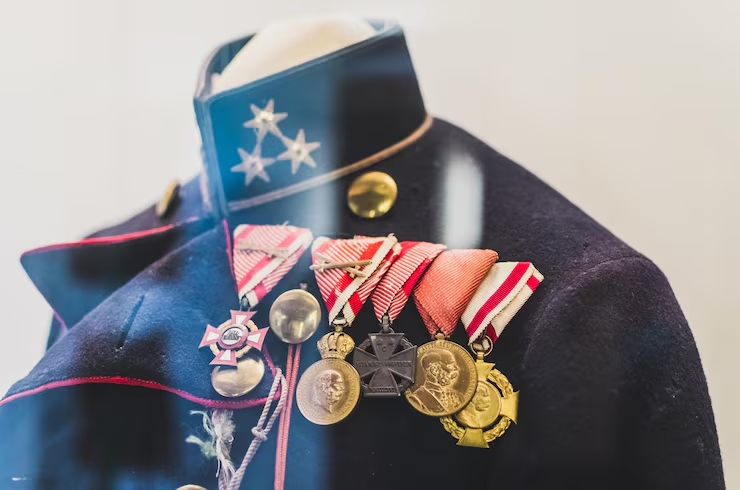
Her uniform was immaculate as always. Silver stars gleamed on her shoulders, catching the fading light. Her identification badge, clipped neatly to her chest, carried the seal of the Department of Defense and her name in bold, precise letters: GEN. REGINA MITCHELL – JOINT OPERATIONS COMMAND.
She had faced hostile fire in three different countries, commanded troops through impossible situations, and walked through active war zones with a calm that steadied everyone around her. Today was supposed to be routine—a briefing, a quick debrief with her team, and then a video call with her teenage niece to help with a history project about women in the military.
She never imagined that the most humiliating confrontation of her thirty-year career would happen in an empty parking lot just a few miles from the base, at the hands of people who were supposed to protect and serve.
As she slowed to check a message on her secure device—a brief update from her executive officer about tomorrow’s schedule—red and blue lights suddenly exploded in her rearview mirror, so bright and unexpected they made her blink.
A local patrol car. Then a second one pulling up alongside it.
Regina frowned slightly, eased the SUV into park with practiced smoothness, and lowered her window. The evening air that rushed in was cool and carried the scent of approaching rain.
“Perhaps they made a mistake,” she thought, already reaching for her credentials. “I’ll show my identification, we’ll clarify whatever confusion exists, and that will be that.”
She had absolutely no idea how catastrophically wrong she was about what was coming.
When Respect Dies at First Glance
Two officers stepped out of their patrol vehicles with the kind of swagger that spoke of authority rarely questioned. Sergeant Cole was older, maybe mid-forties, with a weathered face and eyes that had seen too much routine and not enough challenge. Officer Henkins looked younger, early thirties perhaps, with the eager energy of someone still trying to prove himself.
Neither approached with professional curiosity. They approached with something else entirely—irritation, suspicion, and a casual contempt that Regina had learned to recognize over three decades of breaking barriers in spaces where people didn’t expect to see her.
Cole strode straight to her window, hands resting on his belt in a posture of casual dominance, chin lifted just slightly too high to be merely confident.
“License and registration,” he barked without preamble, without greeting, without even making eye contact with her face. His gaze was fixed somewhere over her shoulder, as if looking directly at her wasn’t worth his time.
Regina offered a polite, professional smile—the same one she’d perfected through countless diplomatic meetings. “Good evening, Sergeant. I’m General Regina Mitchell. This is a government vehicle assigned to Joint Operations Command—”
He cut her off with a dismissive scoff that would have been comedic if it weren’t so insulting. “Yeah, I see the costume. Very official looking. License and registration. Now.”
Costume.
The word hit like a small slap, unexpected and sharp. But Regina had faced far worse than verbal dismissal. She kept her voice even, her tone measured. “Of course, Sergeant. My military identification is displayed on my chest, and my credentials are secured in the glove compartment. I’ll reach for them slowly so there’s no misunderstanding.”
Cole rolled his eyes dramatically, sharing a quick glance with Henkins that communicated volumes—here we go, another one trying to act important. “You can drop the act, lady. This vehicle was reported stolen about an hour ago. And I don’t know what kind of game you think you’re playing, but this isn’t Hollywood. People like you don’t drive around in vehicles like this.”
People like you.
The words hung in the air between them, loaded with implications neither officer bothered to hide.
Regina felt something cold settle in her chest. “People like me?” she repeated quietly, giving him one chance to clarify, to step back from whatever cliff he was approaching.
But Cole still hadn’t read the name on her badge. Still hadn’t actually looked at the identification displayed inches from his face. Still hadn’t followed even the most basic protocol that every law enforcement officer learns in their first week of training.
Officer Henkins had been walking slowly around the SUV, peering through the windows with exaggerated curiosity, like he was examining evidence at a crime scene. He stopped at the passenger window and tapped the glass, pointing at something inside.
“Pentagon credentials, huh?” he called out with a smirk that made his contempt crystal clear. “Who gave you those? Friend who works at a costume shop? They look pretty real, I’ll give you that. Must have cost a fortune.”
The mockery in his voice was casual, automatic, the sound of someone so certain of their judgment that questioning it never even occurred to them.
Regina took a slow breath, forcing herself to remain calm, to give them every opportunity to correct their mistake before this situation escalated beyond repair. “Sergeant Cole, I understand there may have been a communication error regarding this vehicle. If you’ll allow me to contact my command, we can resolve this immediately through proper channels—”
“Enough,” Cole snapped, his patience—what little he’d started with—completely exhausted. “Step out of the car. Right now.”
Regina blinked, her professional composure faltering for just a moment. “Sergeant, with respect, I would appreciate if you would verify my credentials before—”
The door was yanked open with more force than necessary.
In one rough motion, Cole grabbed her arm and pulled her out of the vehicle. Her boots hit the asphalt hard, and before she could fully regain her balance or process what was happening, she felt cold steel clamp around her wrists.
Handcuffs.
They bit into her skin, tightened far more than necessary, the metal edges cutting into flesh that had been soft and uncalloused before thirty years of service had toughened it.
Officer Henkins leaned in close as Cole secured the cuffs, close enough that Regina could smell coffee on his breath. “Don’t get yourself all upset now,” he murmured with a grin that held no humor whatsoever. “Maybe when they process you at the station, they’ll let you help with the cleaning. You know, put that costume to good use.”
Regina stared at the ground, at the cracked asphalt beneath her regulation boots, boots that had walked through mud and sand and blood in service of the country these men had sworn to protect. Heat rose from the pavement into her face. Her heart pounded—not from fear, she’d faced fear on actual battlefields, but from a deep, simmering outrage that was far more dangerous than simple anger.
They had not asked for her identification beyond the initial demand.
They had not examined the badge displayed on her chest.
They had not run the vehicle plates through their system.
They had not followed any basic protocol.
They had simply looked at her, made a decision based on what they saw rather than who she was, and proceeded as if their assumptions were unquestionable facts.
The Search That Crossed the Line
“Search the vehicle,” Cole ordered, already moving toward the open driver’s side door with the confidence of someone who believed he was doing everything right.
“With pleasure,” Henkins replied, enthusiasm evident in his voice as he began rifling through the SUV’s interior with careless hands.
Regina closed her eyes for a brief moment, drawing on reserves of patience she’d built through decades of dealing with difficult people in impossible situations. She had led soldiers through chaos. She had held her composure under actual enemy fire. She could certainly maintain her voice steady now, even with handcuffs cutting into her wrists.
“Sergeant,” she said quietly but firmly, “you are currently in violation of multiple federal regulations. I strongly suggest you verify my identity before this situation becomes—”
“Enough with the ‘federal’ talk,” Cole snapped, his irritation growing with every word she spoke. “Lady, you’re under arrest for possession of a stolen vehicle and possible impersonation of a military officer. Save your elaborate stories for the judge. I’m sure he’ll be very entertained.”
Inside the vehicle, Henkins had found her government-issued phone. It looked similar to any commercial smartphone, but its encryption capabilities and secure connections were anything but ordinary. He emerged from the SUV holding it up like a trophy, waving it in the air with theatrical triumph.
“Well, well, well,” he announced, his voice dripping with sarcasm. “Look what we have here. ‘Pentagon-issued secure device.’ Did you order this from the same website where you got the uniform? They really went all out with the details.”
He pressed the screen experimentally. It lit up immediately without requiring any passcode—a specific security feature that activated only when carried by authorized personnel, using biometric sensors most people didn’t even know existed.
Henkins didn’t understand what that meant. He had no context for why a phone would unlock without a code, no training in military security protocols, no knowledge of the systems he was currently tampering with.
Regina understood exactly what it meant. And she understood with absolute clarity that these officers had just crossed a line from simple misconduct into genuinely dangerous territory.
They weren’t just detaining a general anymore. They were attempting to access secure government communications equipment.
“Put that phone down,” Regina said, her voice suddenly changing, becoming sharper, harder, carrying the tone of command she used when lives were on the line. “Right now, Officer. That device is classified.”
Cole actually laughed, a harsh bark of amusement. “Or what? You’ll call your imaginary Pentagon friends? Go ahead, ‘General.’ Call the Secretary of Defense while you’re at it. I’m sure he’s waiting by the phone for your call.”
He turned away from her dismissively, already reaching for his radio to call for transport, treating her like any common criminal they’d pulled over on a routine stop.
That casual dismissal was his biggest mistake.
Five Seconds That Changed Everything
In the small stumble as Cole shoved her toward his patrol car, Regina shifted her cuffed hands just enough to brush against the secure phone still held carelessly in Henkins’ grip.
Her fingertip found a small, recessed button on the side of the device—a feature so subtle that most people would never notice it, designed specifically to be invisible to anyone who shouldn’t know it existed.
The emergency override.
The screen flashed bright white for a split second. A soft tone chimed—pleasant, almost cheerful, completely at odds with the tension crackling through the parking lot.
Then a calm, synthesized voice filled the evening air, speaking with mechanical precision.
“Emergency signal received. General Mitchell, please confirm situation and authorize response protocol.”
Both officers froze mid-movement, their bodies going rigid with sudden uncertainty.
The phone in Henkins’ hand began glowing with cascading lines of encrypted code and identification sequences that neither officer could possibly understand but that looked undeniably official, undeniably real.
Regina straightened despite the handcuffs, her shoulders squaring with the bearing that had been drilled into her through decades of military service. When she spoke, her voice was clear, calm, and carried the authority of someone who had given orders in life-or-death situations.
“This is General Regina Mitchell, authorization code Alpha Seven Bravo,” she stated with perfect clarity. “I am being unlawfully detained by local law enforcement. Officers have confiscated secure communications equipment and have ignored proper identification protocols. Requesting immediate verification and response.”
There was a brief pause—no more than three seconds, but it felt like an eternity.
Then a new voice cut through the phone’s speaker, deep and unmistakably authoritative, belonging to someone who was very much real and very much paying attention now.
“This is Director Lawson, Department of Defense Security Operations. Sergeant Cole. Officer Henkins. I need you to explain to me, right now, why General Mitchell is calling emergency protocols from your custody.”
The color drained from both officers’ faces so quickly it looked like someone had pulled a plug. Cole’s mouth opened and closed without producing sound. Henkins nearly dropped the phone, his hands suddenly shaking.
“You… how do you know our names?” Henkins stammered, his earlier confidence completely evaporated.
“Of course we know your names,” Director Lawson replied, and there was no warmth in his tone, only cold professional precision. “General Mitchell’s emergency signal came with full GPS coordinates, your badge numbers, your patrol vehicle identification, and your complete service records. You currently have approximately three seconds to remove those handcuffs before this becomes an even more serious incident than it already is.”
Cole’s fingers fumbled with the lock mechanism, his hands trembling so badly he could barely operate the simple release. The cuffs finally clicked open and fell away.
Red marks circled Regina’s wrists where the metal had bitten too deeply, but she didn’t rub them or acknowledge the pain. She simply stood straight, lifted her chin with the dignity of her rank, and met both officers’ eyes with a gaze that had stared down warlords and terrorists.
Neither man could hold that gaze for more than a second.
The General Finally Speaks
“Ma’am, we… we didn’t realize—” Cole began, words tumbling over each other in desperate attempts at explanation or apology or whatever might make this nightmare stop.
“You didn’t realize what, exactly?” Regina cut in, her voice low and controlled, far more intimidating than shouting could ever be. “That the badges you mocked might actually be legitimate? That the identification you refused to read could belong to someone who earned their rank? That your personal assumptions do not override basic professional protocol?”
Henkins swallowed hard enough that his Adam’s apple bobbed visibly. “We thought… we just thought maybe you were pretending, or that someone gave you fake credentials, or—”
“You thought you could decide who deserves to wear this uniform,” Regina interrupted, her words precise as laser cuts. “You made assumptions based on what you saw rather than following procedures you were trained to execute. You never verified anything. You never ran the plates. You never actually read my name. You just decided I couldn’t possibly be who my identification clearly stated I was.”
The phone in Henkins’ trembling hands crackled with Director Lawson’s voice again, colder than before.
“General Mitchell, a secure transport team is en route to your location. Estimated arrival four minutes. Please remain on site. Sergeant Cole, Officer Henkins—you are both ordered to stand exactly where you are. Do not leave the scene. Do not touch another item in that vehicle. Do not take any action whatsoever without direct authorization. Am I absolutely clear?”
“Yes, sir,” both officers mumbled, the words barely audible.
In the distance, a new sound grew louder—the distinctive rhythmic thump of rotor blades cutting through air.
Within moments, a black helicopter appeared on the horizon, sleek and purposeful, bearing the unmistakable markings of military authority. The Pentagon insignia gleamed on its side, catching the last rays of sunset.
Cole staggered backward as if the weight of his actions had physically struck him. “We didn’t know,” he whispered, though whether he was talking to Regina, himself, or some higher power wasn’t clear. “We honestly didn’t know who you were.”
Regina looked at him with something that might have been pity if it weren’t mixed with profound disappointment. “That’s exactly the problem, Sergeant. You didn’t want to know. You’d already decided who I was before you bothered to look.”
From Detained to Documented
The helicopter landed with precision, kicking up a storm of dust and small debris that forced everyone to shield their eyes. A team of four stepped out—crisp uniforms, protective gear, focused expressions that suggested they did this kind of thing regularly and didn’t appreciate having to do it on American soil.
“General Mitchell,” the team leader said with a respectful nod and a salute that was returned with equal precision. “We’re here to provide escort, ma’am. Are you injured?”
Regina glanced at her wrists, where the marks from the handcuffs were already darkening to bruises. “Nothing serious, Captain. But I want a full medical documentation of these injuries and a complete report of this incident filed before the end of the night.”
“Already in progress, ma’am. The vehicle’s recording system captured everything.”
Cole’s face went even paler. “Recording system?”
“Standard equipment on all government vehicles,” the captain explained without looking at him. “Audio and video, multiple angles, encrypted backup to secure servers. The footage was automatically uploaded the moment General Mitchell activated her emergency protocol.”
Regina turned to face both local officers directly, and when she spoke, her voice carried across the parking lot with the clarity of someone used to addressing large groups. “These officers detained a general without cause. They refused to verify identification. They mishandled classified equipment. They used degrading language toward a decorated service member. All of this is documented and will be reviewed by the appropriate authorities.”
Each word was a formal statement. Each sentence would appear in official reports that would follow these men through their careers.
Cole opened his mouth, but whatever he wanted to say died in his throat, strangled by the reality of what he’d done.
Henkins looked like he wanted the ground to open up and swallow him whole.
“Your actions will be thoroughly reviewed,” Regina continued, her tone never rising but somehow becoming more forceful. “By people who do know who I am. By people who understand what professional conduct looks like. By people who will determine whether you’re fit to continue wearing those badges.”
She turned toward the helicopter, her bearing straight, her dignity intact despite everything they’d tried to take from her.
She wasn’t walking away from them. She was demonstrating that they had never really had any power over who she was.
When the Pentagon Pays Attention
Back inside the secure walls of the Pentagon, in a small debriefing room that had seen countless sensitive discussions, Regina sat with a cup of coffee cooling untouched at her elbow. Her wrists still bore visible marks. Her uniform was slightly disheveled from the rough handling. But her composure remained unshaken, built on foundations that couldn’t be rattled by two local officers with inflated egos and deflated respect.
Across from her, Director Lawson slid a thick folder across the polished conference table.
“Internal Affairs has already reviewed the footage,” he said, his voice carrying both professional concern and personal anger at what had been done to one of their most respected officers. “Vehicle cameras captured everything—multiple angles, crystal-clear audio. We have documentation of every word spoken, every action taken.”
Regina nodded slowly. She’d known the vehicles were equipped with comprehensive surveillance, but she’d honestly forgotten about it in the moment. Funny how something designed to protect in exactly this kind of situation had slipped her mind when she needed it most.
“Do you wish to file formal charges?” Lawson asked, watching her carefully. “You would be completely justified. What they did wasn’t just unprofessional—it was assault on a federal officer, mishandling of classified materials, and a clear violation of your civil rights.”
Regina leaned back, her gaze distant as she thought not about herself, but about every other person who might face similar treatment without the protections her rank afforded her.
“Yes,” she said finally, her decision firm. “File formal charges. Not because I need vindication—I know who I am regardless of what anyone else thinks. But because the next person this happens to might not have stars on their shoulders. They might not have a direct line to Pentagon security. They might just be a young lieutenant or a sergeant trying to do their job, and they deserve to know that this behavior has real consequences.”
Lawson’s expression softened with something that looked like pride. “Understood completely, General. This won’t be swept under any rug.”
When Stories Become Lessons
News of the incident began spreading—first quietly through official military channels, then gaining momentum as it reached media outlets that recognized the significance of what had happened.
Most coverage focused not on scandal for scandal’s sake, but on something deeper and more important: how dangerously easy it was for people to dismiss what was directly in front of them when it didn’t match their expectations.
Social media exploded with reactions. Veterans shared their own stories of being doubted, questioned, dismissed. Women in uniform posted pictures with the hashtag #IAmWhoMyBadgeSays. Young recruits talked about the discrimination they faced regularly, how Regina’s story gave them hope that speaking up might actually matter.
But Regina herself stayed largely silent through the initial wave of attention, focusing on her actual job rather than becoming a symbol or spokesperson.
Until she was invited to speak at a national leadership conference three weeks later.
The auditorium held over a thousand people—active-duty personnel from all branches, young cadets still in training, civilian contractors, and military families. Cameras lined the back wall, ready to broadcast her words to bases around the world.
Regina stood at the podium in her dress uniform, medals gleaming under the stage lights, and looked out at the sea of faces watching her with anticipation.
She didn’t mention Cole or Henkins by name. There was no need.
But she told the truth with the kind of straightforward honesty that military culture valued above almost everything else.
“Three weeks ago, I was handcuffed in a parking lot,” she began, her voice calm and conversational, as if describing something that had happened to someone else. “Not in a hostile country during deployment. Not during a dangerous mission behind enemy lines. Right here at home, just a few miles from the base where I’ve worked for five years.”
The room was absolutely silent. A thousand people held their collective breath.
“I wasn’t detained because I’d done something wrong. I was detained because someone looked at me and decided I couldn’t possibly be who my identification clearly stated I was. They decided my uniform must be fake. They decided my credentials were props. They decided I was pretending.”
She paused, letting that sink in.
“The officers who detained me didn’t ask questions. They didn’t follow basic procedures they’d been trained to execute. They saw something that didn’t match their mental picture of what a general should look like, and they stopped thinking. They just acted on assumptions.”
Her gaze swept across the audience, making eye contact with people in different sections, connecting with individuals rather than just addressing a crowd.
“Some of you in this room have lived versions of this story. Maybe not as generals—most of you aren’t, and that’s fine—but as cadets who’ve had their abilities questioned before they even opened their mouths. As junior officers who’ve been mistaken for assistants or support staff. As civilians working alongside military personnel who’ve been treated like you don’t belong in spaces you earned the right to occupy.”
Heads nodded throughout the audience. People exchanged knowing glances.
“This isn’t just about me,” Regina continued, her voice growing stronger. “It’s about a fundamental truth that should be obvious but apparently needs to be stated clearly: Respect is not optional. You don’t have to like someone to treat them with basic professional dignity. You don’t have to know someone’s complete résumé to follow standard protocols. And you absolutely do not get to decide who ‘belongs’ based solely on whether they match your expectations.”
The applause started slowly, a few people clapping, then spreading like wildfire until the entire auditorium erupted in sustained appreciation that lasted nearly a full minute.
Regina didn’t smile or acknowledge it with anything more than a simple nod. The applause wasn’t what mattered. What mattered was whether anyone learned something that would change how they treated the next person whose appearance surprised them.
Consequences and Changes
Later that week, Regina received an official update through proper channels.
Both Sergeant Cole and Officer Henkins had been suspended pending a comprehensive disciplinary review. They were required to undergo extensive retraining in civil rights law, proper identification procedures, and implicit bias recognition. Their actions weren’t simply going to “go away” or be handled with a quiet reprimand that meant nothing.
There were real consequences being applied by people who took this seriously.
Regina didn’t feel joy about their punishment. She wasn’t interested in revenge or vindication. But she did feel a deep sense of relief—relief that the system, for once, was actually working the way it was supposed to work.
Because this time, the message was absolutely clear to every law enforcement officer who heard about it:
What you did was unacceptable. It will not be tolerated. And it will not be ignored just because the person you victimized had the resources to fight back.
Standing on the balcony of her Pentagon office one evening a month after the incident, Regina looked out at the city lights spreading below her like a scattered constellation. The marks on her wrists had faded completely. The sting to her pride had been processed and filed away in the mental compartment where she kept all the indignities and battles she’d faced over three decades.
But the memory remained sharp and clear, preserved not as a wound but as a reminder.
She thought about all the people who didn’t have emergency protocols to activate when they were dismissed or doubted. People who couldn’t call the Pentagon when local authority figures decided they were nothing worth respecting.
That thought stayed with her and quietly fueled the policy changes she began pushing for behind the scenes—better training programs, clearer protocols for interaction between military and civilian law enforcement, stronger protections for service members, and cultural shifts that would make what happened to her less likely to happen to anyone else.
The Real Power
In the end, the story of General Regina Mitchell wasn’t really about her calling the Pentagon, though that made for a dramatic moment that captured public imagination.
The real story was simpler and more profound than any single incident:
She refused to accept being treated as if she were invisible or unimportant. She stood her ground—not with anger or violence, but with calm insistence on the truth of who she was and what she’d earned.
She didn’t just defend herself. She defended everyone who would come after her, everyone who would face similar doubt or dismissal, everyone whose worth would be judged by appearance rather than substance.
And in doing so, she reminded everyone watching—whether in that parking lot, in Pentagon briefing rooms, in auditoriums full of service members, or in homes across the country following the story—that dignity isn’t something that can be taken away by people who refuse to see it.
Your value doesn’t vanish simply because someone lacks the wisdom or training to recognize it.
Sometimes the most powerful thing you can do is calmly, firmly, and unmistakably remind the world of exactly who you are—not by making demands or threats, but simply by standing in your truth until the reality becomes impossible to ignore.
General Regina Mitchell did exactly that.
And in the process, she taught a lesson that went far beyond one parking lot encounter with two officers who learned the hard way that uniforms aren’t costumes, badges aren’t props, and assuming someone is pretending says far more about the observer than it does about the observed.
Six months after the incident, Regina received a handwritten letter from a young Army lieutenant she’d never met.
The letter described how the lieutenant had been repeatedly questioned and dismissed at a civilian facility, her military ID checked and rechecked as if it couldn’t possibly be legitimate, her authority questioned at every turn. But remembering Regina’s story, the lieutenant had stood firm, remained professional, and insisted on proper treatment until the confusion was resolved in her favor.
“Thank you for showing me that speaking up for ourselves isn’t being difficult,” the lieutenant wrote. “It’s being professional. You taught me that demanding respect isn’t arrogance—it’s just insisting on what we’ve earned.”
Regina folded that letter carefully and placed it in her desk drawer, adding it to a growing collection of similar messages from people she’d never met but whose lives had been touched by her refusal to accept dismissal.
Those letters mattered more than any medal or commendation ever could.
Because they meant the story hadn’t ended in that parking lot. It was still rippling outward, still changing things, still teaching lessons about respect and dignity and the simple but revolutionary act of believing people when they tell you who they are.
And that, Regina thought, was exactly what leadership looked like—not in shouting orders or wielding authority like a weapon, but in standing as an example that others could look to when they needed strength.
She had faced enemy combatants on foreign battlefields and emerged victorious.
But perhaps her most important battle had been won in a suburban parking lot, where she’d demonstrated that the uniform she’d earned over three decades meant exactly what it claimed to mean, regardless of whether two officers initially had the wisdom to recognize it.
And that victory, quiet and personal though it was, would echo far beyond one general’s experience, reaching every person who had ever been told they didn’t belong in a space they’d rightfully earned.







This is a very good story and I find a lot of truth to it because it actually happens in this country people are so quiet to judge. I’am so glad that story’s like General Regina Mitchell are told.